Product Overview
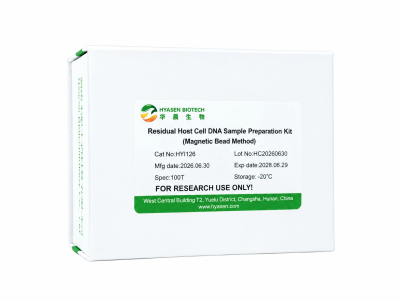
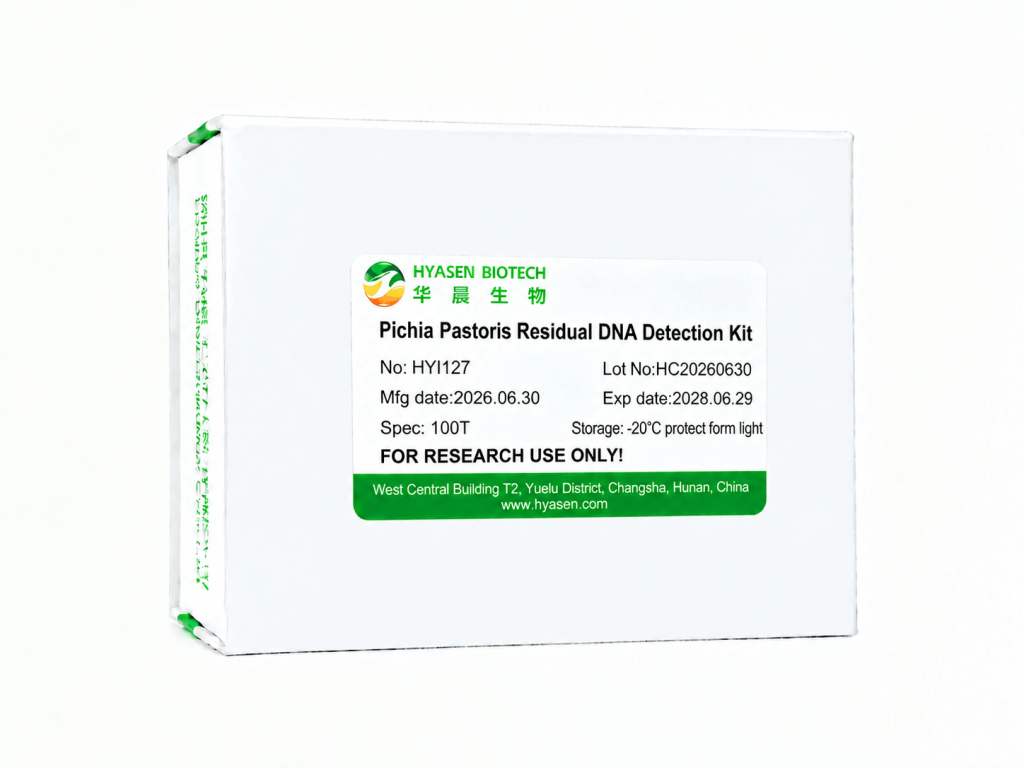
Pichia pastoris is a widely used yeast expression host for recombinant proteins and other biologics. Residual host cell DNA is a process-related impurity that has to be monitored and shown to be cleared, from in-process samples through to the final product. The Pichia Pastoris Residual DNA Detection Kit uses fluorescent quantitative PCR (FAM) for rapid, specific quantitation of residual Pichia pastoris DNA fragments, with a reliable quantitation assay at the fg level. A Pichia pastoris DNA Control is provided as the reference standard, so the standard curve can be prepared from components in the kit. For DNA extraction ahead of the assay, the kit is designed to be used with the Residual Host Cell DNA Sample Preparation Kit (HYI126).
The workflow is built around a standard curve and a set of controls. The DNA Control is diluted in the kit’s DNA Dilution Buffer to a 5-point standard curve covering 0.03 to 300 pg/μL. An Extraction Reference Control (ERC), made by spiking a known amount of DNA into the test sample, checks that extraction recovery is acceptable, and a Negative Control Sample (NCS) and no-template control (NTC) check for contamination. Samples are tested in triplicate, each reaction uses 20 μL of qPCR mix plus 10 μL of template, and the standard cycling program is 95°C for 10 minutes, followed by 40 cycles of 95°C for 15 seconds and 60°C for 1 minute. The kit is used on common real-time PCR systems, including the 7500, CFX96, and LightCycler 480.
Components
| Reagent | Quantity | Storage |
| Pichia Pastoris DNA Control | 50 uL x 1 tube | -20℃ |
| Pichia Pastoris qPCR Master MIX | 850 uL x 2 tubes | -20℃ protect form light |
| DNA Dilution Bufer (DDB) | 1.5 mL x 3 tubes | -20℃ |
| Pichia Pastoris Primer&Probe MlX | 300 uL x 1 tube | -20℃ protect form light |
Product Features
- Specific fg-level quantitation across process stages: A FAM-based fluorescent qPCR assay targets Pichia pastoris DNA with fg-level sensitivity, so the same kit can be used for in-process samples and for final product testing.
- Reference standard and run controls built into the workflow: The kit includes the DNA Control and DNA Dilution Buffer for preparing the standard curve, and the protocol defines the ERC, NCS, and NTC controls with acceptance criteria, which helps laboratories document that each run is valid.
- Works on common qPCR platforms with a simple program: The assay runs on instruments such as the 7500, CFX96, and LightCycler 480, using a two-step program of 40 cycles, so it fits into existing real-time PCR workflows without special equipment.
FAQ
Q1: What controls does the assay use, and what are the acceptance criteria?
The protocol includes a 5-point standard curve, an Extraction Reference Control (ERC), a Negative Control Sample (NCS), and a no-template control (NTC). The recovery rate of the ERC sample should be between 50% and 150%. The Ct value of the NCS should be larger than the mean Ct value of the lowest concentration on the standard curve, and the Ct value of the NTC should be no less than 35.00 cycles, or laboratories can set their own limits based on internal validation.
Q2: How should samples be prepared, and what else do I need to run the kit?
Residual DNA is extracted from 100 μL of test sample before qPCR, and the kit is designed to be used with the Residual Host Cell DNA Sample Preparation Kit (HYI126). For the ERC, 10 μL of a standard dilution is spiked into 100 μL of test sample and extracted alongside it. The kit does not include nonstick, DNase-free, low-retention 1.5 mL tubes, low-retention tips, or 96-well qPCR plates or PCR 8-strip tubes, so these need to be prepared. A real-time PCR system, vortex mixer, microplate shaker, and pipettes are also required.
Q3: How should the kit be stored, and which instruments can it be used with?
All components are stored at -20°C, and the qPCR Master Mix and Primer & Probe Mix should be protected from light. Under appropriate storage conditions the kit components are stable for up to 24 months, and the expiration date is printed on the labels. The kit is used on real-time PCR systems including the 7500, CFX96, and LightCycler 480, and other instruments can be used with settings adapted from their own documentation.