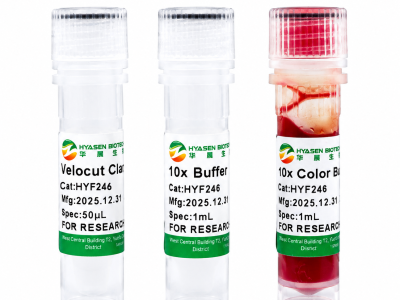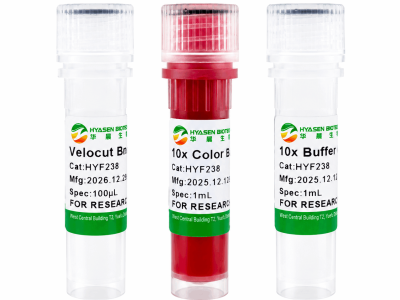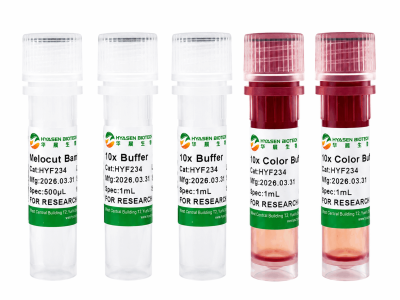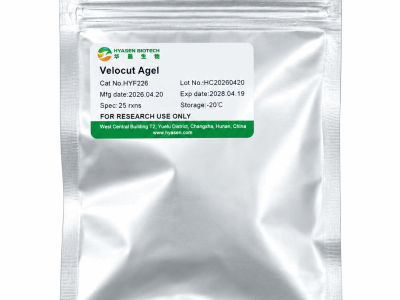
Product Overview
Restriction digestion is one of the most frequent steps in cloning and DNA analysis, and it is often a bottleneck. Standard enzymes can need an hour or more, and combining enzymes often means switching buffers or digesting in sequence. Velocut ApaLI belongs to the Velocut series of engineered restriction enzymes designed for fast DNA digestion. Under recommended reaction conditions, the enzyme digests unit substrate in 5 to 15 minutes, with an optimum reaction temperature of 37°C. It shows superior activity in both the universal buffer and the Color Buffer, so any combination of Velocut restriction enzymes can work simultaneously in one reaction tube, with no need for sequential digestions. Velocut enzymes have passed multiple strict quality controls and can be used to digest plasmid, genomic, and viral DNA as well as PCR products.
The Color Buffer contains a density reagent together with red and yellow tracking dyes, so the reaction mixture can be loaded directly onto a gel. In a 1% agarose gel, the red dye migrates with 2.5 kb double-stranded DNA fragments and the yellow dye migrates with 10 bp double-stranded DNA fragments. The kit’s quality control covers complete digestion, absence of detectable nuclease degradation after 3 hours of incubation, ligation and recutting after 10-fold over-digestion, low non-specific endonuclease activity, and a blue/white screening assay (see the specification table below). Isoschizomers of ApaLI are Alw44I and VneI, which may have different methylation sensitivities.
Components
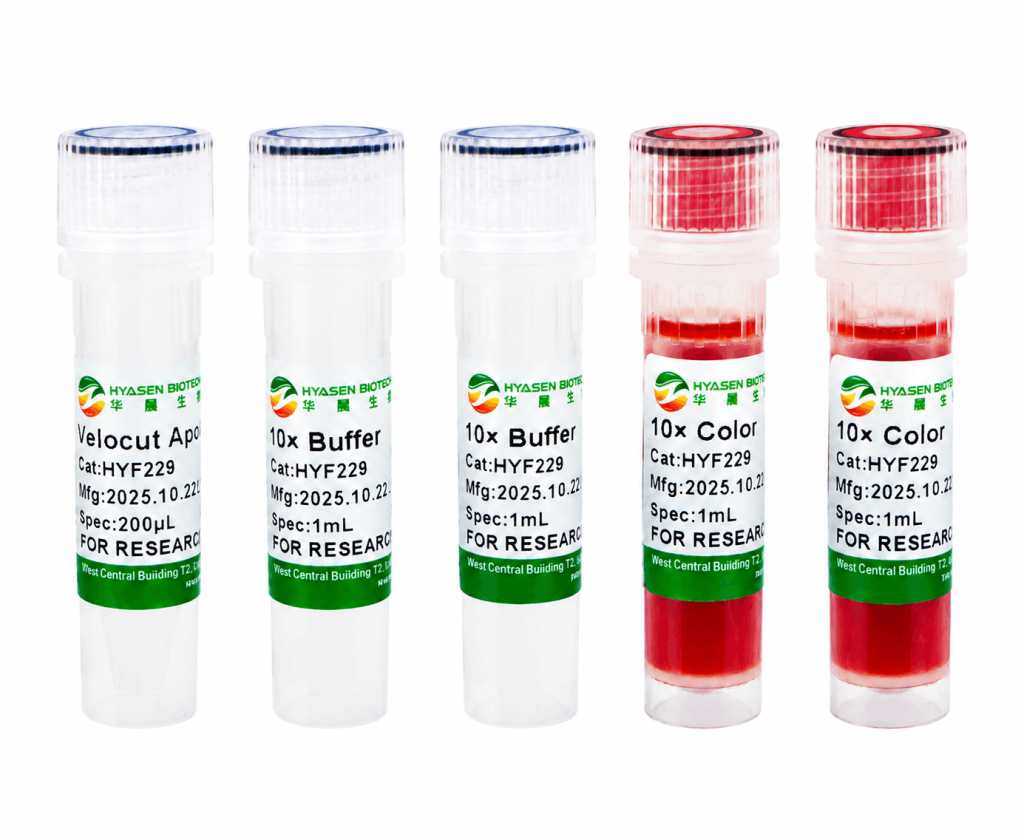
| Components | 25 rxns |
| Velocut AgeI | 25 μL |
| 10× Buffer | 1 mL |
| 10× Color Buffer | 1 mL |
Product Features
- Fast digestion in 5 to 15 minutes: The engineered enzyme digests DNA in 5 to 15 minutes at 37°C, which shortens the digestion step in cloning and analysis workflows from an hour or more to minutes.
- Multiple enzymes in one tube, with direct gel loading: Superior activity in the universal buffer lets any combination of Velocut restriction enzymes work simultaneously in one tube. The Color Buffer has a density reagent and tracking dyes, so reactions go straight onto the gel.
- Strict quality control for cloning-grade results: No detectable nuclease degradation after 3 hours, more than 95% ligation and more than 95% recutting after 10-fold over-digestion, less than 10% non-specific nicking in a 4-hour plasmid test, and fewer than 1% white colonies in the blue/white assay.
FAQ
Q1: What are the recommended reaction conditions, and how do I stop the reaction?
The optimum reaction temperature is 37°C, and the enzyme digests unit substrate in 5 to 15 minutes under recommended conditions. In the functional test, a 20 μL reaction with 1 μg λDNA (HindIII digest) and 1 μL of enzyme incubated for 15 minutes at 37°C gives complete digestion. The enzyme can be heat-inactivated by incubation at 80°C for 20 minutes.
Q2: Is there a risk of star activity, and is the enzyme sensitive to DNA methylation?
A 3-hour incubation shows no star activity, but longer incubation may result in star activity, so keep digestion times as short as the application allows. Cleavage may be blocked or impaired when the substrate DNA is methylated by CpG methylase or by EcoKI methylase. Isoschizomers of ApaLI, such as Alw44I and VneI, may have different methylation sensitivities.
Q3: Can I combine it with other enzymes and load the reaction directly on a gel?
Yes. All Velocut enzymes show superior activity in the universal buffer and Color Buffer, so any combination can work simultaneously in one tube. The Color Buffer contains a density reagent and red and yellow tracking dyes, so reactions can be loaded directly on a gel. In a 1% agarose gel, the red dye runs with 2.5 kb fragments and the yellow dye with 10 bp fragments. Please confirm that the recognition sites of the enzymes you combine do not conflict in your DNA.