Product Overview
Genomic DNA contamination is a common concern in RNA-based experiments, particularly in RT-PCR and RT-qPCR, where residual DNA can contribute to background signals and affect the accuracy of gene expression measurements.
Hyasen HYP419 dsDNase provides a straightforward way to remove double-stranded genomic DNA from RNA samples before reverse transcription. Unlike conventional DNase I, which can digest both single-stranded and double-stranded DNA, dsDNase selectively targets double-stranded DNA while leaving RNA and single-stranded DNA intact under recommended reaction conditions.
The enzyme cleaves phosphodiester bonds within double-stranded DNA, generating oligonucleotide fragments with 5′-phosphate and 3′-hydroxyl ends. Its substrate specificity makes it useful for reducing genomic DNA contamination without directly degrading RNA, single-stranded DNA primers, or probes.
One of its key advantages is heat-sensitive activity. HYP419 dsDNase can be rapidly inactivated at 55°C without adding EDTA, eliminating the need for a separate chelator-based inactivation step. This simplifies RNA sample preparation and helps avoid potential interference from EDTA in subsequent enzymatic reactions.
Suitable for RNA preparation prior to reverse transcription, RT-PCR, and RT-qPCR, the enzyme offers a convenient approach to genomic DNA removal in routine molecular biology workflows.
Product Features
- Selective Double-Stranded DNA Digestion: Specifically degrades double-stranded DNA while preserving RNA and single-stranded DNA, including primers and probes, making it suitable for removing genomic DNA contamination from RNA samples.
- Rapid Heat Inactivation at 55°C: Heat-labile activity allows the enzyme to be rapidly inactivated at 55°C without EDTA, simplifying reaction setup and reducing the need for additional inactivation reagents.
- Convenient RNA Preparation for RT-PCR and RT-qPCR: Helps reduce genomic DNA contamination before reverse transcription, minimizing potential DNA-derived background signals and supporting more accurate RNA expression analysis.
FAQ
Q1: What is the difference between dsDNase and conventional DNase I?
HYP419 dsDNase selectively digests double-stranded DNA without directly degrading RNA or single-stranded DNA. Conventional DNase I can digest both single-stranded and double-stranded DNA. Another important difference is inactivation: HYP419 dsDNase can be rapidly heat-inactivated at 55°C without EDTA, making it convenient for RNA preparation workflows where residual chelating agents may interfere with downstream reactions.
Q2: Can dsDNase be used to remove genomic DNA contamination before RT-qPCR?
Yes. HYP419 dsDNase is designed to remove double-stranded genomic DNA from RNA samples before reverse transcription. Reducing genomic DNA contamination helps minimize DNA-derived amplification signals that can affect RT-qPCR results. The enzyme does not directly degrade RNA, making it suitable for RNA-based analysis. For accurate gene expression measurements, a no-reverse-transcriptase (no-RT) control is still recommended to check for residual DNA contamination.
Q3: How is dsDNase inactivated, and does it require EDTA?
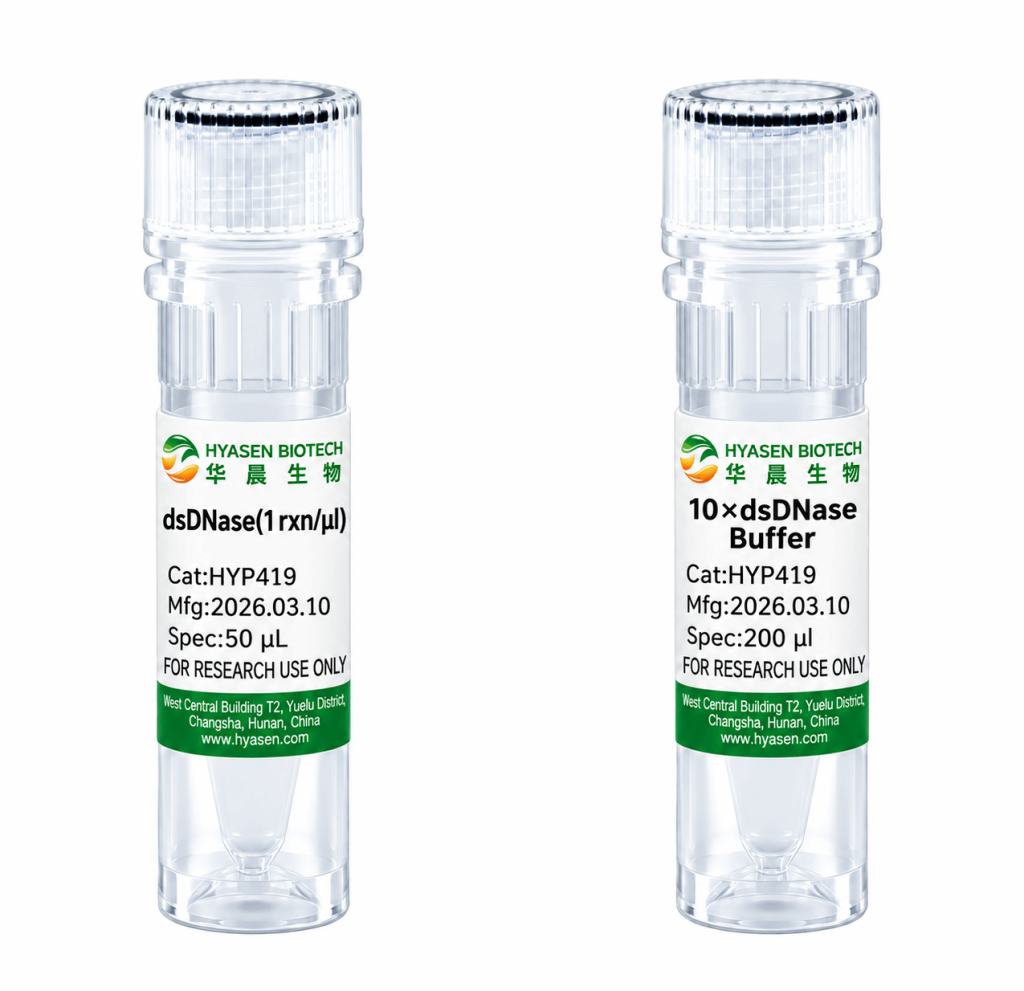
HYP419 dsDNase can be rapidly inactivated by heating to 55°C without adding EDTA. This simplifies sample preparation and avoids introducing a chelating agent that could interfere with subsequent enzymatic reactions. The enzyme is supplied at 1 reaction/µL with a 10× dsDNase Buffer. Store at −20°C for up to 2 years under the recommended storage conditions.