Product Overview
Producing linear DNA with covalently closed ends requires a different approach from conventional restriction enzyme digestion, which typically leaves open DNA termini that may require additional processing.
HYP440 TelN Protelomerase is a site-specific DNA processing enzyme derived from bacteriophage N15. It recognizes a 56 bp DNA sequence known as telRL and catalyzes a cleavage-and-rejoining reaction that generates covalently closed hairpin ends.
When acting on circular double-stranded DNA containing the appropriate recognition site, TelN Protelomerase converts the circular molecule into a linear DNA structure with covalently closed ends. Unlike conventional restriction enzymes, which typically generate free DNA termini, TelN creates hairpin structures that connect the two strands at each end of the resulting DNA molecule.
This unique activity makes the enzyme valuable for constructing closed-ended linear DNA molecules and exploring alternative DNA vector designs. It can be used in DNA engineering, synthetic biology research, and workflows involving enzymatic production of linear DNA constructs.
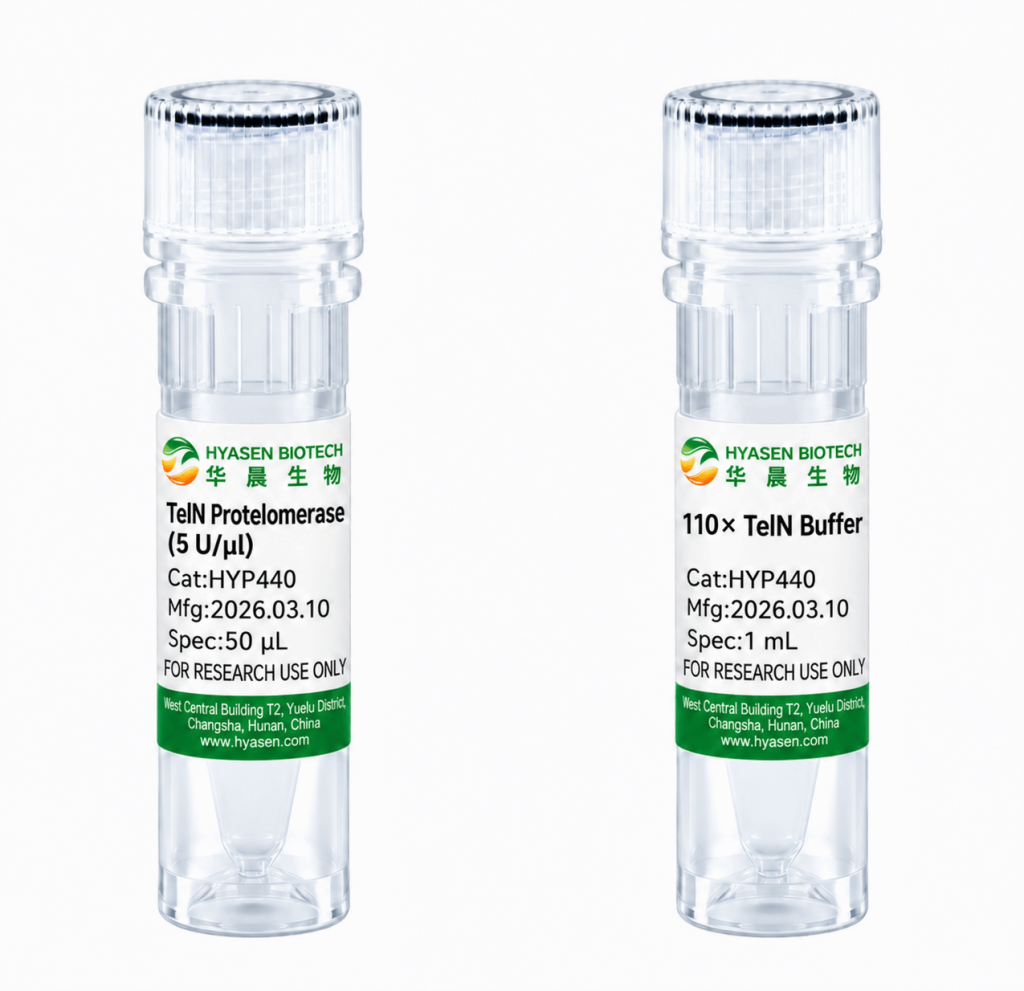
HYP440 TelN Protelomerase is supplied at 5 U/µL with a 10× TelN Buffer for laboratory DNA processing applications.
Product Features
- Specific Recognition of the 56 bp telRL Sequence: Recognizes and processes the 56 bp telRL sequence in double-stranded DNA, enabling targeted DNA cleavage and end formation at a defined recognition site.
- Formation of Covalently Closed Hairpin Ends: Catalyzes DNA cleavage and rejoining to generate covalently closed hairpin ends, producing linear double-stranded DNA with a distinct end structure.
- Conversion of Circular DNA into Closed-Ended Linear DNA: Enables the enzymatic conversion of circular DNA containing the telRL recognition site into closed-ended linear DNA, supporting DNA vector engineering and synthetic biology applications.
FAQ
Q1: What DNA sequence does TelN Protelomerase recognize?
HYP440 TelN Protelomerase specifically recognizes the 56 bp telRL sequence derived from bacteriophage N15. The enzyme cleaves and rejoins DNA at this recognition site to generate covalently closed hairpin ends. DNA substrates must contain the appropriate telRL sequence for TelN-mediated processing.
Q2: How is TelN Protelomerase different from conventional restriction enzymes?
Unlike conventional restriction enzymes that typically generate DNA fragments with free ends, HYP440 TelN Protelomerase performs a cleavage-and-rejoining reaction that creates covalently closed hairpin ends. This allows circular DNA containing a telRL site to be converted into a closed-ended linear DNA molecule without a separate end-ligation step.
Q3: What applications are suitable for TelN Protelomerase, and how should it be stored?
HYP440 TelN Protelomerase is suitable for producing closed-ended linear DNA constructs, DNA vector engineering, and synthetic biology research. The enzyme is supplied at 5 U/µL with a 10× TelN Buffer. It should be stored at −20°C and has a stated shelf life of 2 years under the recommended storage conditions.