Product Overview
Detecting DNA mismatches is an important step in genome editing research, particularly when screening for insertions and deletions (indels) introduced by CRISPR-Cas9 and other gene editing methods.
Hyasen T7 Endonuclease I (HYP432), also known as T7EI or T7 Endo I, is a structure-specific endonuclease that recognizes and cleaves mismatched double-stranded DNA. The enzyme also acts on noncanonical DNA structures, including cruciform DNA, Holliday junctions, and branched DNA intermediates.
When the enzyme encounters a mismatch in heteroduplex DNA, it typically cleaves one to three phosphodiester bonds on the 5′ side of the mismatch. Its cleavage efficiency varies with the type and position of the mismatch, with particularly strong activity toward certain cytosine-containing mismatches.
In genome editing workflows, T7 Endonuclease I can be used to screen PCR products for sequence differences. Following denaturation and reannealing, edited and unedited DNA strands may form heteroduplexes containing mismatches. The enzyme cleaves susceptible heteroduplexes, allowing the resulting DNA fragments to be analyzed by gel electrophoresis.
The enzyme is especially useful for screening insertions and deletions of two base pairs or larger, although detection depends on mismatch structure and reaction conditions. Single-base changes may be poorly detected and generally require more sensitive methods for reliable identification.
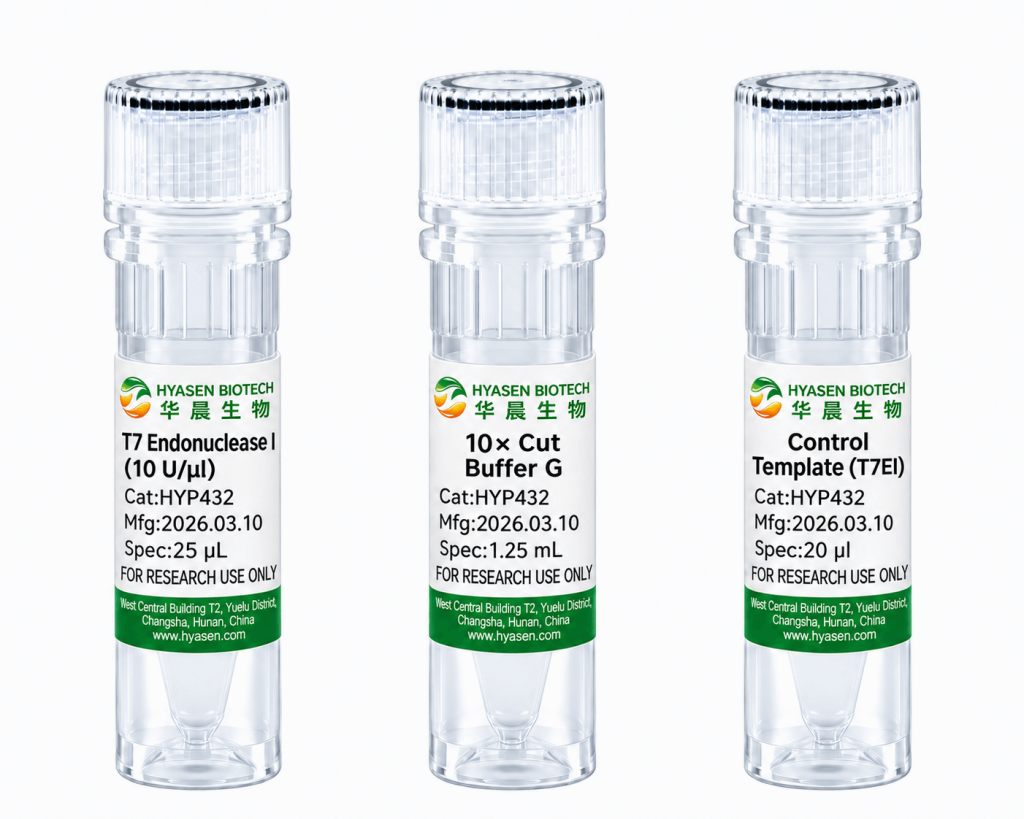
HYP432 T7 Endonuclease I is produced by recombinant expression in Escherichia coli and purified for molecular biology applications. It is supplied at 10 U/µL with a 10× Cut Buffer G and a control DNA template.
Product Features
- Mismatch-Sensitive DNA Cleavage: Recognizes and cleaves mismatched heteroduplex DNA, with cleavage typically occurring one to three phosphodiester bonds upstream of the mismatch. Particularly effective for certain cytosine-containing mismatches.
- Useful for CRISPR Genome Editing Screening: Supports the detection of insertions and deletions in PCR-amplified DNA, providing a convenient enzymatic method for preliminary screening of genome editing outcomes.
- Recognition of Complex DNA Structures: Cleaves various noncanonical DNA structures, including cruciform DNA, Holliday junctions, and branched DNA intermediates, making it useful for DNA recombination and structure-related research.
FAQ
Q1: Can T7 Endonuclease I be used to detect CRISPR-Cas9 gene editing mutations?
Yes. HYP432 T7 Endonuclease I can be used to screen for insertions and deletions introduced by CRISPR-Cas9. After PCR amplification, DNA fragments are denatured and reannealed to form heteroduplexes between different DNA sequences. The enzyme recognizes susceptible mismatches and cleaves the DNA, producing fragments that can be analyzed by gel electrophoresis. This approach is useful for preliminary mutation screening but does not identify the exact sequence changes.
Q2: Can T7 Endonuclease I detect single-base mutations or 1 bp insertions and deletions?
HYP432 T7 Endonuclease I is more suitable for screening insertions and deletions of two base pairs or larger. Single-base substitutions and 1 bp insertions or deletions may not be reliably detected because cleavage efficiency depends on the mismatch sequence and structure. For accurate identification of single-nucleotide changes, DNA sequencing or another validated mutation detection method is recommended.
Q3: Does T7 Endonuclease I recognize all DNA mismatches?
No. HYP432 T7 Endonuclease I does not cleave every type of DNA mismatch with equal efficiency. It generally shows stronger activity toward certain cytosine-containing mismatches, while other mismatches may be cleaved less efficiently or remain undetected. For reliable results, appropriate controls and optimized digestion conditions are important. A negative cleavage result does not necessarily indicate the absence of a mutation.