Product Overview
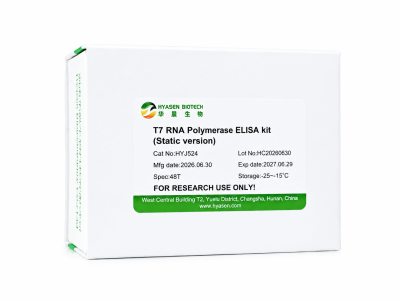
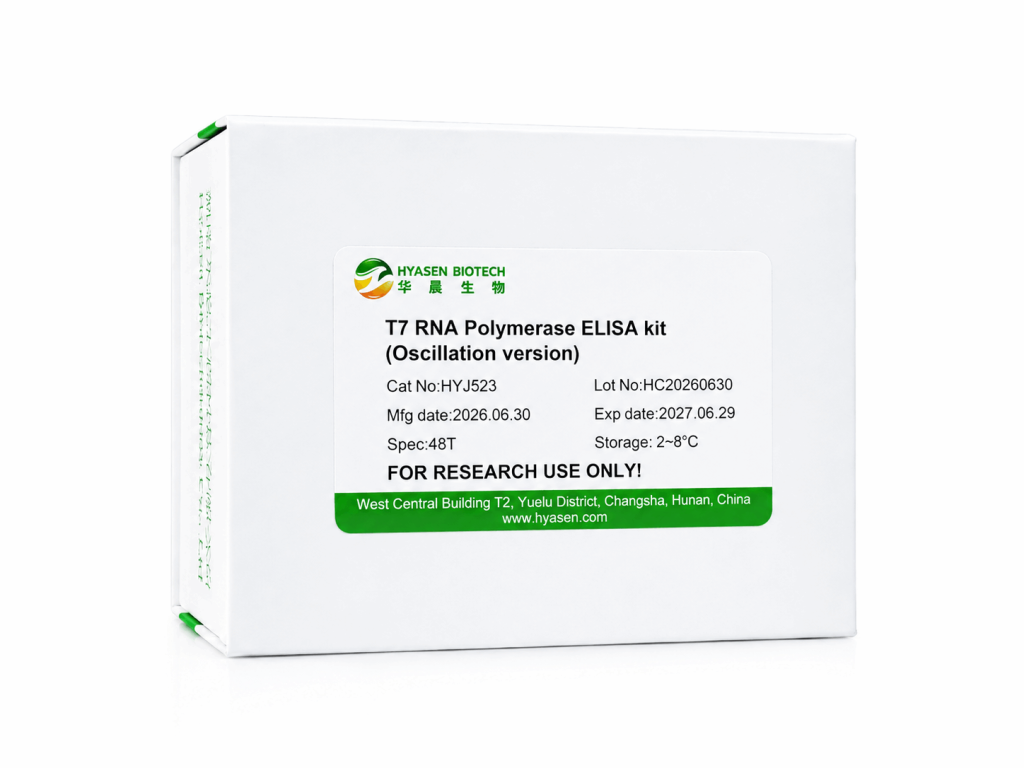
The T7 RNA Polymerase ELISA Kit (Oscillation version) is a double-antibody sandwich ELISA assay designed for the quantitative detection of residual T7 RNA Polymerase — a key process-related impurity that must be monitored and controlled in mRNA manufacturing, since incomplete removal of the transcription enzyme can affect product purity and regulatory compliance. The assay employs a sandwich ELISA format: the microwell plate is pre-coated with anti-T7 RNA Polymerase capture antibody. The sample is added and incubated together with an HRP-labeled detection antibody, forming an antibody-antigen-enzyme-labeled antibody sandwich complex wherever T7 RNA Polymerase is present. This kit specifically uses an oscillation-based incubation protocol, in which the plate is agitated during the binding steps to promote more efficient antigen-antibody interaction and faster equilibrium binding compared to static incubation. After washing to remove unbound components, TMB substrate is added and catalyzed by HRP to generate a blue color product, which turns yellow upon addition of an acidic stop solution. Color intensity is positively correlated with T7 RNA Polymerase content in the sample, and is quantified by measuring absorbance (OD value) at 450 nm. This oscillation-based format is designed for laboratories seeking faster assay turnaround through active plate agitation during incubation. For laboratories preferring a standard, non-agitated workflow, our T7 RNA Polymerase ELISA Kit (Static version) offers the same double-antibody sandwich detection principle using a conventional static incubation protocol. This kit supports mRNA quality control laboratories, mRNA vaccine and therapeutic developers, and CDMOs in monitoring residual T7 RNA Polymerase levels throughout process development and release testing workflows.
Components
| Components | 48T | 96T |
| ELISA Microplate | 8×6 | 8×12 |
| Standard concentrate (0. 1mg/ml) | 0.025mL | 0.05mL |
| Enzyme conjugate (100×) | 0.03mL | 0.06mL |
| Sample dilution buffer | 15mL | 30mL |
| Enzyme conjugate dilution buffer | 3mL | 6mL |
| Wash concentrate (10×) | 15mL | 30mL |
| Substrate solution | 6mL | 12mL |
| Stop solution | 3mL | 6mL |
| Plate sealer | 2 pieces | 4 pieces |
Product Features
- Oscillation-based incubation for efficient binding: Active plate agitation during the antibody-antigen incubation steps promotes more efficient molecular interaction, supporting faster equilibrium binding compared to conventional static incubation protocols.
- Specific double-antibody sandwich detection: The pre-coated capture antibody combined with an HRP-labeled detection antibody provides specific, sensitive quantification of T7 RNA Polymerase, minimizing cross-reactivity with other process-related proteins.
- Standardized colorimetric readout for straightforward quantification: Results are read as a simple absorbance measurement at 450 nm using a standard microplate reader, providing a quantitative, reproducible readout suitable for routine residual protein monitoring in mRNA manufacturing QC workflows.
FAQ
Q1: What is the difference between the Oscillation version and the Static version of this ELISA kit?
Both kits use the same double-antibody sandwich ELISA principle and detection chemistry to quantify residual T7 RNA Polymerase. The Oscillation version incorporates active plate agitation during the incubation steps to promote faster, more efficient antigen-antibody binding, which can shorten overall assay time. The Static version instead uses a conventional, non-agitated incubation protocol. Laboratories should select the version that best matches their available equipment (e.g., plate shaker availability) and preferred workflow.
Q2: Why is monitoring residual T7 RNA Polymerase important in mRNA manufacturing?
T7 RNA Polymerase is used to drive in vitro transcription during mRNA synthesis and is typically removed during downstream purification. However, incomplete removal can leave residual enzyme in the final mRNA product, which may raise concerns for product purity, regulatory compliance, and potential immunogenicity. This ELISA kit provides a sensitive, quantitative method for monitoring residual T7 RNA Polymerase levels to support process validation and release testing.
Q3: What equipment is required to run this assay, including for the oscillation step?
In addition to standard ELISA equipment (plate washer, plate reader capable of 450 nm absorbance measurement), this oscillation version requires a compatible plate shaker/oscillator to perform the agitated incubation steps as specified in the protocol. Results are quantified by comparing sample absorbance values to a standard curve generated using known T7 RNA Polymerase concentrations.