Product Overview
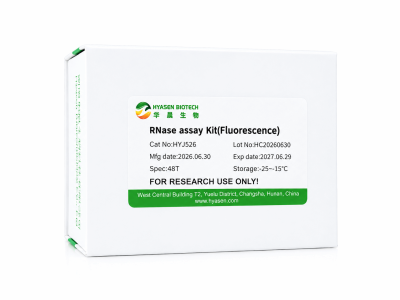
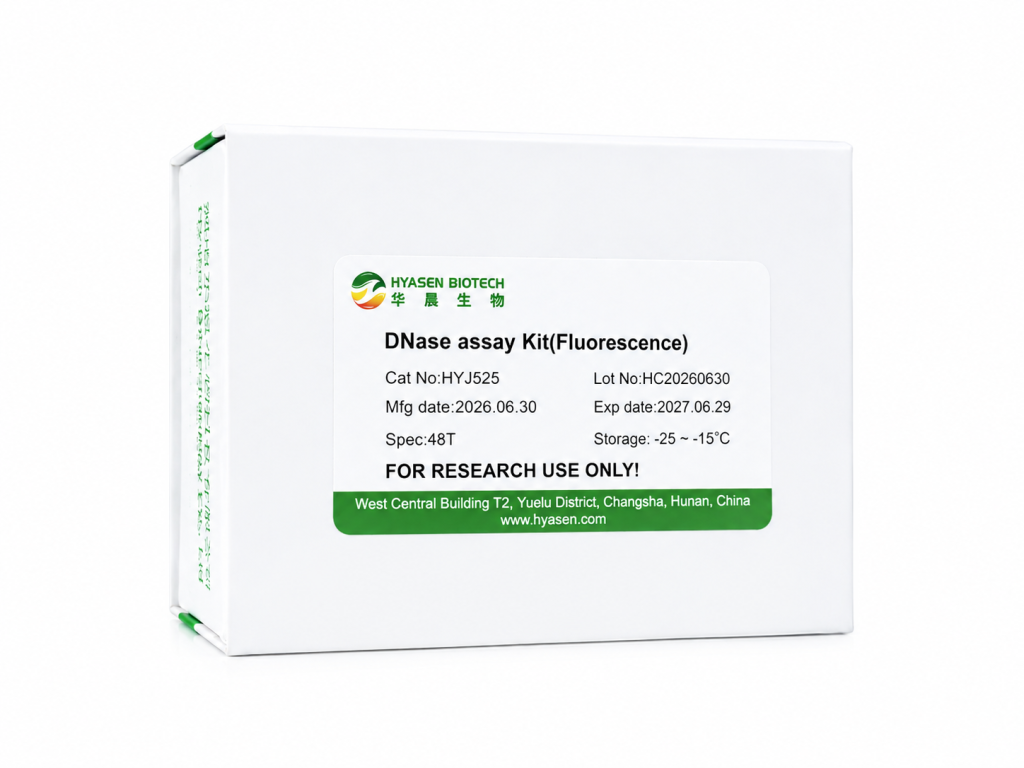
The DNase Assay Kit (Fluorescence) provides a sensitive, real-time method for detecting DNase contamination based on a fluorophore-labeled DNA probe. In the absence of DNase activity, the probe remains structurally intact and stable, producing minimal fluorescence signal. When DNase activity is present in the sample, the probe is progressively degraded, releasing the fluorophore from its quenched state and resulting in a gradual increase in fluorescence signal over time. The rate of fluorescence increase is directly and positively correlated with the amount and activity of DNase present, enabling both qualitative detection and relative quantification of contamination levels. Signal is measured using a fluorescence microplate reader at an excitation/emission wavelength of 485/525 nm, allowing straightforward determination of whether a sample is contaminated with DNase activity. This assay format is well suited for quality control screening of enzyme preparations, reagent lots, and biological samples where DNase contamination could compromise the integrity of downstream DNA-based applications, including nucleic acid extraction reagents, molecular biology kits, and biopharmaceutical raw materials.
Components
| Components | 48 T | 192 T |
| 10×reaction solution | 0.5mL | 2.0mL |
| DNA probe | 1tube | 1tube |
| TE buffer | 0.5mL | 2.0mL |
| DNase I standard (2U/μL) | 10μL | 20μL |
| Standard Dilution Buffer | 6mL | 12mL |
| DNase&RNase-free water | 25mL | 25mL |
| DNase RNase away | 50mL | 50mL |
Product Features
- Real-time, kinetic fluorescence detection: The fluorophore-labeled probe enables continuous, real-time monitoring of DNase activity as fluorescence signal increases over the course of the reaction, allowing users to track degradation kinetics rather than relying solely on a single endpoint measurement.
- Sensitive detection proportional to enzyme activity: The rate of fluorescence increase is directly correlated with both the amount and activity of DNase present in the sample, supporting sensitive detection of low-level contamination as well as relative quantification across samples.
- Simple, standard-equipment workflow: Detection requires only a standard fluorescence microplate reader capable of measuring at 485/525 nm excitation/emission, making the assay accessible for routine QC screening without specialized instrumentation.
FAQ
Q1: How does this fluorescence-based assay detect DNase activity in a sample?
The assay uses a DNA probe labeled with a fluorophore that is quenched while the probe remains intact. When DNase activity is present in the tested sample, the enzyme degrades the DNA probe, separating the fluorophore from its quencher and releasing a fluorescence signal. As degradation continues, fluorescence intensity increases progressively, with the rate of increase reflecting the level of DNase activity present.
Q2: What types of samples or products is this kit typically used to screen for DNase contamination?
This kit is commonly used to screen for DNase contamination in enzyme preparations (such as recombinant proteins produced in bacterial or other expression systems), reagent lots used in molecular biology and diagnostic kits, and other biological materials where residual DNase activity could degrade DNA-based products or interfere with downstream nucleic acid applications.
Q3: What equipment is required to run this assay, and how quickly can results be obtained?
The assay requires a fluorescence microplate reader capable of measuring at an excitation/emission wavelength of 485/525 nm. Because the assay is kinetic in nature, fluorescence signal can be monitored over a defined incubation period (following the protocol’s recommended reaction time) to assess DNase activity, with the presence or absence of a rising fluorescence signal directly indicating DNase contamination status.