Product Overview
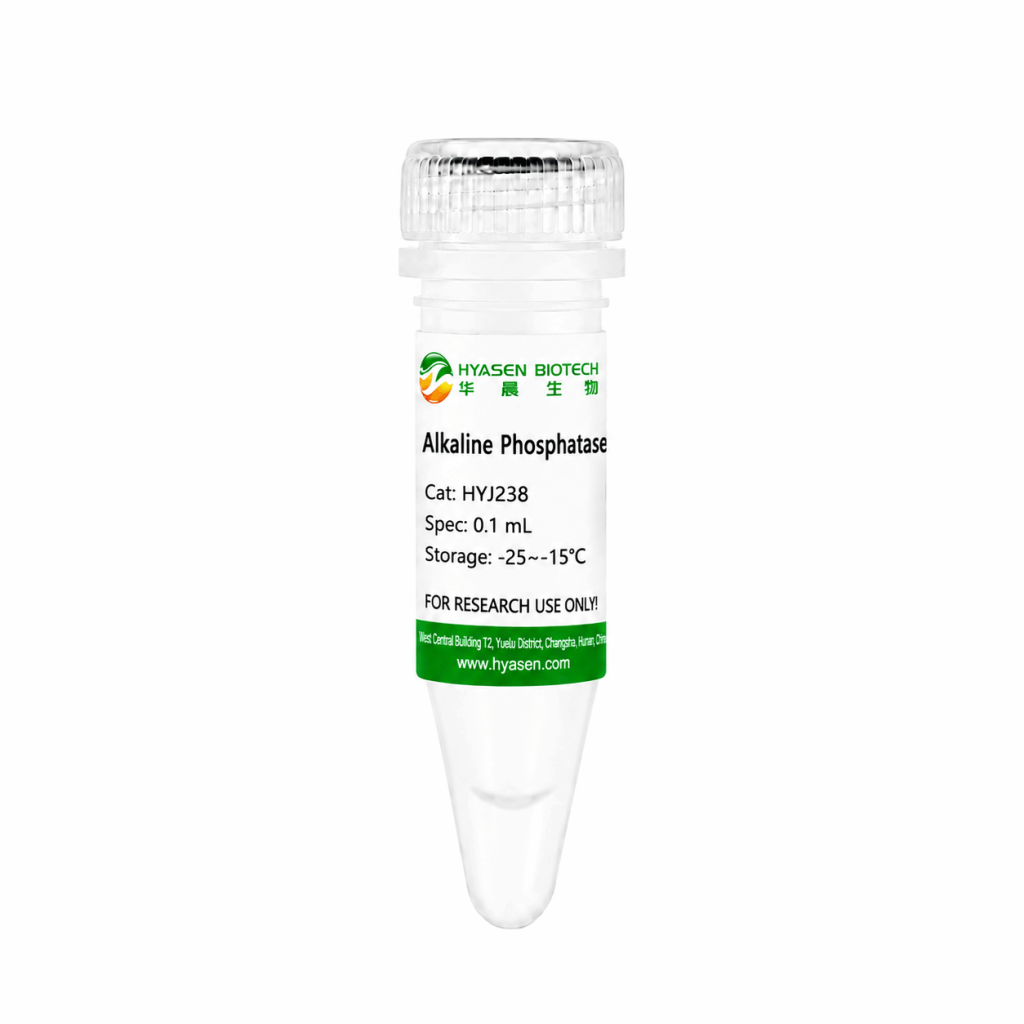
Alkaline Phosphatase is a recombinant enzyme derived from an E. coli strain carrying the TAB5 gene, produced under controlled fermentation and purification processes to ensure high purity and consistent activity. The enzyme catalyzes the dephosphorylation of 5′ and 3′ phosphomonoester groups on DNA and RNA, and also hydrolyzes free ribonucleoside and deoxyribonucleoside triphosphates (NTPs and dNTPs). Alkaline Phosphatase acts effectively on 5′ protruding, 5′ recessed, and blunt DNA ends, making it broadly applicable across common molecular biology workflows. In cloning applications, dephosphorylation of linearized plasmid DNA prevents self-ligation, improving cloning efficiency and reducing background colonies. It is also used in probe end-labeling protocols to remove existing phosphate groups prior to labeling, and in PCR-based workflows to degrade unincorporated dNTPs, preparing amplification products for downstream sequencing reactions. A key practical advantage of Alkaline Phosphatase is its complete and irreversible inactivation by heating at 70°C for 5 minutes, eliminating the need for additional phosphatase removal steps prior to subsequent ligation or end-labeling reactions — streamlining experimental workflows and reducing hands-on time.
Components
| Components | 0.5 KU | 2.5 KU | 50 KU |
| Alkaline Phosphatase | 0.1 mL | 0.5 mL | 10 mL |
Product Features
- Broad substrate compatibility across end types: Alkaline Phosphatase efficiently dephosphorylates DNA and RNA with 5′ protruding, 5′ recessed, or blunt ends, as well as free NTPs and dNTPs, providing flexibility across a wide range of nucleic acid preparation applications.
- Simple, complete heat inactivation: The enzyme is fully and irreversibly inactivated by a brief 70°C, 5-minute heat treatment, removing the need for phenol-chloroform extraction or column purification before proceeding to downstream ligation or labeling steps.
- Prevents plasmid self-ligation in cloning workflows: By removing 5′ phosphate groups from linearized vector DNA, Alkaline Phosphatase effectively blocks vector self-ligation, significantly improving the efficiency of directional or non-directional cloning experiments.
FAQ
Q1: Why is dephosphorylation important in cloning experiments, and how does this enzyme help?
When a plasmid vector is linearized (e.g., by restriction digestion), its free 5′ phosphate ends can allow the vector to re-circularize (self-ligate) without incorporating the insert, leading to high background in cloning experiments. Treating the linearized vector with Alkaline Phosphatase removes these 5′ phosphate groups, preventing self-ligation and favoring successful insert-vector ligation.
Q2: Do I need to remove Alkaline Phosphatase from my reaction before proceeding to ligation or labeling?
No additional removal step is required. Alkaline Phosphatase is completely and irreversibly inactivated by heating the reaction at 70°C for 5 minutes, after which the reaction can proceed directly to downstream ligation, end-labeling, or other enzymatic steps without further purification.
Q3: Can this enzyme be used to remove unincorporated dNTPs after a PCR reaction to prepare samples for sequencing?
Yes. Alkaline Phosphatase can hydrolyze free, unincorporated dNTPs remaining after PCR amplification, helping to prepare clean template for downstream applications such as Sanger sequencing, where residual dNTPs could otherwise interfere with the sequencing reaction.