Product Overview
16S rDNA amplicon sequencing is one of the most widely used methods for characterizing the bacteria in a sample. The 16S rRNA gene sits in the small subunit of the prokaryotic ribosome and has 10 conserved regions and 9 hypervariable regions (V1–V9). The conserved regions change very little between bacterial taxa, which makes them good binding sites for universal PCR primers. The hypervariable regions differ between genera and species in ways that follow phylogenetic distance, so they carry the information needed for identification. For this reason, 16S rDNA is widely regarded as the most suitable molecular marker for bacterial phylogeny and taxonomic classification. In 16S amplicon sequencing, one or more hypervariable regions are amplified with primers that target the flanking conserved regions, and the amplicons are then sequenced at high throughput and analyzed with bioinformatics. Amplifying the V3–V4 region from DNA extracted from different environmental sources allows discrimination and identification of the vast majority of bacterial species, and it is the most widely adopted standard for bacterial classification in microbiome research. Combined with bioinformatics analysis, the approach gives information on species classification, relative abundance, community structure, and phylogenetic relationships.
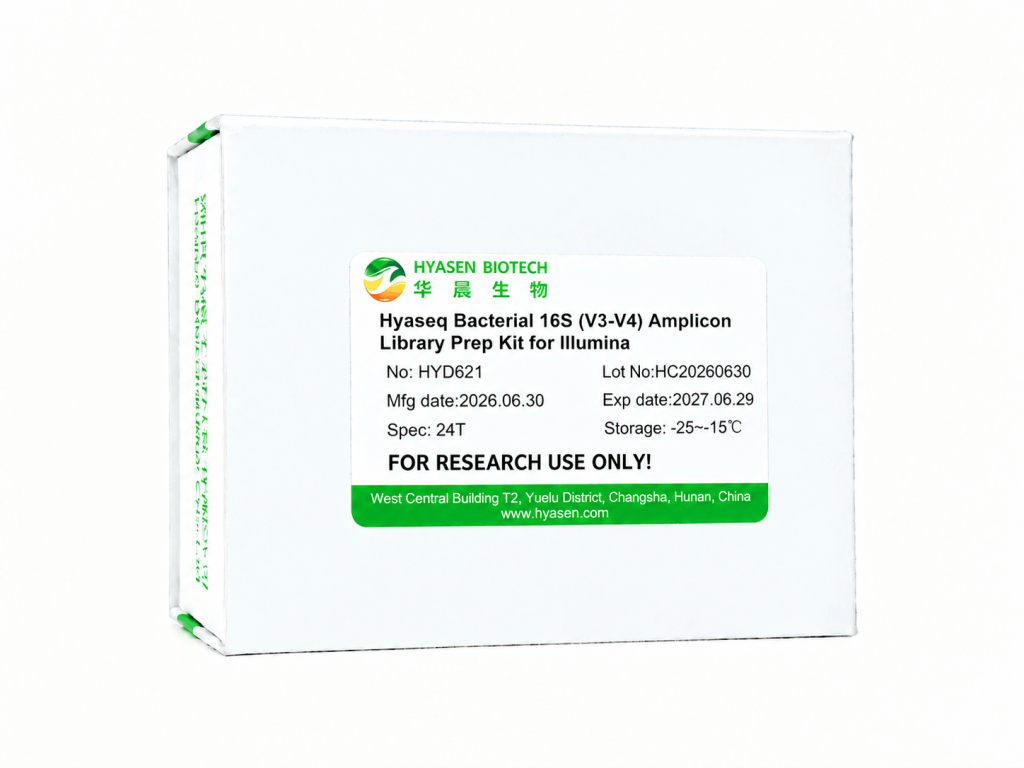
The Hyaseq Bacterial 16S (V3-V4) Amplicon Library Prep Kit for Illumina includes all reagents required for the amplification of bacterial 16S rDNA. The included 16S forward and reverse primers (F/R) are designed to amplify approximately the first 500 bp of the 16S rDNA gene. To generate Illumina-compatible 16S bacterial libraries, the kit is used together with a tagment index kit for Illumina. It supports 100 pg to 10 ng of metagenomic DNA, including feces, soil, and extracted meta-DNA. All reagents have undergone rigorous quality control and functional validation to support stability and reproducibility during library preparation.
Product Features
- All amplification reagents with V3–V4 primers included: The kit supplies the reagents required to amplify bacterial 16S rDNA, along with forward and reverse primers designed to amplify roughly the first 500 bp of the gene across the V3–V4 region, the standard region for bacterial classification in microbiome research.
- Broad sample compatibility with low input: It supports metagenomic samples from 100 pg to 10 ng, including feces, soil, and extracted meta-DNA, so it works for low-biomass samples as well as typical extracts.
- Validated efficiency and consistent quality: Amplification efficiency has been validated across multiple samples, giving good library yields and high-quality sequencing data, and rigorous batch-to-batch performance and stability controls support reliable results.
FAQ
Q1: Why is the V3–V4 region used for bacterial identification?
The 16S rRNA gene has conserved regions, which are good binding sites for universal primers, and hypervariable regions (V1–V9), whose sequence differences reflect phylogenetic distance. Amplifying the V3–V4 region from DNA extracted from different environmental sources allows discrimination and identification of the vast majority of bacterial species, which is why it is the most widely adopted standard for bacterial classification in microbiome research.
Q2: What input and sample types does the kit support, and what do the primers amplify?
The kit supports 100 pg to 10 ng of metagenomic DNA, including feces, soil, and extracted meta-DNA. The included forward and reverse primers are designed to amplify approximately the first 500 bp of the 16S rDNA gene, covering the V3–V4 region.
Q3: What else do I need to prepare an Illumina-compatible library?
The kit includes all reagents required for amplification of bacterial 16S rDNA. To generate Illumina-compatible 16S libraries, it is paired with a tagment index kit for Illumina, which is sold separately. Sequencing and bioinformatics analysis are then used to obtain species classification, relative abundance, community structure, and phylogenetic information.