Product Overview
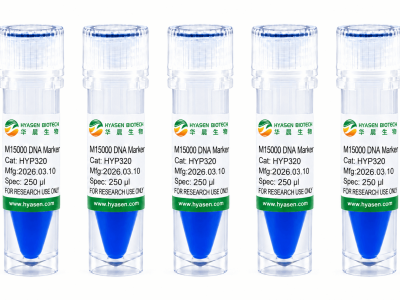
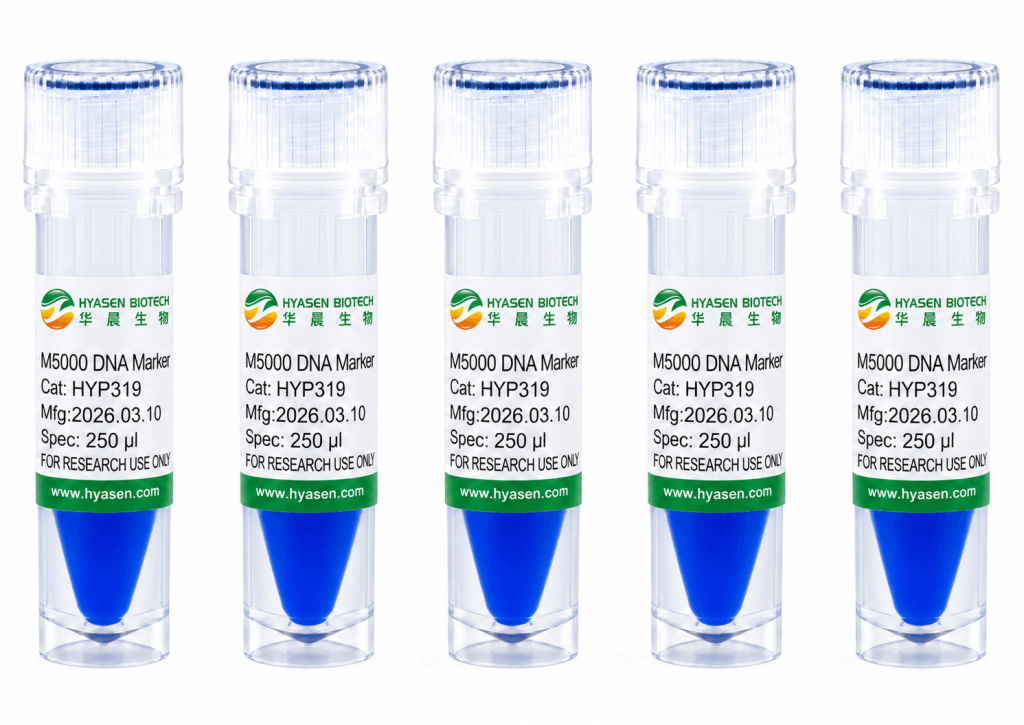
HYP319 M5000 DNA Marker is designed for estimating DNA fragment sizes across a broad range during agarose gel electrophoresis. It contains 9 linear double-stranded DNA fragments at 100, 250, 500, 750, 1,000, 1,500, 2,000, 3,000, and 5,000 bp, providing reference bands for routine molecular biology applications. The DNA fragments are supplied in 1× loading buffer for convenient gel loading. In a 5 μL loading volume, the 500 bp and 1,500 bp bands each contain approximately 120 ng of DNA, while each of the other bands contains approximately 50 ng. These enhanced reference bands help users identify key positions when comparing DNA sample migration patterns. Under normal use conditions, HYP319 M5000 DNA Marker provides clear, sharp bands with relatively uniform brightness and a clean gel background. It is supplied in 5 × 250 μL format. Store at 4°C for up to 6 months or at −20°C for long-term storage.
Product Features
- Broad DNA Size Coverage: Includes 9 defined DNA fragments from 100 bp to 5,000 bp for estimating DNA fragments across a wide size range.
- Two Enhanced Reference Bands: The 500 bp and 1,500 bp bands each contain approximately 120 ng of DNA per 5 μL loading volume, compared with approximately 50 ng in each of the other bands.
- Ready-to-Use Formulation: Supplied in 1× loading buffer for convenient sample loading and clear band visualization during agarose gel electrophoresis.
FAQ
1. Which DNA fragment sizes are included in the M5000 DNA Marker?
It contains 9 linear double-stranded DNA fragments: 100, 250, 500, 750, 1,000, 1,500, 2,000, 3,000, and 5,000 bp.
2. Which bands contain more DNA, and what are their approximate amounts?
The 500 bp and 1,500 bp bands each contain approximately 120 ng of DNA in a 5 μL loading volume. Each of the remaining bands contains approximately 50 ng.
3. Can the M5000 DNA Marker be used for PCR product size estimation?
Yes. It can serve as a reference for estimating PCR product sizes and other DNA fragments separated by agarose gel electrophoresis, provided the fragments fall within its 100–5,000 bp marker range.