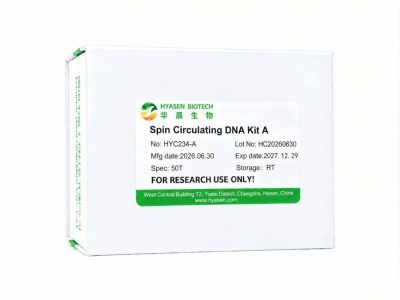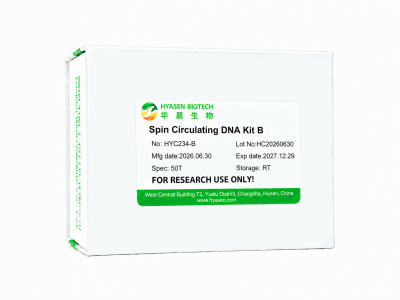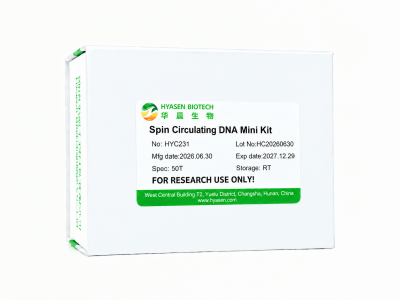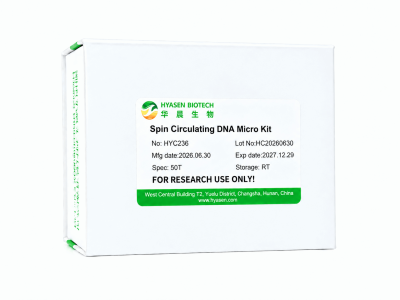
Product Overview
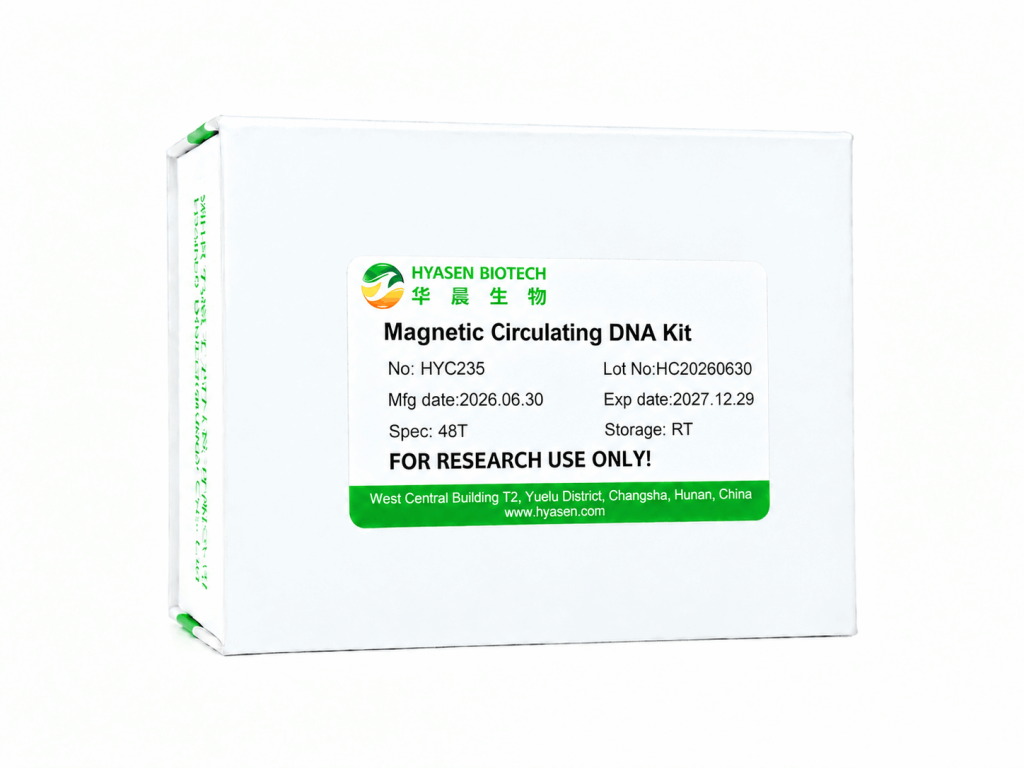
This kit is designed to isolate and purify cell-free DNA (cfDNA) from 1–5 mL of cell-free body fluids, including plasma, serum, and urine. It combines room-temperature lysis and DNA binding into a single step, eliminating the need for an ice bath or interruptions to add binding buffer and magnetic beads, greatly simplifying the workflow. Under high-salt conditions, cfDNA binds to the surface of silica-coated magnetic beads. After washing, the DNA is eluted in nuclease-free water. DNA yield depends strongly on sample type, storage conditions and duration, and individual variability. The kit offers high extraction efficiency, excellent reproducibility, and a simple, rapid workflow. The purified cfDNA is of consistent, reliable quality and is suitable for routine downstream applications, including quantitative PCR (qPCR) and next-generation sequencing (NGS) library preparation.
Components
| Components | 48 T |
| Buffer CTL | 2×72 mL |
| Buffer CTW | 60 mL |
| Buffer GCW2* | 2×10 mL |
| RNase-Free Water | 10 mL |
| Proteinase K | 5 mL |
| Magnetic Microspheres N | 2×1 mL |
Product Features
- High Yield: Delivers high DNA yields with a high proportion of target short fragments.
- Broad Sample Compatibility: Purifies high-quality cfDNA from 1–5 mL of cell-free body fluids, including plasma, serum, and urine.
- Simple Workflow: Combines lysis and binding in a single step, with no ice bath or interruptions required.
- Automation Compatible: Supports both manual extraction and automated high-throughput workflows.
FAQ
Q1: What should I do if precipitates form in Buffer CTL or Buffer CTW?
Check Buffer CTL and Buffer CTW for crystals or precipitates before use. If present, warm the buffer in a 50°C water bath for a few minutes until the solution is clear.
Q2: Which sample types are compatible with this kit?
The kit is suitable for extracting cfDNA from 1–5 mL of cell-free body fluids, including plasma, serum, and urine.
Q3: What can cause low DNA yield, and how can I improve it?
- Proteinase K inactivation due to an incorrect order of reagent addition: Always add Proteinase K first, followed by the sample and Buffer CTL.
- Poor sample quality: Avoid repeated freeze–thaw cycles.
- Insufficient binding to magnetic beads: Vortex Magnetic Microspheres N for at least 30 seconds before use to fully resuspend the beads. During the lysis and binding step, shake at room temperature for 20 minutes to keep the beads suspended. When processing multiple samples, remix the bead suspension every few samples to prevent settling.
- Insufficient elution: Use RNase-Free Water prewarmed to 55–60°C. Vortex to resuspend the beads, then elute with shaking at 1,600 rpm for 10 minutes.
- Overdrying of magnetic beads: Avoid prolonged air-drying after the ethanol wash. Once the liquid on the tube walls has evaporated, the bead surface should appear matte rather than wet and glossy, with no visible cracks.
- Incorrect wash buffer preparation: Before using Buffer GCW2 for the first time, add absolute ethanol as directed on the bottle label and mark the bottle to indicate that ethanol has been added.