Product Overview
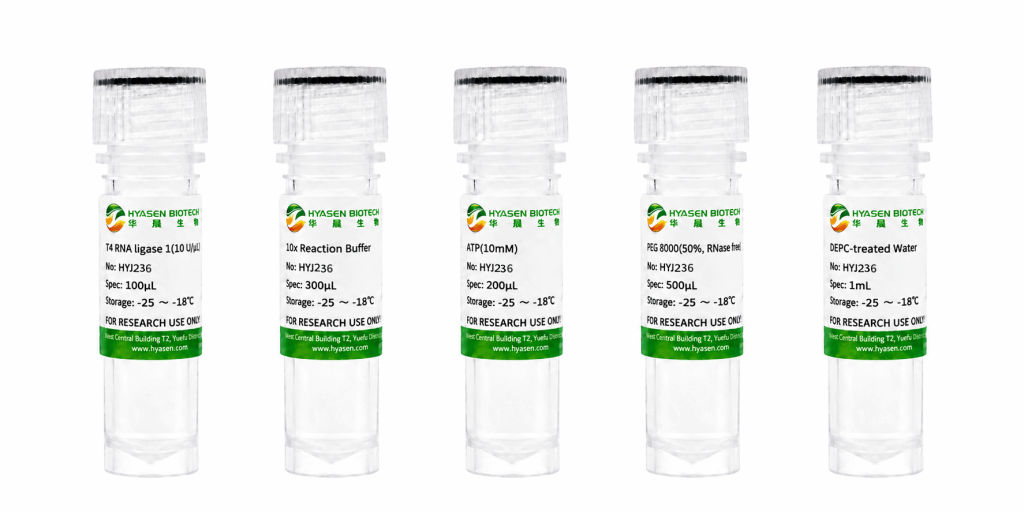
T4 RNA Ligase 1 is an ATP-dependent enzyme that catalyzes the formation of a phosphodiester bond between a 5′-phosphate terminus and a 3′-hydroxyl terminus. Its substrates are single-stranded RNA, single-stranded DNA, or mononucleotides, and the reaction can take place intermolecularly (joining two separate molecules) or intramolecularly (joining the two ends of one molecule). Because it acts on single-stranded ends, it is a basic tool for building and modifying RNA and short DNA molecules.
The enzyme is produced by expressing the T4 phage gene in E. coli. It is used in a range of applications:
- Intermolecular joining of ssRNA
- Joining of ssRNA to ssDNA
- Labeling the 3′-OH ends of ssRNA with the radioisotope 5′-[³²P]pCp
- Synthesis of single-stranded oligo RNAs and oligo DNAs
- Specialized modification of tRNAs
- Introduction of non-natural amino acids into proteins
This breadth makes T4 RNA Ligase 1 a useful component in RNA research workflows, and a raw material for kit and reagent manufacturers that build RNA ligation steps into their own products.
Product Features
- Joins single-stranded RNA, DNA, and mononucleotides: The enzyme ligates the 5′-phosphate and 3′-hydroxyl termini of ssRNA, ssDNA, or mononucleotides, so it works on RNA-RNA and RNA-DNA joins, as well as on single nucleotides.
- Intermolecular and intramolecular ligation: It supports both joining of separate molecules and ligation within one molecule, which gives flexibility across different experimental designs.
- Broad application coverage: Applications include joining of ssRNA, joining of ssRNA to ssDNA, ³²P 3′-end labeling of RNA with 5′-[³²P]pCp, synthesis of oligo RNAs and DNAs, tRNA modification, and introduction of non-natural amino acids into proteins.
FAQ
Q1: What substrates does T4 RNA Ligase 1 act on, and what does it need to work?
It acts on single-stranded RNA, single-stranded DNA, or mononucleotides. The reaction is ATP-dependent and forms a phosphodiester bond between a 5′-phosphate terminus (the donor) and a 3′-hydroxyl terminus (the acceptor). Substrates therefore need a 5′-phosphate on one end and a free 3′-OH on the other end to be joined.
Q2: How is T4 RNA Ligase 1 different from T4 RNA Ligase 2?
T4 RNA Ligase 1 acts on single-stranded ends, so it is used for ssRNA joining, ssRNA-to-ssDNA joining, and 3′-end labeling. T4 RNA Ligase 2 is a double-stranded RNA ligase that prefers nicks within double-stranded RNA over the ends of single-stranded RNA. The choice depends on whether your substrate is single-stranded with free ends or a nicked duplex.
Q3: What applications is the enzyme used for?
Typical applications are intermolecular joining of ssRNA, joining of ssRNA to ssDNA, labeling of ssRNA 3′-OH ends with 5′-[³²P]pCp, synthesis of single-stranded oligo RNAs and oligo DNAs, special modification of tRNAs, and introduction of non-natural amino acids into proteins.