Product Overview
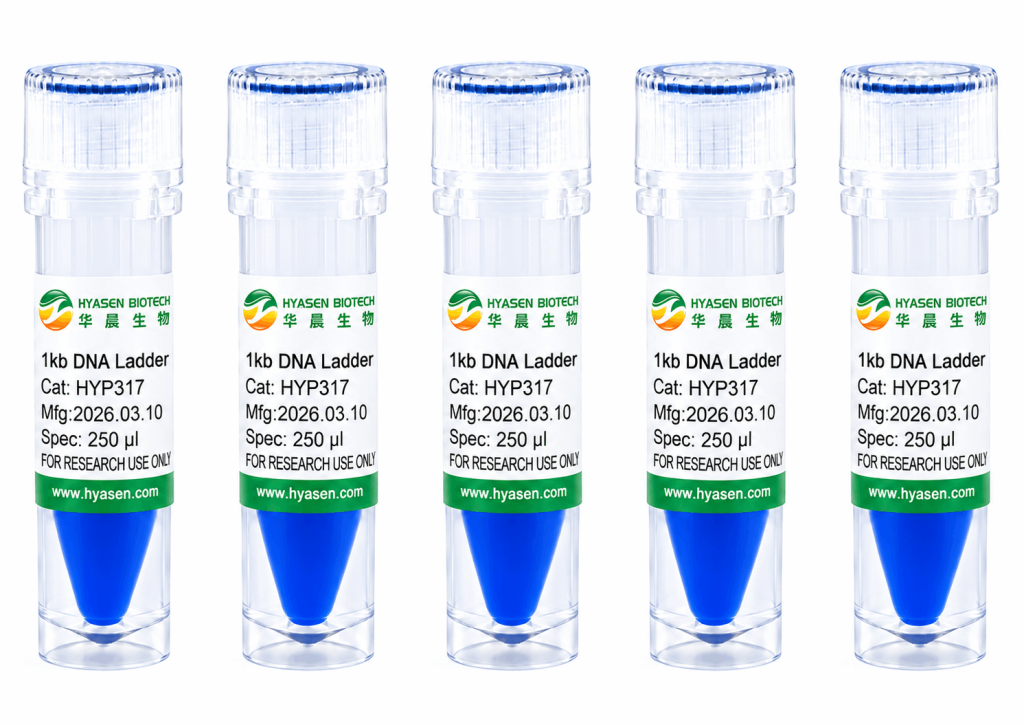
HYP317 1kb DNA Ladder is designed for estimating DNA fragment sizes across a broad range during agarose gel electrophoresis. It contains 13 linear double-stranded DNA fragments at 250, 500, 750, 1,000, 1,500, 2,000, 2,500, 3,000, 4,000, 5,000, 6,000, 8,000, and 12,000 bp, providing reference bands for routine molecular biology applications involving medium to large DNA fragments. The DNA fragments are supplied in 1× loading buffer for convenient gel loading. In a 5 μL loading volume, the 1,500 bp and 4,000 bp bands each contain approximately 80 ng of DNA, while each of the other bands contains approximately 30 ng. These enhanced reference bands help users identify key positions when comparing DNA sample migration patterns. Under normal use conditions, HYP317 1kb DNA Ladder provides clear, sharp bands with relatively uniform brightness and a clean gel background. It is supplied in 5 × 250 μL format. Store at 4°C for up to 6 months or at −20°C for long-term storage.
Product Features
- Broad DNA Size Range: Contains 13 defined DNA fragments from 250 bp to 12,000 bp for estimating DNA fragments across a wide size range.
- Two Enhanced Reference Bands: The 1,500 bp and 4,000 bp bands each contain approximately 80 ng of DNA per 5 μL loading volume, compared with approximately 30 ng in the other bands.
- Ready-to-Use Formulation: Supplied in 1× loading buffer for convenient sample loading and clear band visualization during agarose gel electrophoresis.
FAQ
1. Which DNA fragment sizes are included in the 1kb DNA Ladder?
It contains 13 linear double-stranded DNA fragments: 250, 500, 750, 1,000, 1,500, 2,000, 2,500, 3,000, 4,000, 5,000, 6,000, 8,000, and 12,000 bp.
2. Which bands contain more DNA, and what are their approximate amounts?
The 1,500 bp and 4,000 bp bands each contain approximately 80 ng of DNA in a 5 μL loading volume. Each of the remaining bands contains approximately 30 ng.
3. How should the 1kb DNA Ladder be stored?
Store at 4°C for up to 6 months. For long-term storage, keep the product at −20°C and follow the recommended handling instructions.