Product Overview
HYJ237 (T4 RNA Ligase 2) is a recombinant enzyme expressed in Escherichia coli, encoded by a gene derived from bacteriophage T4, and produced under controlled fermentation and purification processes to ensure high purity and consistent activity. As an ATP-dependent double-stranded RNA ligase, it catalyzes both intramolecular circularization and intermolecular linear ligation of double-stranded RNA. Unlike T4 RNA Ligase 1, T4 RNA Ligase 2 shows markedly greater catalytic activity toward nicks located within double-stranded RNA than toward the ends of single-stranded RNA, making it especially well suited for repairing or joining nicked duplex RNA structures. Beyond RNA-RNA ligation, T4 RNA Ligase 2 can also join the 3′-hydroxyl end of an RNA strand to the 5′-phosphate end of a DNA strand, functioning across RNA duplexes, RNA/DNA hybrids, and DNA duplexes, whether intramolecularly or intermolecularly. The enzyme requires a 5′-phosphate donor and a 3′-hydroxyl acceptor to complete the ligation reaction. These properties make T4 RNA Ligase 2 particularly valuable for double-stranded RNA sticky-end ligation, nick repair in double-stranded nucleic acid structures, and construction of RNA/DNA hybrid molecules — applications relevant to RNA structural studies, small RNA library preparation, and nucleic acid engineering workflows.
Components
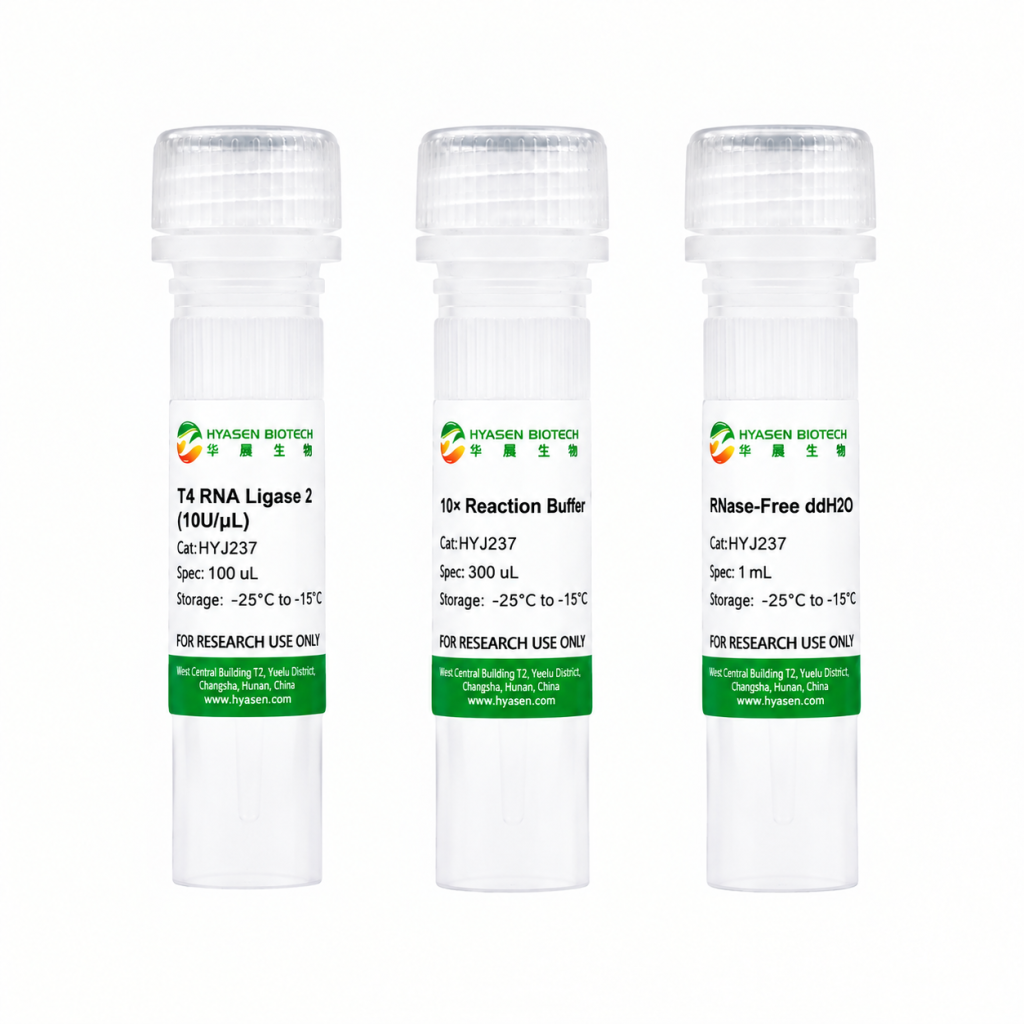
| Components | 1KU | 5KU |
| T4 RNA Ligase 2 (10U/µL) | 100 uL | 500 uL |
| 10× Reaction Buffer | 300 uL | 1.5 mL |
| RNase-Free ddH2O | 1 mL | 5 mL |
Product Features
- Preferential ligation of nicks within double-stranded RNA: Unlike single-strand-preferring RNA ligases, this enzyme exhibits significantly higher activity toward nicks within dsRNA structures than toward single-stranded RNA ends, making it highly effective for sealing breaks in RNA duplexes with minimal unwanted single-strand ligation byproducts.
- Versatile across RNA, DNA, and hybrid duplex substrates: In addition to RNA-RNA ligation, this enzyme joins the 3′-OH of RNA to the 5′-phosphate of DNA, functioning across RNA duplexes, RNA/DNA hybrids, and DNA duplexes — supporting a broad range of nucleic acid engineering and hybrid construct applications.
- Supports both intramolecular and intermolecular ligation: The enzyme catalyzes both circularization (intramolecular) and end-joining (intermolecular) reactions on double-stranded substrates, providing flexibility for applications ranging from RNA circularization to multi-fragment duplex assembly.
FAQ
Q1: How does T4 RNA Ligase 2 differ from T4 RNA Ligase 1 in substrate preference?
T4 RNA Ligase 1 primarily ligates single-stranded RNA ends and is commonly used for 3′ adapter ligation in small RNA library preparation. T4 RNA Ligase 2, by contrast, strongly prefers ligating nicks within double-stranded RNA structures over joining single-stranded RNA ends, making it the appropriate choice when the goal is to repair or join nicks in RNA duplexes or RNA/DNA hybrid structures rather than ligate free single-stranded ends.
Q2: What are the substrate requirements for a successful ligation reaction with this enzyme?
The enzyme requires a 5′-phosphate group on the donor strand and a free 3′-hydroxyl group on the acceptor strand at the ligation junction, along with ATP as an energy cofactor. The substrate must be double-stranded (RNA duplex, RNA/DNA hybrid, or DNA duplex) with the nick or ends properly base-paired to the complementary strand to position the reactive groups for ligation.
Q3: Can this enzyme be used to ligate an RNA strand to a DNA strand, and in what orientation?
Yes. This enzyme can join the 3′-hydroxyl group of an RNA strand to the 5′-phosphate group of a DNA strand, functioning within RNA/DNA hybrid duplex structures. This capability is useful for constructing chimeric RNA/DNA molecules or repairing nicks at RNA-DNA junctions within a double-stranded context, provided the strands are properly annealed to their complementary partner strand.