Product Overview
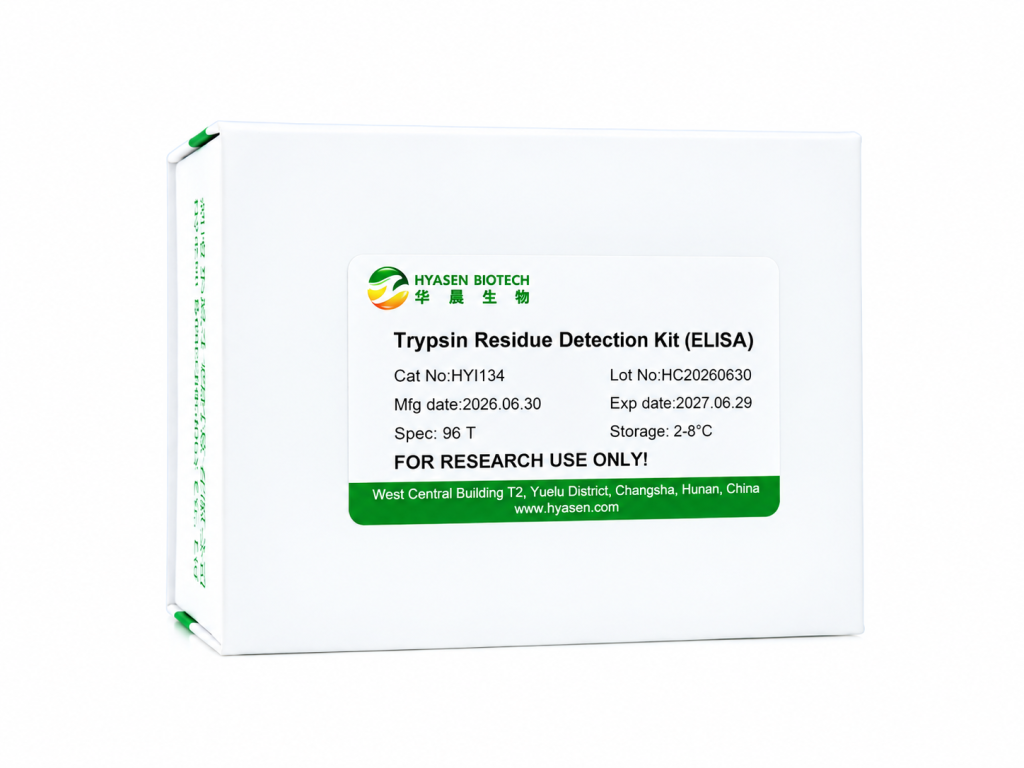
The Trypsin Residue Detection Kit (ELISA) is an enzyme-linked immunosorbent assay designed for the quantitative detection of residual porcine trypsin — a commonly used enzyme for cell detachment and dissociation in cell culture-based bioprocessing, where its complete removal or accurate residual quantification is important for downstream product purity and quality control. The microplate used in this assay is pre-coated with porcine trypsin antibody. Trypsin present in the sample binds to the antibody coated on the wells. A biotinylated porcine trypsin antibody is then added and binds to the captured trypsin. Following washing, HRP-conjugated streptavidin is introduced and binds to the biotinylated antibody; unbound HRP-streptavidin is subsequently removed by washing. TMB substrate solution is then added and catalyzed by HRP to generate a blue color product, which turns yellow upon addition of an acidic stop solution. The intensity of the yellow coloration is directly proportional to the amount of trypsin captured on the plate, and is quantified by measuring absorbance at 450 nm. This kit supports cell culture-based biopharmaceutical manufacturers, vaccine developers, and CDMOs in monitoring residual porcine trypsin levels throughout process development and release testing workflows.
Components
| Reagent | 96 T |
| ELISA microplate | 8×12 wells |
| Biotinylated detection antibody (100x) | 120 μL |
| HRP-streptavidin (100x) | 120 μL |
| Dilution buffer | 45 mL |
| TMB substrate solution | 12 mL |
| Stop solution | 6 mL |
| concentrated wash buffer (20x) | 35 mL |
| Standard (100ng/mL) | 0.5mL |
| Sealing film | 4 films |
Product Features
- Sensitive detection via biotin-streptavidin amplification: The biotin-streptavidin-HRP detection cascade provides signal amplification, supporting sensitive and reliable quantification of residual porcine trypsin, even at relatively low concentrations.
- Specific antibody-based recognition: The pre-coated capture antibody combined with a biotinylated detection antibody provides specific binding to porcine trypsin, minimizing cross-reactivity with other proteins present in the sample.
- Standardized colorimetric readout for straightforward quantification: Results are read as a simple absorbance measurement at 450 nm using a standard microplate reader, providing a quantitative, reproducible readout suitable for routine residual protein monitoring in QC workflows.
FAQ
Q1: Why is monitoring residual trypsin important in cell culture-based biopharmaceutical manufacturing?
Porcine trypsin is commonly used to detach adherent cells during cell culture processes, such as vaccine production or cell-based therapeutic manufacturing. Since trypsin is a process-related additive of animal origin rather than part of the final product, its residual presence must be monitored and controlled to meet product purity specifications, minimize potential immunogenicity risk, and satisfy regulatory expectations regarding animal-derived component clearance.
Q2: How does the biotin-streptavidin system enhance detection sensitivity in this assay?
The biotin-streptavidin interaction is one of the strongest known non-covalent biological interactions, enabling efficient binding of HRP-conjugated streptavidin to the biotinylated detection antibody. This creates a robust signal amplification step, improving the assay’s sensitivity for detecting lower concentrations of residual trypsin compared to a direct enzyme-labeled antibody format.
Q3: What equipment is required to run this assay, and how are results quantified?
The assay requires standard ELISA equipment, including a plate washer and a microplate reader capable of measuring absorbance at 450 nm. Results are quantified by comparing sample absorbance values to a standard curve generated using known concentrations of porcine trypsin, allowing straightforward calculation of concentration in unknown samples.