Product Overview
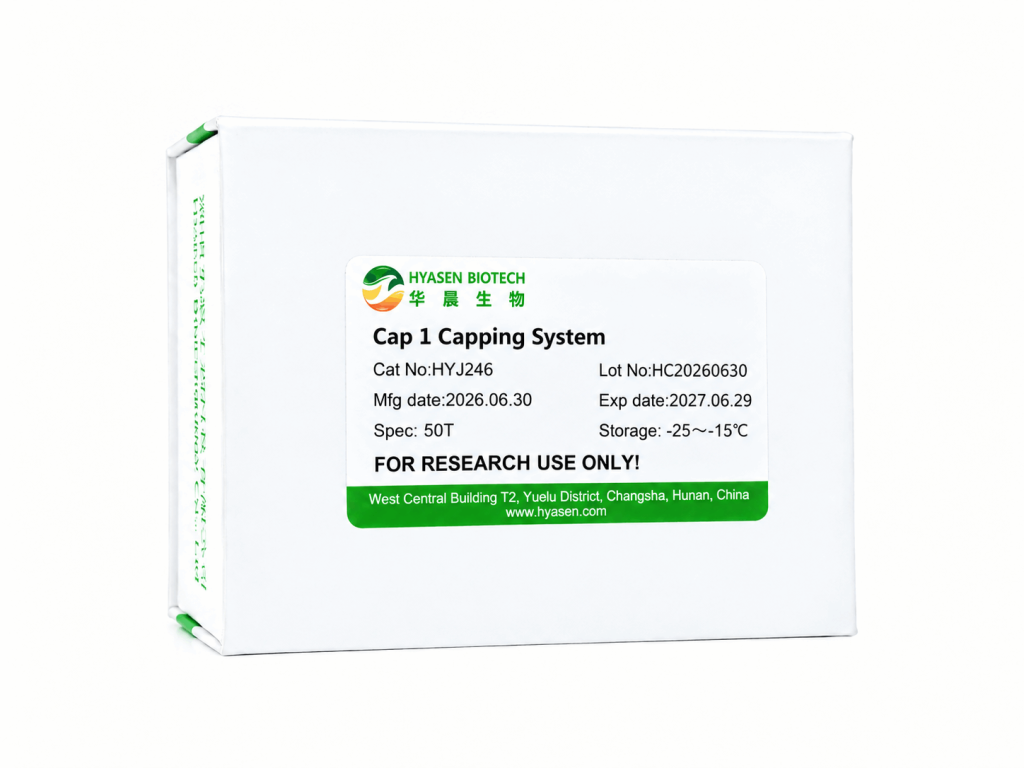
The Cap 1 Capping System is an enzymatic capping kit containing Vaccinia Capping Enzyme, mRNA Cap 2´-O-Methyltransferase, and other supporting capping components, designed to add a Cap 0 or Cap 1 structure to the 5′ end of uncapped mRNA. The resulting cap structure is structurally identical to the natural cap found in eukaryotic mRNA, significantly reducing the immunogenicity of exogenous mRNA while enhancing its stability and translation efficiency. The Vaccinia Capping Enzyme component consists of two subunits — D1R and D12L — carrying three enzymatic activities: RNA triphosphatase, guanylyltransferase, and guanine methyltransferase. The D1 subunit performs the RNA triphosphatase and guanylyltransferase functions, while the D12 subunit provides guanine methyltransferase activity, together installing a 7-methylguanylate Cap 0 structure at the RNA 5′ end. The mRNA Cap 2´-O-Methyltransferase component then uses S-adenosylmethionine (SAM) as a methyl donor to methylate the 2´-O position of the first nucleotide adjacent to the Cap 0 structure, converting it into a mature Cap 1 structure.
Together, the Cap 1 Capping System catalyzes four sequential enzymatic reactions: ① RNA triphosphatase cleaves the RNA 5′-triphosphate to a diphosphate; ② guanylyltransferase attaches GTP to the 5′-diphosphate at the RNA’s first nucleotide; ③ guanine-N7-methyltransferase methylates the guanine cap using SAM as cofactor, forming Cap 0; ④ mRNA Cap 2´-O-methyltransferase adds a further methyl group to the 2´-O position of the first transcribed nucleotide, completing the Cap 1 structure. This system caps 50 μg of RNA per single reaction, with the process scalable to milligram-quantity RNA production. Enzymatic capping using this system enhances mRNA translation efficiency and significantly improves mRNA expression outcomes in transfection and microinjection experiments.
Components
| Components | Concentration | 50T |
| Vaccinia Capping Enzyme | 10 U/μL | 250 μL |
| mRNA Cap 2 ´ -O-Methyltransferase | 50 U/μL | 250 μL |
| SAM | 32 mM | 50 μL |
| GTP | 100 mM | 50 μL |
| Recombinant RNase Inhibitor | 40 U/μL | 150 μL |
| 10×Capping Buffer | / | 500 μL |
Product Features
- Complete four-step enzymatic pathway to native Cap 1 structure: Combining Vaccinia Capping Enzyme’s triphosphatase, guanylyltransferase, and guanine methyltransferase activities with the 2´-O-methyltransferase activity of the second enzyme component, this system generates a Cap 1 structure identical to native eukaryotic mRNA in a defined four-reaction pathway.
- Reduced immunogenicity and enhanced translation efficiency: The resulting Cap 1 structure closely mimics natural eukaryotic mRNA caps, reducing recognition by innate immune RNA sensors and substantially improving mRNA translational output compared to uncapped or Cap 0-only RNA.
- Scalable capping capacity for research through production-scale needs: Each reaction caps 50 μg of RNA, with straightforward scale-up to milligram quantities, supporting both routine research applications and larger-scale mRNA production workflows.
FAQ
Q1: What is the difference between the Cap 0 and Cap 1 structures produced by this system, and can I generate either one?
Cap 0 refers to RNA capped with a 7-methylguanylate structure at the 5′ end, formed by the first three enzymatic reactions in this system (RNA triphosphatase, guanylyltransferase, and guanine-N7-methyltransferase). Cap 1 adds a further 2´-O-methylation at the first transcribed nucleotide via the fourth reaction (mRNA Cap 2´-O-methyltransferase), producing a structure that more closely resembles native eukaryotic mRNA. This system can generate either Cap 0 or Cap 1 depending on which reaction components/steps are included, with Cap 1 generally offering improved translation efficiency and reduced immunogenicity.
Q2: What RNA substrate is required for this capping system, and can it be used on any in vitro transcribed RNA?
This system requires RNA bearing a 5′-triphosphate group as its starting substrate, which is typical of RNA generated by standard in vitro transcription using T7 (or related) RNA polymerases. The enzymatic reactions proceed sequentially from this triphosphate end, making the system broadly compatible with in vitro transcribed RNA of varying lengths intended for transfection, microinjection, or other mRNA-based applications.
Q3: How much RNA can be capped in a single reaction, and can the reaction be scaled up for larger production needs?
A single standard reaction caps 50 μg of RNA. The reaction system is designed to scale proportionally, allowing production to be scaled up to milligram quantities of capped RNA for applications requiring larger production volumes, such as downstream mRNA manufacturing workflows.