Product Overview
Hotstart Taq DNA Polymerase M2 is an enhanced thermostable DNA polymerase engineered for high-performance PCR amplification. Through advanced hot-start technology, the enzyme remains inactive during reaction setup and early temperature stages, preventing unwanted DNA synthesis before PCR cycling. After thermal activation, HYA116 provides strong polymerase activity for efficient target amplification with improved specificity and reproducibility compared with conventional Taq DNA polymerases. The optimized enzyme performance enables reliable amplification across a wide range of templates, including complex genomic DNA, low-abundance targets, and challenging sequences. HYA116 Hotstart Taq DNA Polymerase M2 is suitable for research and commercial applications including conventional PCR, qPCR, multiplex PCR, genotyping, and molecular diagnostic reagent development.
Components
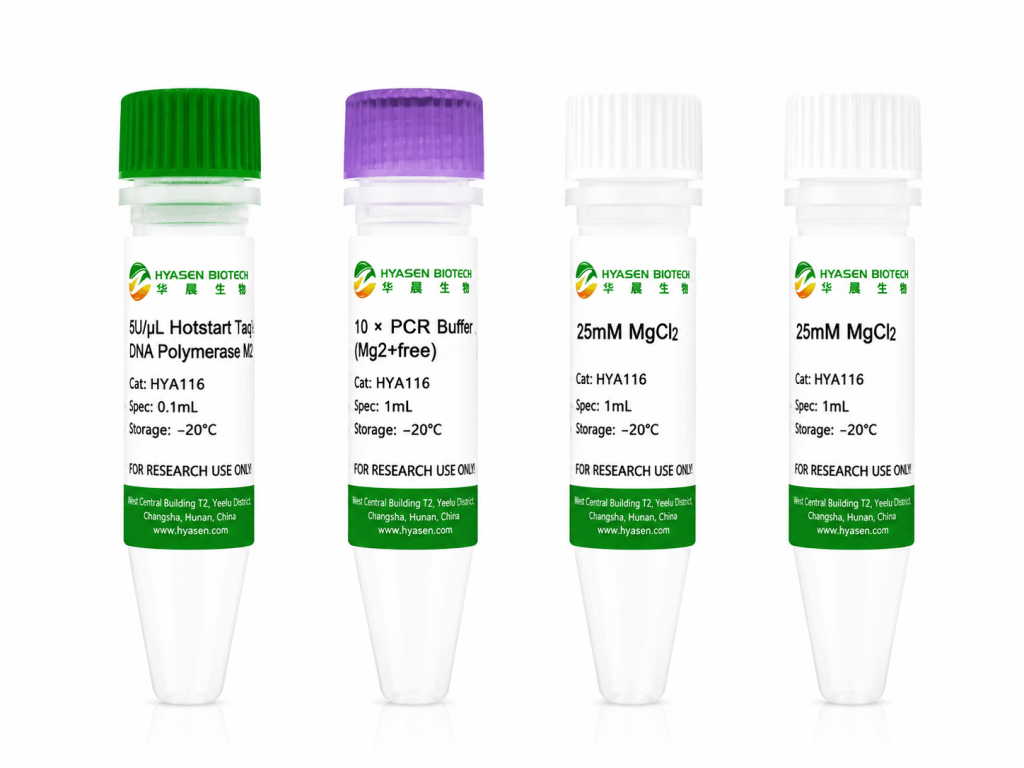
- 5U/µL Hotstart Taq DNA Polymerase M2
- 10 × PCR Buffer (Mg2+ free) (optional)
- 25mM MgCl2 (optional)
*10×PCR Buffer (Mg2+ free) does not contain dNTP and Mg2+. Please add dNTPs and MgCl2 when preparing the reaction system.
Product Features
- Enhanced Hot-Start PCR Performance: HYA116 utilizes advanced hot-start technology to suppress polymerase activity before thermal activation..
- Improved Specificity and Amplification Accuracy:HYA116 is optimized to provide a balance between specificity and amplification efficiency.
- Efficient Amplification of Complex Templates: HYA116 provides robust extension capability for challenging PCR targets.
FAQ
Q1: What is HYA116 Hotstart Taq DNA Polymerase M2?
HYA116 Hotstart Taq DNA Polymerase M2 is an enhanced hot-start thermostable DNA polymerase designed for specific and reliable PCR amplification.
Q2: What are the advantages of HYA116 compared with regular Taq DNA polymerase?
Reduced nonspecific amplification;Lower primer-dimer formation;Improved target specificity;Better reproducibility.
Q3: How does hot-start technology improve PCR performance?
Hot-start technology keeps the polymerase inactive before PCR activation, preventing unwanted DNA synthesis during reaction preparation.After heating activation, the enzyme becomes fully active for target amplification.