Product Overview
I-SceI is an intron-encoded endonuclease originally derived from Saccharomyces cerevisiae. It specifically recognizes and cleaves an 18 bp non-palindromic DNA sequence: 5′-TAGGGATAACAGGGTAAT-3′, producing DNA fragments with 4 bp 3′ overhangs.
Due to its unusually long recognition sequence, I-SceI is a rare-cutting endonuclease with a low probability of encountering its target site randomly in a genome. This makes it a useful molecular biology tool for targeted DNA cleavage, genome engineering research, and other applications requiring site-specific DNA manipulation.
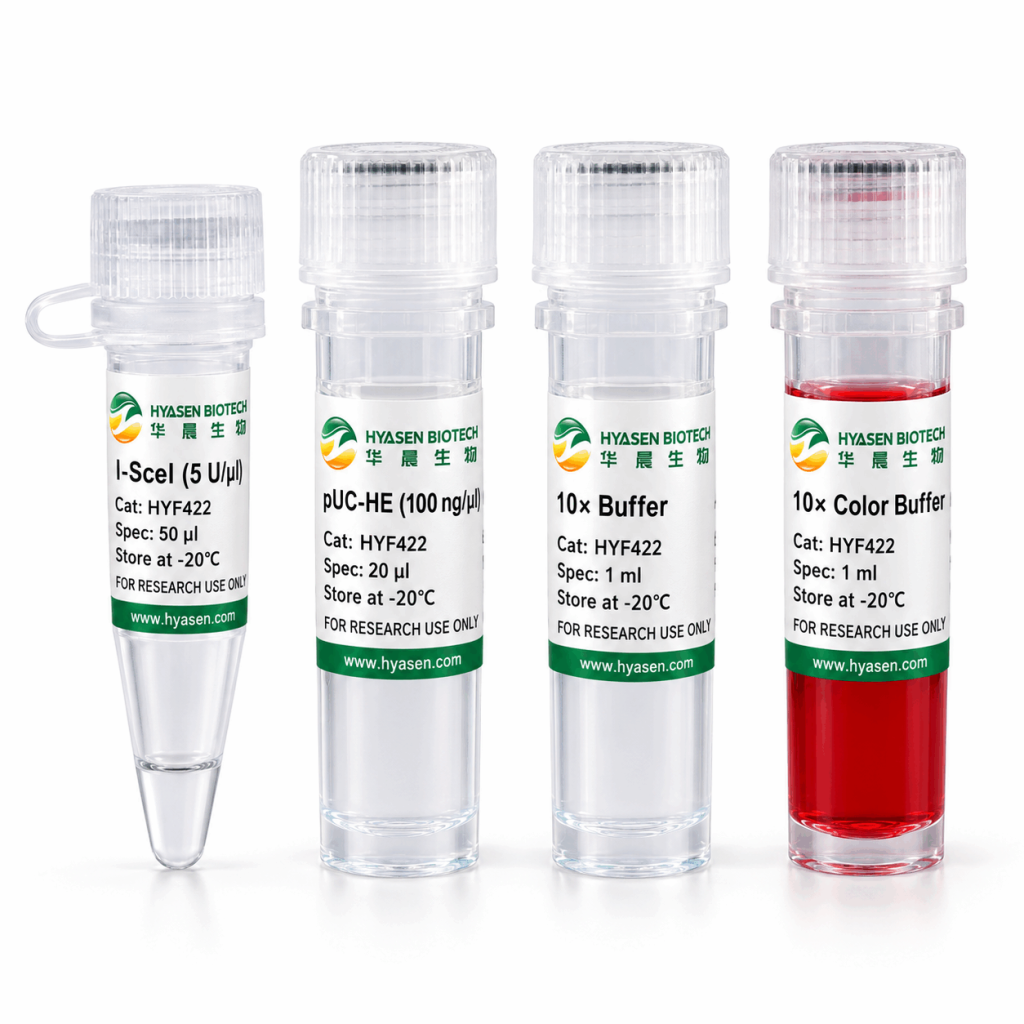
I-SceI exhibits good activity in both standard CutOne® Buffer and CutOne® Color Buffer. The color-coded buffer contains red and yellow tracking dyes, allowing digestion products to be loaded directly onto agarose gels for electrophoresis without adding a separate loading buffer.
The recommended reaction temperature is 37°C, and the enzyme can be heat-inactivated at 65°C for 5 minutes.
Product Features
- Long Recognition Sequence: Specifically recognizes an 18 bp non-palindromic DNA sequence, 5′-TAGGGATAACAGGGTAAT-3′, enabling rare and highly specific DNA cleavage.
- Defined 3′ Overhangs: Produces DNA fragments with 4 bp 3′ cohesive ends, supporting downstream DNA manipulation and molecular cloning workflows.
- Flexible Buffer Compatibility: Performs well in both standard and color-coded buffers, with tracking dyes in the color-coded buffer for direct gel electrophoresis.
FAQ
Q1: What DNA sequence does I-SceI recognize?
I-SceI specifically recognizes the 18 bp non-palindromic sequence 5′-TAGGGATAACAGGGTAAT-3′.
Q2: What type of DNA ends does I-SceI generate?
I-SceI cleavage produces DNA fragments with 4 bp 3′ overhangs, which can be used in downstream DNA manipulation and cloning workflows.
Q3: Why is I-SceI considered a rare-cutting endonuclease?
I-SceI recognizes an unusually long 18 bp DNA sequence. Under a simplified random-sequence model, this recognition site is expected to occur approximately once per 7 × 10¹⁰ bp, making it uncommon in genomic DNA and useful for targeted DNA cleavage.