Product Overview
SgrAI is a restriction endonuclease originally derived from Streptomyces griseus and produced through recombinant expression in Escherichia coli. It specifically recognizes and cleaves the CR/CCGGYG DNA sequence, making it useful for sequence-specific DNA digestion in molecular biology workflows.
SgrAI has a distinctive cleavage characteristic: efficient digestion generally requires two or more recognition sites on the DNA substrate, while cleavage efficiency is significantly reduced when only one recognition site is present. Although it is not part of the LightNing® enzyme series, SgrAI is compatible with CutOne® buffer and can be used in double-digestion reactions with compatible enzymes.
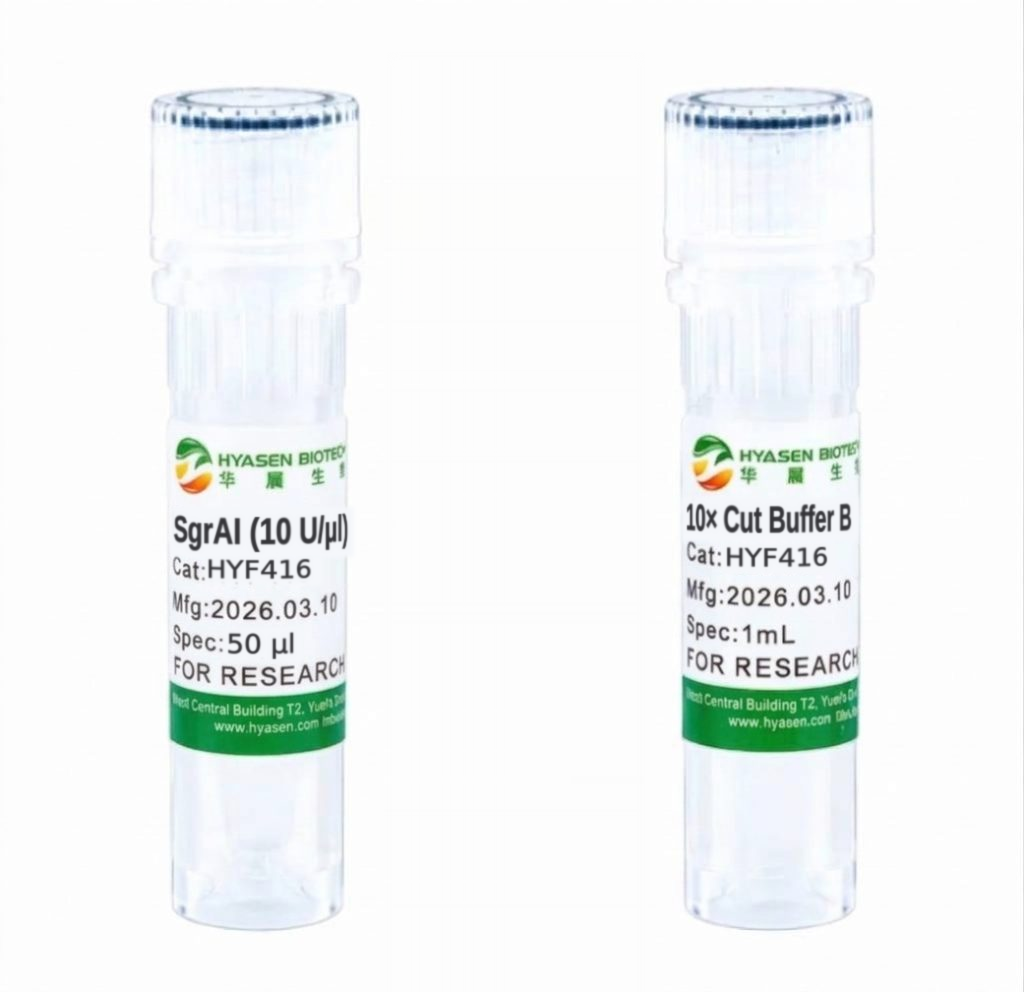
The enzyme is supplied with 10× Cut Buffer B and is recommended for reactions at 37°C. It can be heat-inactivated at 65°C for 5 minutes. DNA methylation, including CpG, EcoKI, and EcoBI methylation, may interfere with cleavage.
Product Features
- Specific DNA Recognition: Recognizes and cleaves the CR/CCGGYG sequence for targeted DNA digestion.
- Multiple-Site-Dependent Activity: Delivers more efficient cleavage when the DNA substrate contains two or more recognition sites; single-site substrates may show substantially reduced digestion efficiency.
- Flexible Digestion Compatibility: Compatible with CutOne® buffer and suitable for double-digestion workflows with compatible restriction enzymes.
FAQ
Q1: What DNA sequence does SgrAI recognize?
SgrAI specifically recognizes and cleaves the CR/CCGGYG DNA sequence.
Q2: Can SgrAI efficiently digest DNA containing only one recognition site?
SgrAI typically requires two or more recognition sites for efficient cleavage. Digestion efficiency can be significantly reduced when the substrate contains only one recognition site.
Q3: Does DNA methylation affect SgrAI activity?
Yes. CpG, EcoKI, and EcoBI methylation may inhibit SgrAI cleavage. The methylation status of the DNA template should be considered when planning digestion reactions.