Product Overview
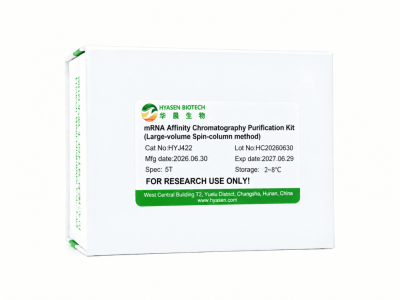
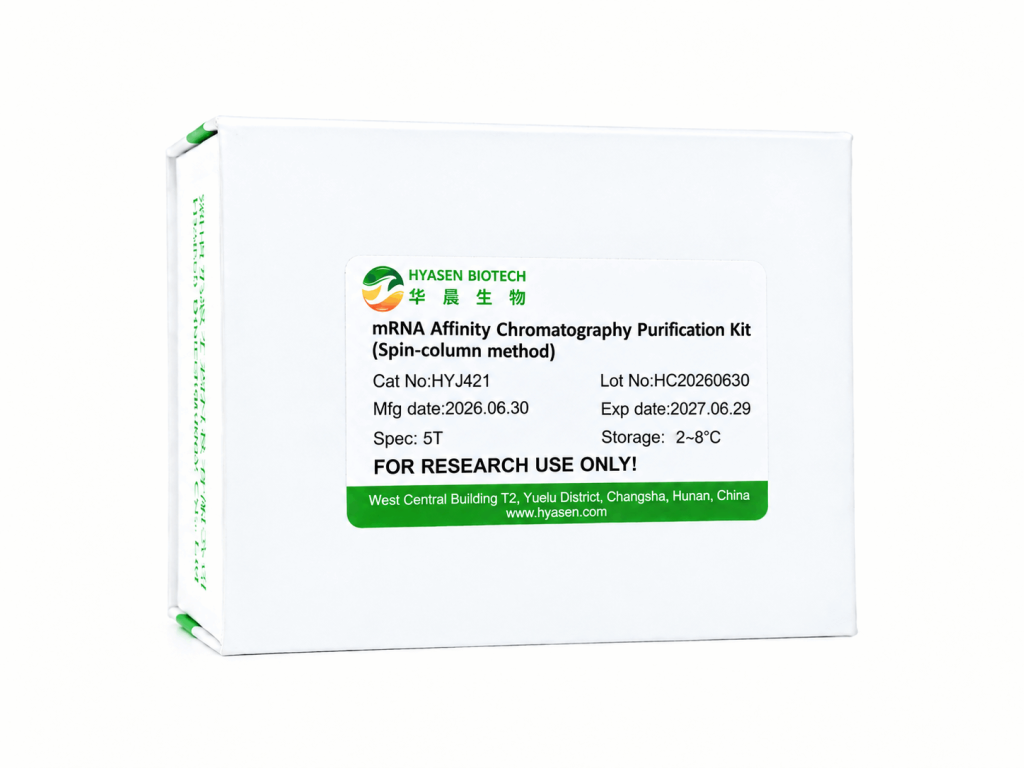
The mRNA Affinity Chromatography Purification Kit (Spin-column method) provides a simple, spin-column-based workflow for purifying mRNA directly from in vitro transcription reactions. The kit captures mRNA by exploiting base-pairing between Oligo dT immobilized on the surface of an affinity resin and the poly(A) tail present at the 3′ end of mRNA, enabling specific and reliable mRNA capture from complex reaction mixtures. Using a straightforward bind-wash-elute spin-column format, this kit eliminates the need for specialized purification equipment or cryogenic/cold-chain handling steps typically associated with other mRNA purification methods, making it accessible for routine bench-top use. The resulting mRNA samples exhibit high integrity and show clear removal of unincorporated NTPs and other reaction components, supporting downstream applications where mRNA purity and structural integrity are critical, such as transfection, in vitro translation, and further enzymatic processing (capping, tailing, or quality control analysis). The kit includes pre-formulated binding buffer, wash buffers, and spin-column affinity resin, enabling complete sample preparation in as little as 0.5 hours. This spin-column format is optimized for standard-scale mRNA purification; for higher-throughput or larger-volume purification needs, our mRNA Affinity Chromatography Purification Kit (Large-volume Spin-column method) offers a scaled-up alternative using the same Oligo dT/poly(A) capture principle.
Components
| Components | 5 T | 10 T | 20 T |
| Sample Binding Buffer | 4 mL | 8 mL | 20 mL |
| Equilibration/Wash 1 Buffer | 15 ml | 30 ml | 60 ml |
| Wash 2 Buffer | 8 ml | 15 ml | 30 ml |
| Resin | 2 mL | 4 mL | 8 ml |
| Empty spin columns | 5 pcs | 10 pcs | 20 pcs |
Product Features
- Simple, equipment-free spin-column workflow: The spin-column format enables complete mRNA capture, washing, and elution using standard benchtop centrifugation — no specialized purification equipment, chromatography system, or cryogenic/cold-chain handling required.
- Specific mRNA capture via Oligo dT/poly(A) base-pairing: The affinity resin selectively captures mRNA through hybridization between immobilized Oligo dT and the mRNA’s poly(A) tail, enabling specific purification of polyadenylated mRNA away from non-polyadenylated reaction components.
- Fast turnaround with high mRNA integrity: Complete sample preparation — from binding through elution — can be achieved in as little as 0.5 hours using pre-formulated reagents, yielding clean, high-integrity mRNA with effective removal of unincorporated NTPs.
FAQ
Q1: How does the spin-column format simplify the mRNA purification process?
The spin-column format integrates the binding, washing, and elution steps into a single column device processed via standard benchtop centrifugation, eliminating the need for a dedicated chromatography system, vacuum manifold, or gravity-flow setup. This makes the purification workflow fast, straightforward, and accessible for routine laboratory use without specialized equipment.
Q2: How does this kit specifically capture mRNA from an in vitro transcription reaction mixture?
The affinity resin packed in the spin-column is functionalized with Oligo dT sequences, which specifically base-pair with the poly(A) tail present at the 3′ end of mRNA molecules. This hybridization-based capture selectively binds polyadenylated mRNA to the resin as the sample passes through the column, allowing unincorporated NTPs, template DNA, enzymes, and other reaction components to be washed away before the purified mRNA is eluted.
Q3: What sample volume or mRNA quantity is this spin-column kit designed for, and is there an option for larger-scale purification?
This spin-column kit is optimized for standard-scale mRNA purification from typical in vitro transcription reaction volumes. For applications requiring purification of larger reaction volumes or higher mRNA quantities, our mRNA Affinity Chromatography Purification Kit (Large-volume Spin-column method) is designed to accommodate scaled-up purification needs using the same Oligo dT/poly(A) capture chemistry.