Product Overview
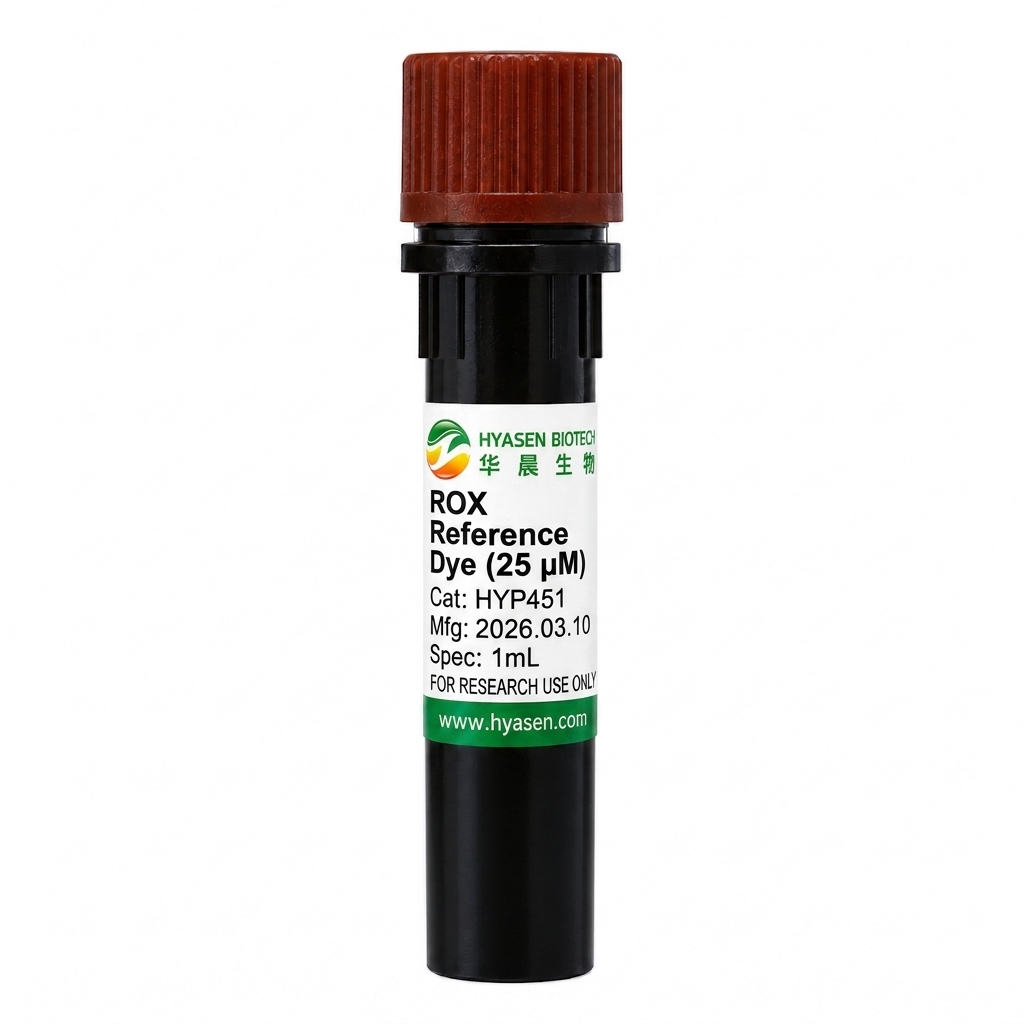
The HYP451 ROX Reference Dye (25 μM) is designed for use as a passive reference dye in real-time quantitative PCR and reverse transcription qPCR workflows. It helps normalize fluorescence fluctuations unrelated to target amplification, supporting more consistent signal analysis across reaction wells.
By providing a reference signal alongside the reporter fluorescence, ROX dye can help compensate for variations in signal intensity caused by factors such as optical or reaction-volume differences. It is suitable for compatible qPCR assays and can be used with existing ROX detection settings on supported instruments.
ROX requirements vary by qPCR instrument and assay chemistry. Before use, confirm whether the instrument requires a passive reference dye and determine the appropriate final concentration according to the instrument and qPCR mix manufacturer’s instructions. The supplied solution has a concentration of 25 μM.
Store at -20°C, protected from light.
Product Features
- Fluorescence Signal Normalization: Helps correct for fluorescence fluctuations unrelated to target amplification, supporting more consistent real-time PCR data analysis.
- Supports qPCR and RT-qPCR Workflows: Designed for use as a passive reference dye in compatible quantitative PCR and reverse transcription qPCR assays.
- Convenient 25 μM Stock Solution: Supplied as a ready-to-use reference dye solution, allowing users to calculate and add the required amount based on their assay and instrument specifications.
FAQ
1. What is ROX Reference Dye used for in qPCR?
ROX is used as a passive reference dye to normalize fluorescence signal fluctuations unrelated to target amplification, helping improve consistency in qPCR data analysis.
2. Do all qPCR instruments require ROX Reference Dye?
No. Some instruments require ROX normalization, while others do not. Check your instrument’s specifications and the recommendations for your qPCR mix before adding ROX.
3. How should ROX Reference Dye (25 μM) be stored and used?
Store at -20°C protected from light. Before use, determine the required final concentration and addition volume based on the qPCR instrument and reaction system. Avoid adding ROX to assays or instruments that do not require it.