Product Overview
T4 DNA Ligase is a widely used enzyme in molecular biology for joining DNA fragments and repairing nicks in double-stranded DNA. It catalyzes the formation of phosphodiester bonds between adjacent 5′-phosphate and 3′-hydroxyl groups in an ATP-dependent reaction.
Hyasen HYP416 T4 DNA Ligase is produced using recombinant Escherichia coli expressing the T4 bacteriophage DNA ligase gene. The enzyme efficiently joins DNA fragments with compatible sticky ends or blunt ends, making it suitable for a variety of molecular cloning and DNA manipulation workflows.
For sticky-end ligation, reactions can be completed in as little as 10 minutes at room temperature, helping reduce incubation time during routine cloning experiments. The enzyme also supports blunt-end ligation and sealing of single-strand nicks in double-stranded DNA.
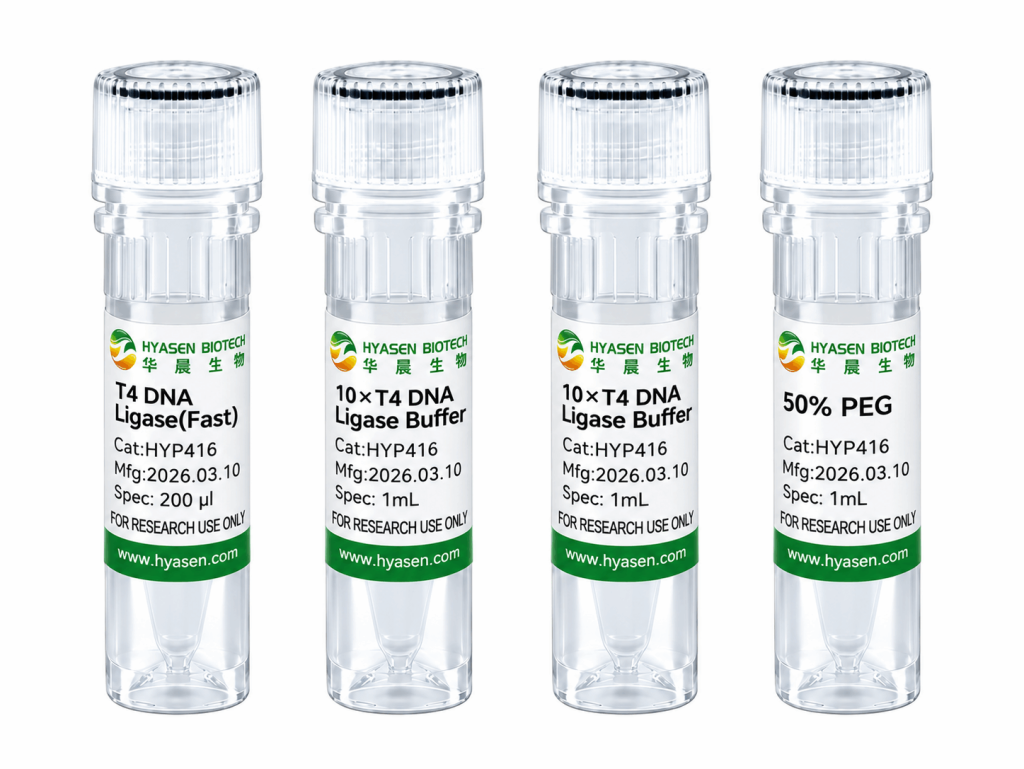
Common applications include cloning restriction enzyme-digested DNA fragments, ligating PCR products, site-directed mutagenesis workflows, and circularizing linear DNA. The kit includes a 10× ligation buffer and 50% PEG solution to support reaction setup and optimization.
Product Features
- Fast Sticky-End Ligation: Complete sticky-end DNA ligation in as little as 10 minutes at room temperature, reducing incubation time in routine molecular cloning workflows.
- Versatile DNA Ligation Activity: Supports both sticky-end and blunt-end DNA ligation, as well as nick sealing in double-stranded DNA, making it useful for a wide range of DNA manipulation applications.
- Broad Molecular Cloning Applications: Suitable for restriction fragment cloning, PCR product ligation, site-directed mutagenesis workflows, and linear DNA circularization. Supplied with 10× ligation buffer and 50% PEG for flexible reaction setup.
FAQ
Q1: Can T4 DNA Ligase join both sticky-end and blunt-end DNA fragments?
Yes. HYP416 T4 DNA Ligase supports ligation of DNA fragments with compatible sticky ends or blunt ends. Sticky-end ligation can be completed in as little as 10 minutes at room temperature under suitable reaction conditions. Blunt-end ligation is generally less efficient and may require longer incubation times or optimized reaction conditions.
Q2: Can T4 DNA Ligase be used to ligate PCR products into cloning vectors?
Yes. HYP416 T4 DNA Ligase can be used for PCR product cloning when the DNA fragments have compatible ends and the appropriate 5′-phosphate groups required for ligation. Depending on how the PCR products are generated, additional end preparation, phosphorylation, or restriction digestion may be necessary before ligation.
Q3: Does T4 DNA Ligase require ATP, and how should it be stored?
Yes. HYP416 T4 DNA Ligase requires ATP as a cofactor to catalyze phosphodiester bond formation. Reactions should be prepared using an appropriate ATP-containing ligation buffer. The enzyme should be stored at −20°C and has a stated shelf life of 2 years when stored under the recommended conditions.