Product Overview
Taq DNA Polymerase is a highly thermostable DNA polymerase originally isolated from the thermophilic bacterium Thermus aquaticus. It tolerates the repeated high-temperature denaturation steps of thermal cycling, which is why it remains one of the most widely used enzymes in PCR. The enzyme catalyzes template-dependent polymerization of deoxynucleotides in the 5′ to 3′ direction and requires Mg²⁺. The product is a high-purity enzyme protein obtained by recombinant expression of the Thermus aquaticus DNA polymerase gene in E. coli and multi-step chromatographic purification, and it has the same properties as natural Taq DNA Polymerase. Quality control covers electrophoretic purity (≥98% by SDS-PAGE), amplification sensitivity, inter-batch variation, stability, and the absence of extraneous nuclease, endonuclease, and exonuclease contamination. Taq DNA Polymerase has 5′→3′ polymerase and 5′→3′ exonuclease activity, and has no 3′→5′ exonuclease activity or proofreading function. At 70–75°C the extension rate is 1–2 kb/min. The 3′ end of the PCR product is an A, so products can be cloned directly into a T vector. It is suitable for qualitative and quantitative detection by ordinary PCR and RT-PCR, fluorescence quantitative PCR detection, and DNA sequencing. The enzyme is supplied at 5 U/μL, with an optional 10× PCR Buffer (Mg²⁺ free) and optional 25 mM MgCl₂. Because the buffer contains neither dNTPs nor Mg²⁺, users can set the Mg²⁺ concentration for each primer-template system, and kit manufacturers can build the enzyme into their own formulations.
Components
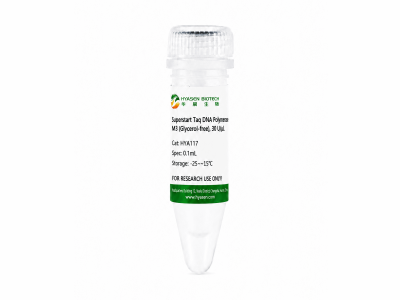
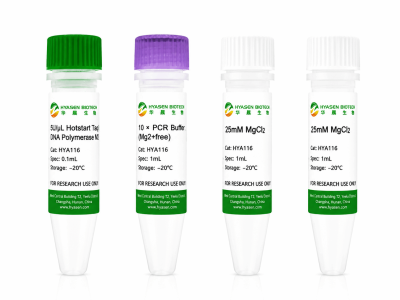
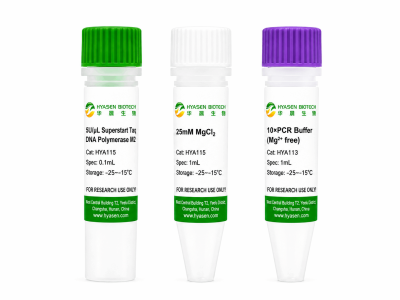
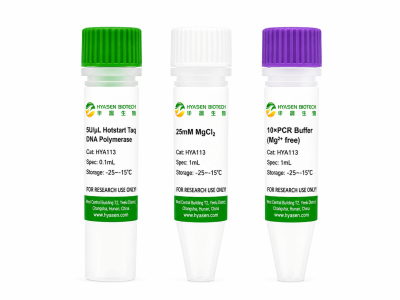
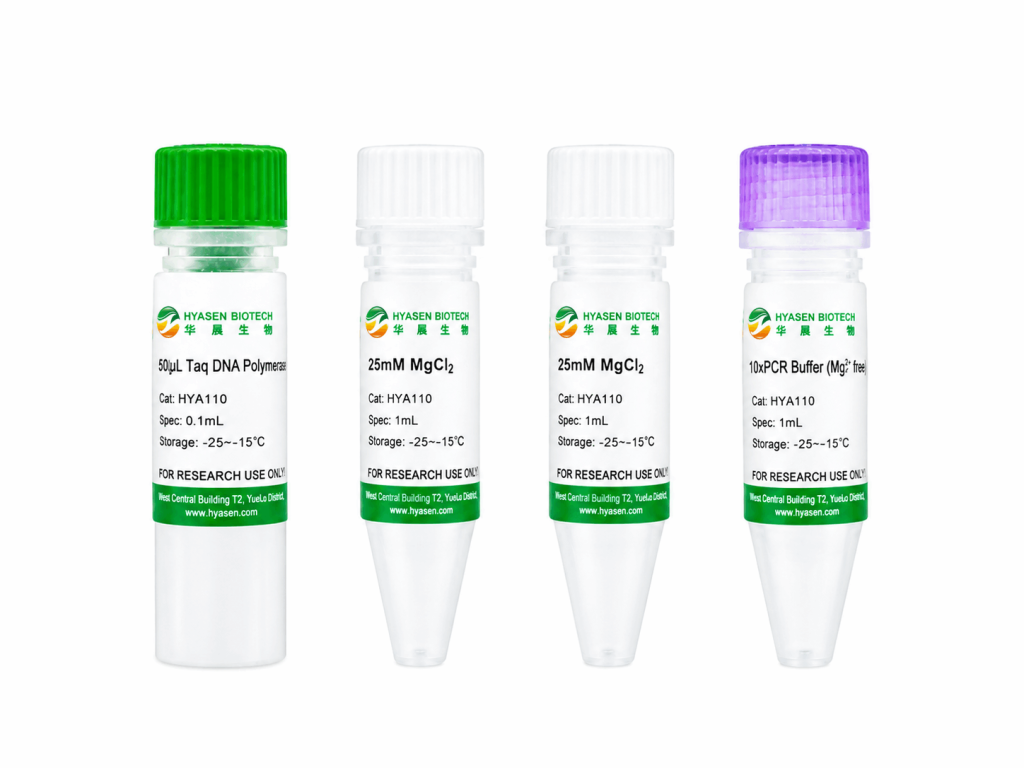
1. 5U/µL Taq DNA Polymerase
2. 10×PCR Buffer (Mg2+ free) (optional)
3. 25mM MgCl2 (optional)
* 10×PCR Buffer (Mg2+ free) does not contain dNTP and Mg2+, please add dNTPs and MgCl2 when preparing the reaction system.
Product Features
- High purity: Electrophoretic purity is ≥98% by SDS-PAGE, and each lot is controlled for amplification sensitivity, inter-batch variation, stability, and the absence of extraneous nuclease, endonuclease, and exonuclease contamination.
- 3′-A overhang for direct T-vector cloning, plus broad application coverage: PCR products carry a 3′-A end and can be cloned directly into a T vector. The enzyme is suitable for ordinary PCR and RT-PCR detection, fluorescence quantitative PCR, and DNA sequencing.
- Flexible reaction setup with a Mg²⁺-free buffer: The optional 10× PCR Buffer is supplied without dNTPs and Mg²⁺, and 25 mM MgCl₂ is available separately, so Mg²⁺ can be tuned across the 1–4 mM range. Extension times of 10–60 s at 72°C and an extension rate of 1–2 kb/min fit standard fast-cycling protocols.
FAQ
Q1: Does Taq DNA Polymerase have proofreading activity, and what are the ends of the PCR product?
No. It has 5′→3′ polymerase and 5′→3′ exonuclease activity, but no 3′→5′ exonuclease activity, so it has no proofreading function. For applications that need higher fidelity, a proofreading polymerase is usually the better choice. A practical advantage is that the 3′ end of the PCR product is an A, so products can be cloned directly into a T vector.
Q2: How do I set up a standard PCR reaction?
For a 50 μL reaction, use 5 μL of 10× PCR Buffer (Mg²⁺ free), 1 μL of dNTPs (10 mM each, 200 μM final), 2–8 μL of 25 mM MgCl₂ (1–4 mM final), 0.25–0.5 μL of 5 U/μL Taq DNA Polymerase (1.25–2.5 U), 2 μL of 25× primer mix, less than 1 μg of template, and ddH₂O to volume. Note that the buffer does not contain dNTPs or Mg²⁺, so both must be added. A typical three-step program is 95°C for 30 s, then 35–50 cycles of 95°C for 10–20 s, 56–64°C for 10–30 s, and 72°C for 10–60 s.
Q3: Can this enzyme be used for qPCR and RT-PCR?
Yes. It is suitable for fluorescence quantitative PCR and for qualitative and quantitative RT-PCR detection. Taq DNA Polymerase does not perform reverse transcription, so for RT-PCR it is used for the PCR amplification step after the RNA has been reverse-transcribed. For qPCR, a fluorescent probe must be added to the reaction: a final primer concentration of 0.2 μM usually works well (adjustable within 0.2–1 μM), and probe concentration is generally optimized within 0.1–0.3 μM. A concentration gradient is recommended to find the best primer and probe combination.