Product Overview
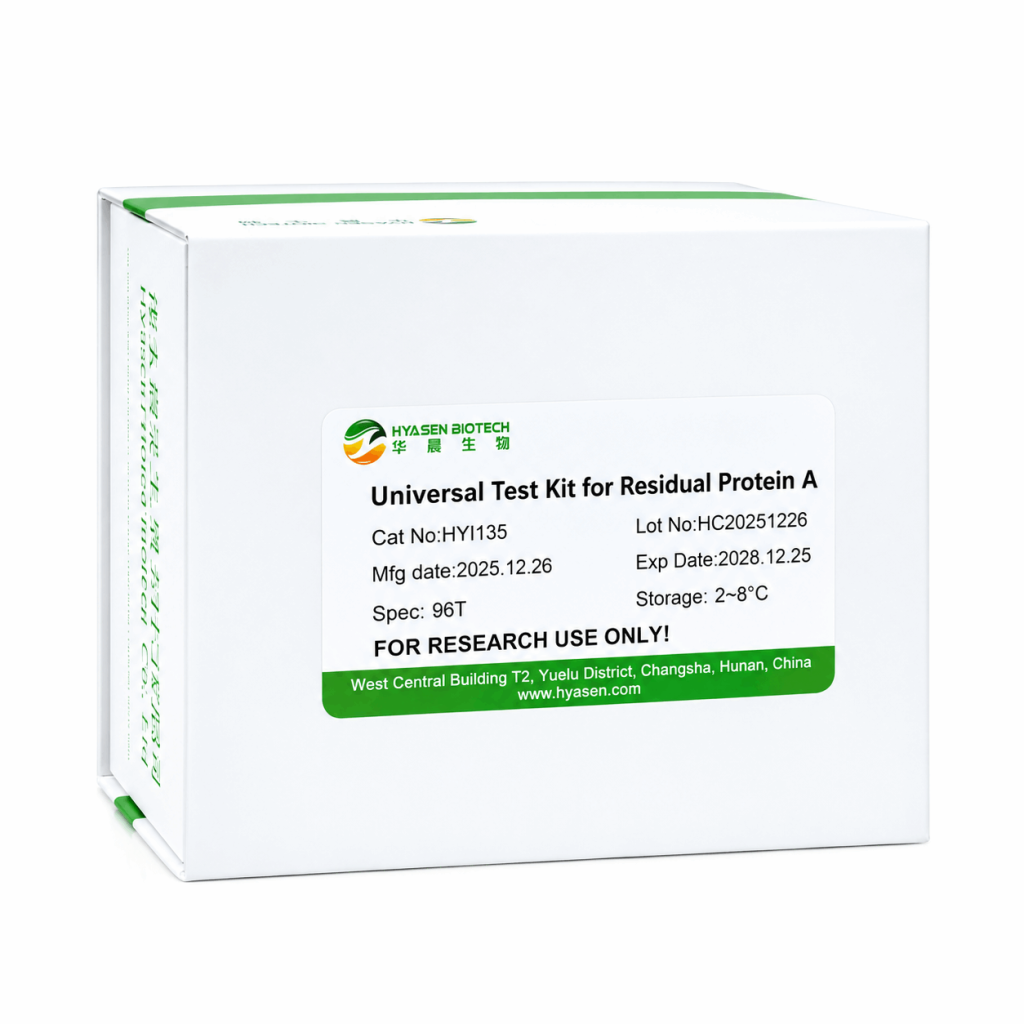
Universal Test Kit for Residual Protein A Detection is designed for quantitative analysis of residual Protein A, a common process-related impurity introduced during Protein A affinity chromatography in antibody purification. The kit uses a sandwich ELISA format. Samples are acid-diluted to help dissociate residual Protein A from the Fc region of antibodies or Fc-fusion proteins, followed by direct addition to a pre-coated microplate. The workflow does not require complex sample pretreatment such as heating, denaturation, centrifugation or pre-incubation. A key advantage of HYI135 is its broad compatibility with different Protein A ligands. The kit includes a universal Protein A standard and multiple commonly used imported and domestic Protein A ligand standards, allowing users to select an appropriate standard according to the Protein A ligand used in their purification process. The assay provides a 10–640 pg/mL linear range with an LOQ of 10 pg/mL. Method validation data demonstrate acceptable accuracy, precision, specificity and linearity for residual Protein A analysis in therapeutic antibodies and Fc-fusion proteins.
Components
| Components | Specifications | |
| Anti-Protein A Antibody Pre-Coated Plate | 8 wells × 12 strips * 1 plate | |
| Protein A Standard | Universal Protein A Standards | 128 ng/mL 120 μL/vial |
| Standard 1: MabSelect SuRe(Cytiva) | 128 ng/mL 100 μL/vial | |
| Standard 2: MabSelect PrismA(Cytiva) | ||
| Standard 3: TOYOPEARL AF-rProtein A(HC)-650F(Tosoh) | ||
| Standard 4: Eshmuno A(Merck) | ||
| Standard 5: NMab Pro(NanoMicro) | ||
| Standard 6: UniMab 50HC, NMab(NanoMicro) | ||
| Standard 7: MabPurixTM A/P(Sepax) | ||
| Standard 9 :MaXtar® ARPA(BioLink) | ||
| Wash Buffer 1 | 50 mL/bottle(10×) | |
| Biotin-labeled Detection Antibody | 150 μL/vial(100×) | |
| SA-HRP | 150 μL/vial(100×) | |
| Detection Antibody and SA-HRP Diluent | 30 mL/bottle(1×) | |
| Wash Buffer 2 | 30 mL/bottle(10×) | |
| TMB Substrate Solution | 12 mL/bottle(1×) | |
| Stop Solution | 8 mL/bottle(1×) | |
| Plate sealing film. | 1 piece | |
Product Features
- Broad compatibility across Protein A ligands: The included universal Protein A ligand standard has been validated for good recovery across multiple other ligand types, and the kit further includes four imported and four domestic Protein A ligands commonly used in the industry, offering exceptional flexibility for laboratories working with diverse Protein A resins.
- High sensitivity with a simplified workflow: With a quantitation limit as low as 10 pg/mL and a streamlined ~3-hour procedure requiring only dilution and direct plate addition — no heating, denaturation, or centrifugation — the kit combines strong analytical performance with ease of use.
- Rigorous ICH-Q2(R2) methodological validation: The kit has been comprehensively validated for accuracy, precision, linearity, quantitation limit, and specificity in accordance with the latest ICH-Q2(R2) guidance, supporting regulatory compliance for residual Protein A testing in antibody and Fc-fusion protein drug products across multiple markets.
FAQ
Q1: How does the universal Protein A ligand feature work, and does it mean I don’t need to match my specific resin’s ligand?
The kit’s universal Protein A ligand standard has been validated to demonstrate good recovery across a range of other Protein A ligand types in actual samples, providing broad applicability. However, the kit also includes four imported and four domestic Protein A ligands commonly used in the industry, allowing users to select a standard that specifically matches their manufacturing resin when higher assay specificity to that exact ligand is preferred. Additional ligands not included can also be prepared following the manual’s dilution procedure.
Q2: Should I use the 10 pg/mL quantitation limit stated for this kit directly in my own validation report?
No. The 10 pg/mL quantitation limit reflects performance obtained through methodological validation on representative samples under a specific protocol. Because assay performance can vary with individual sample characteristics, users should conduct their own methodological validation based on their specific sample matrix and specification requirements, and establish a quantitation limit appropriate to their own validation results, rather than directly citing the kit’s stated value.
Q3: What are the recommended storage and transport conditions for this kit?
The kit has demonstrated stability with no significant performance changes after storage at 37°C for one month, and currently supports room-temperature transport. For long-term storage, however, 2–8°C is recommended to preserve reagent performance over extended periods. Long-term room-temperature stability data collection is ongoing.