Magnetic bead DNA extraction is a method that uses paramagnetic particles to capture DNA from a lysed sample, separate it with a magnet, wash away impurities and release purified DNA in a small volume of buffer. Because it needs no centrifugation or vacuum steps and is easy to automate, it has become a standard approach for research laboratories, molecular diagnostics and high-throughput genomics workflows.
This guide explains how magnetic beads for DNA extraction works, walks through the workflow step by step, compares it with spin column methods, covers the factors that affect yield and purity, and shows how to troubleshoot common problems and choose suitable reagents. If you are looking for a ready-to-use option, the Magnetic Universal DNA Kit is a general-purpose kit that uses the magnetic bead method.
How Does Magnetic Bead DNA Extraction Work?
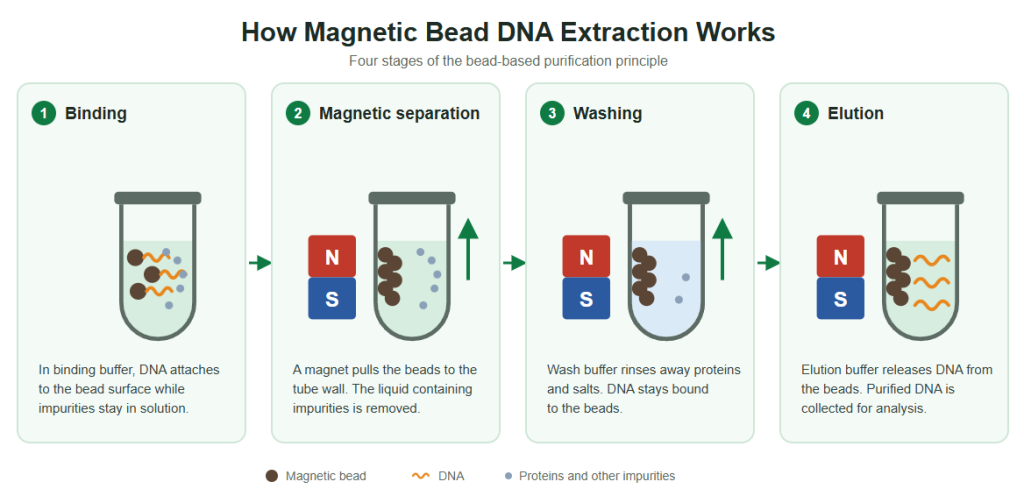
DNA binds to the beads, a magnet holds them in place, impurities are washed away, and purified DNA is eluted.
The method relies on a simple principle: under the right buffer conditions, DNA binds reversibly to the surface of magnetic beads, and a magnet holds the beads in place while everything else is removed.
- Binding. After the sample is lysed, a binding buffer is added. In many silica-based systems, chaotropic salts and alcohol promote DNA binding to the bead surface. Other systems use carboxyl-coated beads with a polyethylene glycol (PEG) and salt mixture to bind DNA.
- Magnetic separation. A magnet pulls the beads, with DNA attached, to the side or bottom of the tube or well. The remaining liquid, containing proteins, salts and other contaminants, is removed.
- Washing. The beads are washed, usually with an ethanol-based wash buffer, to remove residual impurities while DNA stays bound.
- Elution. The beads are resuspended in a low-salt elution buffer or water, which releases the DNA. The magnet then holds the beads back while the purified DNA is transferred.
The beads themselves are small superparamagnetic particles, which means they respond strongly to a magnet but do not stay magnetized once the magnet is removed. This allows them to be resuspended evenly and reused across many mixing and separation cycles within a protocol. For kit developers and laboratories that need the particles themselves, magnetic microspheres can be used as the solid phase for nucleic acid extraction and purification.
Step-by-Step Magnetic Bead DNA Extraction Workflow
A typical workflow follows these stages. Exact volumes, times and temperatures depend on the kit or protocol being used.
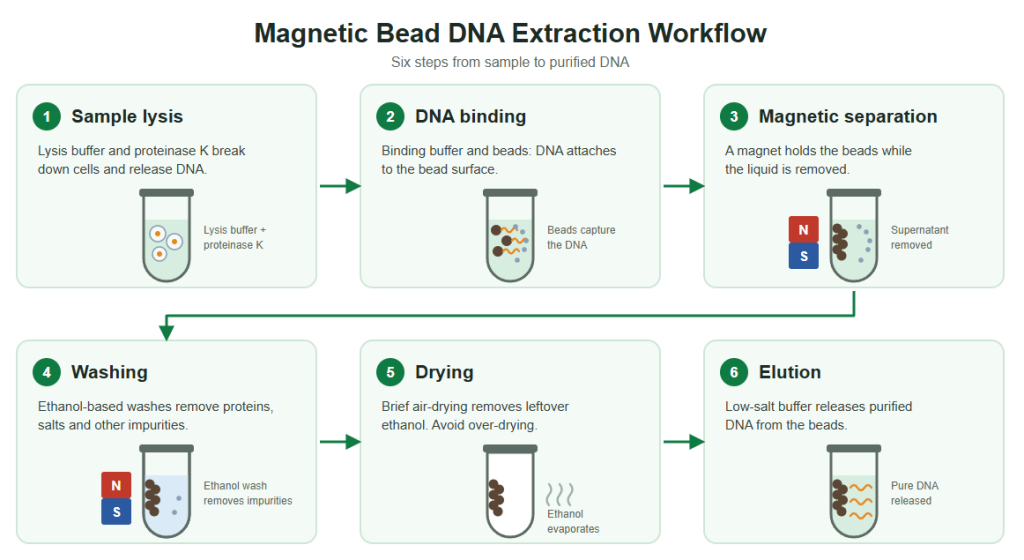
The six main steps of magnetic bead DNA extraction.
Step 1: Sample lysis
A lysis buffer disrupts cell membranes and releases DNA. Depending on the sample, lysis may include detergents, chaotropic salts, mechanical disruption or enzymatic pretreatment. For tissue samples, a dedicated option is the Magnetic Fast Tissue DNA Kit.
Step 2: Protein digestion
For many sample types, proteinase K is added during lysis to digest proteins, release DNA from protein complexes and inactivate nucleases. If you want a detailed explanation of this step, see our guide to proteinase K in DNA extraction.
Step 3: DNA binding to magnetic beads
The lysate is mixed with beads and binding buffer. Thorough mixing and sufficient binding time allow DNA to attach to the bead surface. Many general-purpose kits follow this lysis, binding, washing and elution format for common sample types.
Step 4: Magnetic separation
The tube or plate is placed on a magnetic stand, and the beads collect against the wall. The supernatant is carefully removed without disturbing the bead pellet.
Step 5: Washing
Two or more wash steps remove proteins, salts and other contaminants. Ethanol-based washes are common, and complete removal of ethanol afterwards is important, because residual ethanol can inhibit downstream reactions.
Step 6: Drying
The beads are briefly air-dried to evaporate leftover ethanol. Over-drying can make DNA harder to elute, so this step should follow the protocol closely.
Step 7: Elution
The beads are resuspended in elution buffer or nuclease-free water. After a short incubation, the beads are separated again and the purified DNA is collected for PCR, qPCR, sequencing, genotyping or other downstream analysis.
Magnetic Beads vs Spin Columns
Both methods can deliver high-quality DNA, and the better choice depends on the application.
For low sample numbers and simple bench work, spin columns remain a good option. When throughput, consistency and automation matter, magnetic beads for DNA extraction is usually the more practical choice. Magnetic bead methods are also widely used for low-concentration samples such as plasma, for which the Magnetic Circulating DNA Kit is intended.
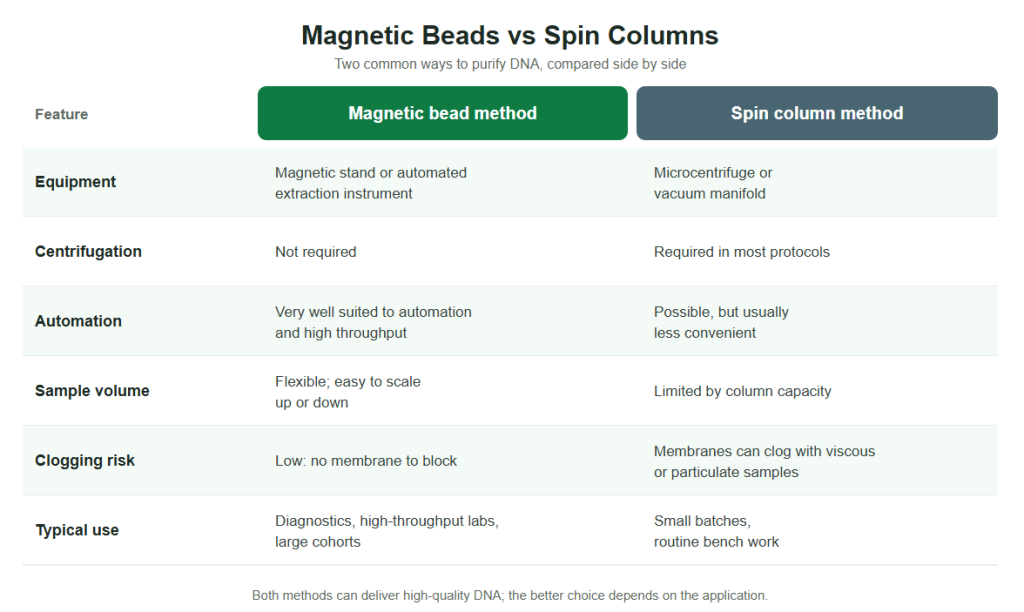
Magnetic beads suit automation and high throughput, while spin columns remain convenient for small batches.
Advantages and Limitations
Advantages
- Easy to automate on extraction platforms, which reduces operator variability.
- No centrifugation, so workflows are faster and easier to scale.
- Flexible sample volumes and compatibility with plates and tubes.
- Less risk of clogging with viscous or particulate samples.
- Elution in small volumes gives concentrated DNA.
Limitations
- Bead loss during supernatant removal can reduce yield if pipetting is careless.
- Residual ethanol or carried-over beads can interfere with downstream reactions.
- Over-drying beads can reduce elution efficiency.
- Highly viscous or protein-rich samples may need extra pretreatment.
- Performance depends on matching beads, buffers and the instrument.
Key Factors That Affect Yield and Purity
The following factors have the biggest effect on results. The ranges are typical values from common protocols, and the validated protocol for your kit or instrument should always take priority.
| Factor | What to consider |
| Lysis efficiency | Incomplete lysis lowers yield. Tissue should be cut or homogenized, and tough samples may need longer or stronger digestion. |
| Binding conditions | Salt and alcohol concentration, pH and bead-to-sample ratio all influence how much DNA binds. |
| Mixing | Beads should be fully resuspended during binding so that all DNA can contact the surface. |
| Binding time | Several minutes is typical for many protocols. Longer times can help for dilute samples. |
| Magnetic separation time | Beads should be completely collected before the supernatant is removed; the required time depends on bead size and magnet strength. |
| Washing | Enough wash steps are needed to remove contaminants, and ethanol should be removed completely afterwards. |
| Drying | Beads should be dried only until residual ethanol is gone, without cracking or over-drying. |
| Elution | Elution volume, temperature and incubation time affect recovery. Smaller volumes give higher concentrations but may lower total yield. |
Magnetic Bead DNA Extraction for Different Sample Types
| Sample type | Practical considerations |
| Blood | Contains many proteins and, in some cases, anticoagulants. Efficient lysis and protein digestion help recover genomic DNA consistently. |
| Tissue | Cut or homogenize into small pieces and allow enough digestion time. A dedicated workflow such as the Magnetic Fast Tissue DNA Kit is designed around tissue samples. |
| Plasma and serum | Cell-free DNA is present at very low concentrations and in short fragments, so the method needs good recovery of small amounts of DNA. The Magnetic Circulating DNA Kit is intended for circulating DNA applications. |
| Swabs and saliva | May contain mucus and microorganisms that interfere with amplification. Proper lysis and washing are important. |
| Cultured cells | Usually lyse easily and give good yields with short protocols. |
| Bacteria and fungi | Cell walls may need extra pretreatment, such as enzymatic or mechanical disruption, before the standard workflow. |
Magnetic Bead DNA Extraction in Automated and High-Throughput Workflows
Automation is the main reason magnetic bead DNA extraction dominates in diagnostics and large-scale testing. Instruments move the beads between wells of a plate, mix, separate and wash with minimal operator intervention. This improves reproducibility and shortens hands-on time, which is critical for clinical laboratories, screening programs and large cohort studies.
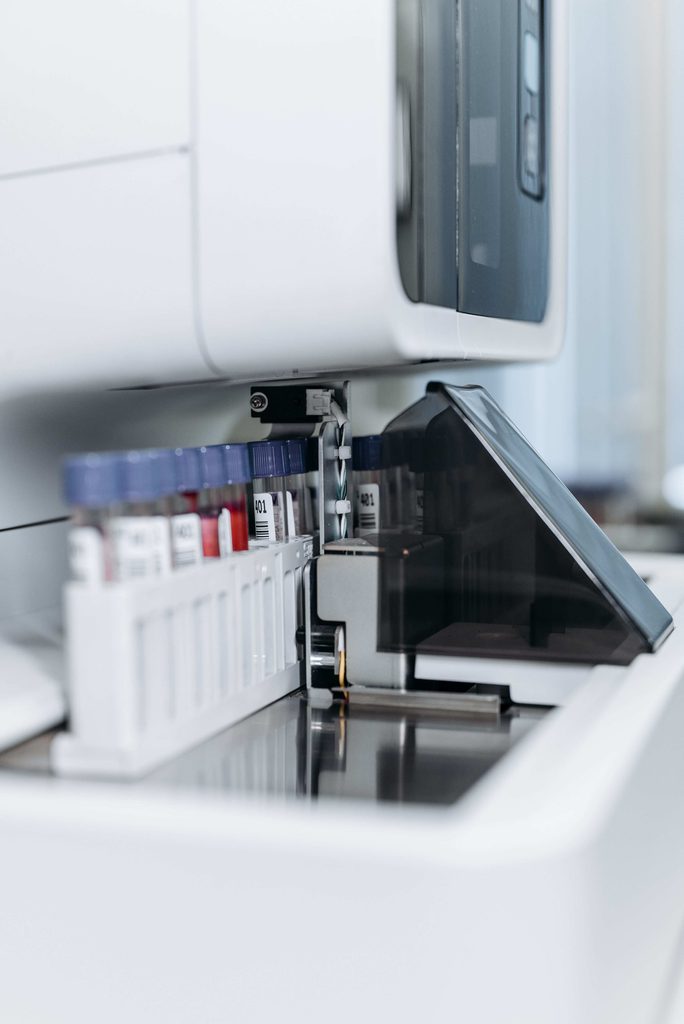
For automated workflows, the following points matter:
- Compatibility of the beads and buffers with the instrument and plate format.
- Speed, including bead collection time and the lysis step.
- Reproducibility across wells, runs and operators.
- Contamination control, because many samples are processed in parallel.
- Reagent stability, so that kits perform consistently throughout their shelf life.
Troubleshooting Magnetic Bead DNA Extraction
| Problem | Possible cause | What to try |
| Low DNA yield | Incomplete lysis; insufficient binding time; bead loss during supernatant removal | Improve lysis and digestion, mix beads well, extend binding, remove liquid carefully |
| Low A260/A280 ratio | Protein carryover | Make sure protein digestion is complete and wash steps are performed properly |
| Low A260/230 ratio | Residual salts or ethanol | Add or extend wash steps and ensure ethanol is fully removed |
| PCR or qPCR inhibition | Residual ethanol, salts or carried-over beads | Dry briefly, use sufficient washes, and separate beads fully before collecting DNA |
| Beads clump or are hard to resuspend | Over-drying; insufficient mixing | Shorten the drying step and resuspend thoroughly |
| Beads in the final eluate | Incomplete magnetic separation | Allow longer separation time and take eluate carefully |
| Degraded DNA | Nuclease activity; delayed lysis; harsh handling | Process or lyse samples promptly and avoid unnecessary shearing |
| Variable results between runs | Inconsistent reagents or pipetting | Check bead and reagent lot consistency and automate liquid handling where possible |
How to Choose Magnetic Beads and Kits for DNA Extraction
For laboratories choosing a kit, the best option is the one validated for the sample type and throughput you need. For diagnostic reagent developers and kit manufacturers, the selection of the beads themselves is a critical design choice. Key criteria include:
- Binding capacity and recovery. The beads should capture DNA efficiently across the range of input amounts in your application.
- Particle size and uniformity. Consistent size gives predictable magnetic response and binding behavior.
- Magnetic response. Beads should separate quickly and completely, but redisperse easily after the magnet is removed.
- Dispersion and stability. Beads should resist aggregation and remain stable during storage.
- Surface chemistry. The surface must match the binding chemistry of your buffer system, for example silica-based or carboxyl-based.
- Purity and contamination control. Residual nucleases or impurities can affect sample integrity and downstream assays.
- Lot-to-lot consistency. A protocol validated with one lot should perform in the same way with later lots.
- Scale-up and supply. Suppliers should be able to support the move from development to bulk manufacturing, with reliable supply and quality documentation.
Hyasen Magnetic Bead Products for DNA Extraction
Hyasen offers magnetic bead products for different needs, from raw materials for kit developers to ready-to-use extraction kits:
- Magnetic Microspheres: magnetic beads that can be used as the solid phase for nucleic acid extraction and purification.
- Magnetic Universal DNA Kit: a general-purpose kit for DNA extraction using the magnetic bead method.
- Magnetic Fast Tissue DNA Kit: a kit designed for DNA extraction from tissue samples.
- Magnetic Circulating DNA Kit: a kit for the extraction of circulating DNA.
Please refer to each product page for specifications, applicable sample types and instrument compatibility.
Frequently Asked Questions
What is magnetic bead DNA extraction?
Magnetic bead DNA extraction is a method in which DNA binds to magnetic particles, the particles are held with a magnet while impurities are washed away, and purified DNA is then eluted. It does not require centrifugation, which makes it easy to automate.
How does magnetic beads for DNA extraction differ from spin column extraction?
Spin columns capture DNA on a membrane and rely on centrifugation or vacuum to move liquids through it. Magnetic beads capture DNA in solution and use a magnet to separate it, which is better for automation and flexible sample volumes.
Is magnetic bead DNA extraction better than column-based methods?
It depends on the application. Magnetic beads are usually preferred for high-throughput and automated work, while spin columns remain convenient for small batches at the bench.
Do you need proteinase K for magnetic beads for DNA extraction?
Not always, but it is commonly used in the lysis step for protein-rich samples such as blood and tissue, because it digests proteins and reduces nuclease activity.
What can cause low DNA yield with magnetic beads?
Common causes include incomplete lysis, insufficient binding time or mixing, bead loss during supernatant removal, and over-drying of the beads before elution.
Why is there ethanol or bead carryover in my eluate?
Residual ethanol comes from incomplete removal of the wash buffer, and bead carryover comes from incomplete magnetic separation before collecting the eluate. Allow enough drying and separation time.
Can magnetic bead extraction be used for circulating DNA?
Yes. Magnetic bead methods are widely used for cell-free and circulating DNA, provided the protocol is designed to recover low concentrations of short fragments efficiently.
Can the same beads be used for DNA and RNA?
Many bead chemistries can bind both DNA and RNA, but the buffers and steps differ, so the protocol should be designed or validated for the target nucleic acid.
What should manufacturers consider when sourcing magnetic beads?
Binding capacity, particle uniformity, magnetic response, dispersion, surface chemistry, purity, lot-to-lot consistency and supply capacity are the key factors.
Conclusion
Magnetic bead DNA extraction offers a fast, scalable and automation-friendly way to obtain high-quality DNA from a wide range of samples. Good results depend on efficient lysis, correct binding and washing conditions, careful magnetic separation and the right choice of beads and reagents for each application.
Looking for magnetic beads or DNA extraction kits for your laboratory or product development? Contact Hyasen to discuss samples, technical specifications, bulk supply and customized solutions.