Product Overview
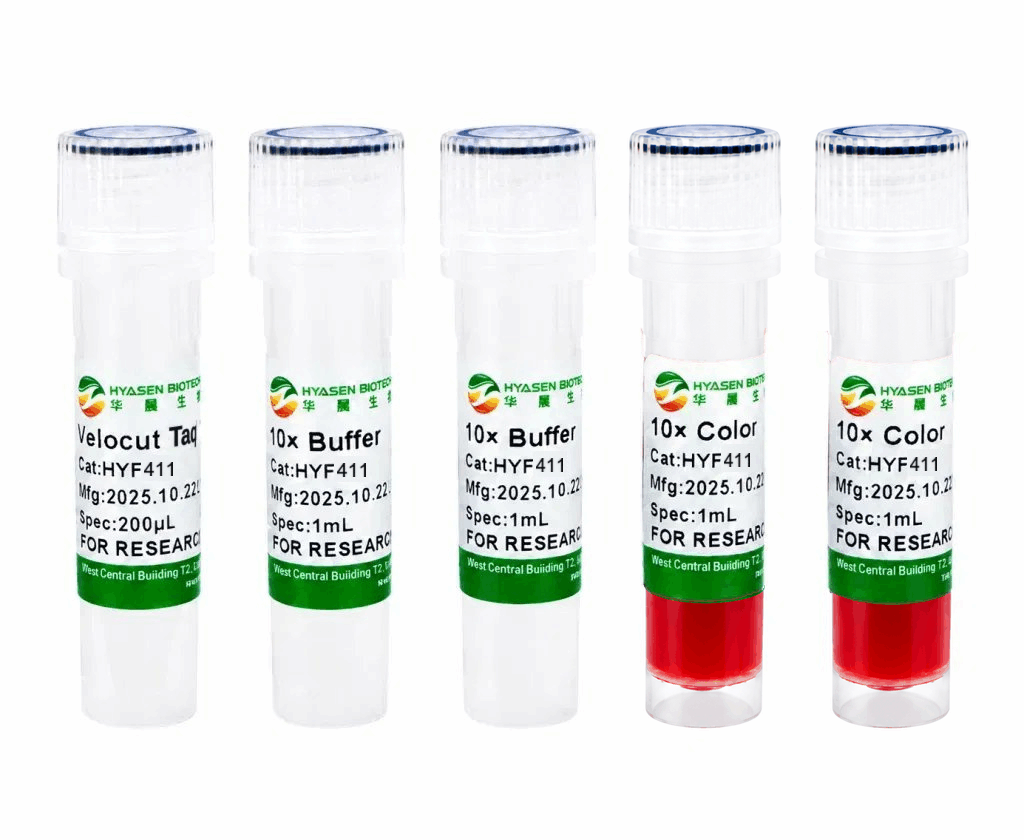
Velocut TaqI (HYF411) is a recombinant restriction endonuclease designed for rapid DNA digestion in molecular biology workflows. It is suitable for plasmid DNA, PCR products, and genomic DNA containing the specific recognition site. Under the recommended conditions, digestion can be completed in 5–15 minutes at 65°C using a 1× reaction buffer.
The supplied color reaction buffer contains red and yellow tracking dyes, allowing digestion products to be loaded directly onto an agarose gel without adding a separate loading dye. In a 1% agarose gel, the red dye migrates similarly to a 2,500 bp double-stranded DNA fragment, while the yellow dye migrates similarly to a 10 bp fragment.
Velocut TaqI cannot be heat-inactivated. When enzyme removal is required for downstream applications, phenol-chloroform extraction or column purification is recommended. Cleavage of Dam-methylated DNA may be inhibited, so DNA methylation status should be considered when planning the digestion workflow.
Product Features
- Rapid Digestion at 65°C: Supports DNA digestion in 5–15 minutes under the recommended reaction conditions.
- Convenient Direct Gel Loading: The supplied color reaction buffer contains tracking dyes for direct loading of digestion products onto agarose gels.
- Defined Methylation Sensitivity: Cleavage of Dam-methylated DNA may be inhibited. As the enzyme cannot be heat-inactivated, phenol-chloroform extraction or column purification can be used when enzyme removal is required.
FAQ
Q1: What are the recommended reaction conditions for Velocut TaqI?
Use the recommended 1× reaction buffer and incubate at 65°C. Digestion typically takes 5–15 minutes, depending on the DNA substrate and reaction setup.
Q2: Can Velocut TaqI be heat-inactivated after digestion?
No. Velocut TaqI cannot be heat-inactivated. If enzyme removal is required, use phenol-chloroform extraction or column purification.
Q3: Does Dam methylation affect Velocut TaqI digestion?
Yes. Cleavage of Dam-methylated DNA may be inhibited. Consider the methylation status of the DNA substrate when planning the digestion workflow.