Product Overview
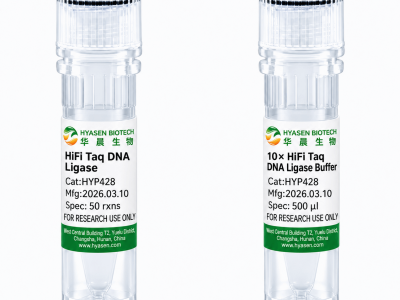
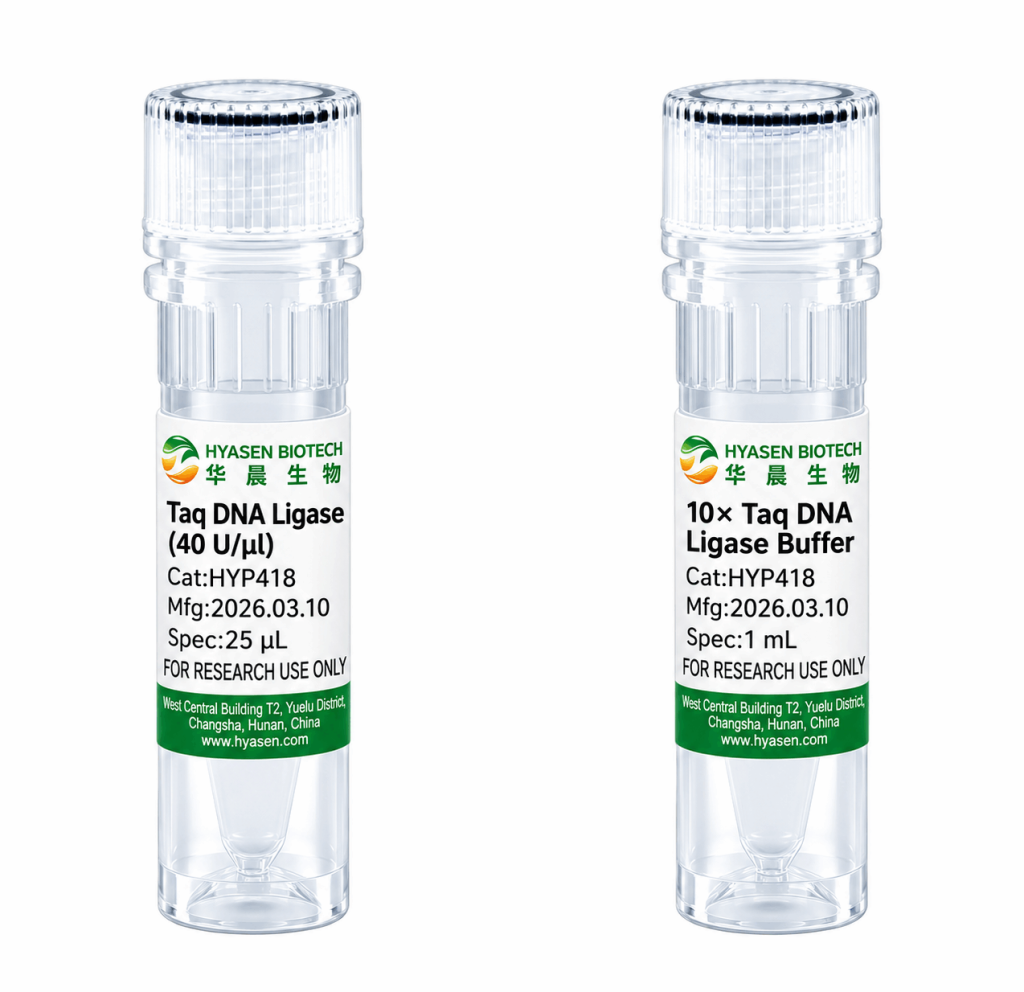
Taq DNA Ligase is a thermostable DNA ligase widely used in molecular biology applications that require precise recognition of DNA sequences. Unlike conventional DNA ligases used primarily for fragment cloning, Taq DNA Ligase is particularly useful for distinguishing single-base differences at a ligation junction.
Hyasen HYP418 Taq DNA Ligase catalyzes the formation of a phosphodiester bond between the 5′-phosphate and 3′-hydroxyl groups of two adjacent DNA oligonucleotides hybridized to a complementary DNA template. Efficient ligation requires the oligonucleotides to align correctly without gaps, with mismatches at the ligation junction strongly reducing ligation efficiency.
The enzyme uses NAD⁺ as a cofactor and is active across a temperature range of 45–65°C. Its thermostability supports ligation reactions at elevated temperatures, where more stringent hybridization conditions can help improve sequence discrimination.
With an enzyme concentration of 40 U/µL, HYP418 Taq DNA Ligase is suitable for applications such as single nucleotide polymorphism (SNP) detection, ligase detection reactions (LDR), and sequence-specific oligonucleotide ligation assays.
Product Features
- Thermostable Ligation Activity: Active at 45–65°C, allowing DNA ligation under elevated-temperature conditions that support stringent oligonucleotide hybridization and sequence-specific analysis.
- High Sensitivity to Single-Base Mismatches: Efficient ligation depends on correct base pairing at the ligation junction, making the enzyme useful for distinguishing single nucleotide differences in SNP detection and genotyping assays.
- Precise, NAD⁺-Dependent DNA Ligation: Catalyzes phosphodiester bond formation between adjacent, correctly aligned DNA oligonucleotides on a complementary DNA template. Suitable for ligase detection reactions and other sequence-specific DNA analysis workflows.
FAQ
Q1: Can Taq DNA Ligase be used for single nucleotide polymorphism (SNP) detection?
Yes. HYP418 Taq DNA Ligase is suitable for SNP detection because its ligation activity is highly sensitive to mismatches at the ligation junction. When two adjacent oligonucleotides hybridize correctly to a complementary DNA template, the enzyme can join them through a phosphodiester bond. A mismatch near the ligation junction can significantly reduce ligation efficiency, allowing single-base differences to be distinguished under optimized assay conditions.
Q2: What is the difference between Taq DNA Ligase and T4 DNA Ligase?
Taq DNA Ligase and T4 DNA Ligase differ in their cofactor requirements, temperature characteristics, and typical applications. HYP418 Taq DNA Ligase is thermostable, requires NAD⁺, and is particularly useful for sequence-specific ligation and SNP detection. T4 DNA Ligase requires ATP and is commonly used for joining sticky-end or blunt-end DNA fragments in molecular cloning.
Q3: What reaction conditions are recommended for Taq DNA Ligase?
HYP418 Taq DNA Ligase is active at 45–65°C and requires NAD⁺ for catalytic activity. The DNA oligonucleotides should have the appropriate 5′-phosphate and 3′-hydroxyl groups and hybridize adjacently to a complementary DNA template without gaps. The optimal reaction temperature and incubation time depend on the oligonucleotide sequences and assay design. The enzyme should be stored at −20°C and has a stated shelf life of 2 years under the recommended storage conditions.