Product Overview
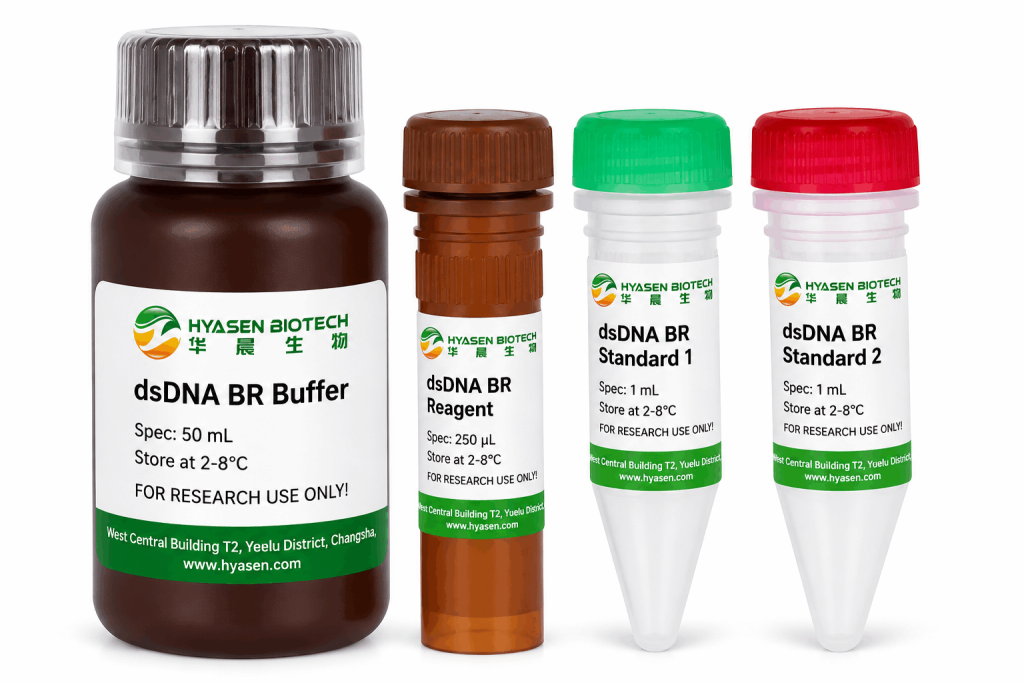
dsDNA BR Assay Kit is a simple, sensitive, accurate, and broad-range fluorescent assay kit for double-stranded DNA (dsDNA) quantification, offering excellent linearity across a quantification range of 2–1,000 ng. The kit includes fluorescent assay reagent, buffer, and dsDNA BR standards. Before use, dilute the fluorescent assay reagent with the buffer to prepare the working solution, then add the dsDNA samples. After generating a standard curve, measure fluorescence using a fluorescence microplate reader or Qubit fluorometer. The kit also offers good tolerance to common contaminants, such as proteins and salts, ensuring reliable quantification results.
Components
| Components | Concentration | 100 rxn | 500 rxn |
| dsDNA BR Reagent | 200×concentrate in DMSO | 250 μL | 1.25 mL |
| dsDNA BR Buffer | Not applicable | 50 mL | 250 mL |
| dsDNA BR Standard 1 | 0 ng/μL in TE buffer | 1 mL | 5×1 mL |
| dsDNA BR Standard 2 | 100 ng/μL in TE buffer | 1 mL | 5×1 mL |
Product Features
- Excellent Linearity: Provides excellent linearity across 0–1,000 ng, enabling accurate quantification of dsDNA over a range of 2–1,000 ng.
- High Specificity and Contaminant Tolerance: Offers good tolerance to common contaminants, including proteins and salts, ensuring reliable quantification.
- Strict Quality Control: Each production batch undergoes rigorous performance and stability testing to ensure consistent quality and reliable results.
Storage Conditions
Store at 2-8°C. Shelf life: 1 year.
FAQ
Q1: What is this kit used for?
The kit measures double-stranded DNA concentration using fluorescence. Its broad measurement range supports routine quantification of DNA samples containing 2–1,000 ng per assay.v
Q2: How does the BR assay differ from the HS assay?
The BR assay measures 2–1,000 ng per reaction, while dsDNA HS assay measures 0.2–100 ng. Choose BR for higher DNA amounts and HS for lower DNA amounts.
Q3: Does the reagent require dilution before use?
Yes. Mix one part of the 200× reagent with 199 parts of the supplied buffer. Prepare the working solution fresh and use within 3 hours.
Q4: How can I improve measurement consistency?
Bring reagents to room temperature, pipette accurately, and avoid bubbles. Use suitable assay tubes and label their lids rather than their sidewalls.