Product Overview
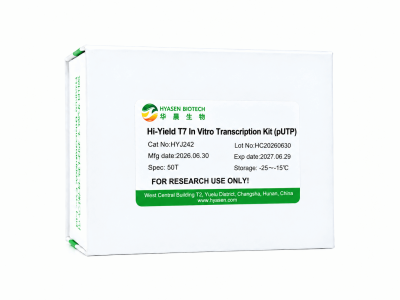
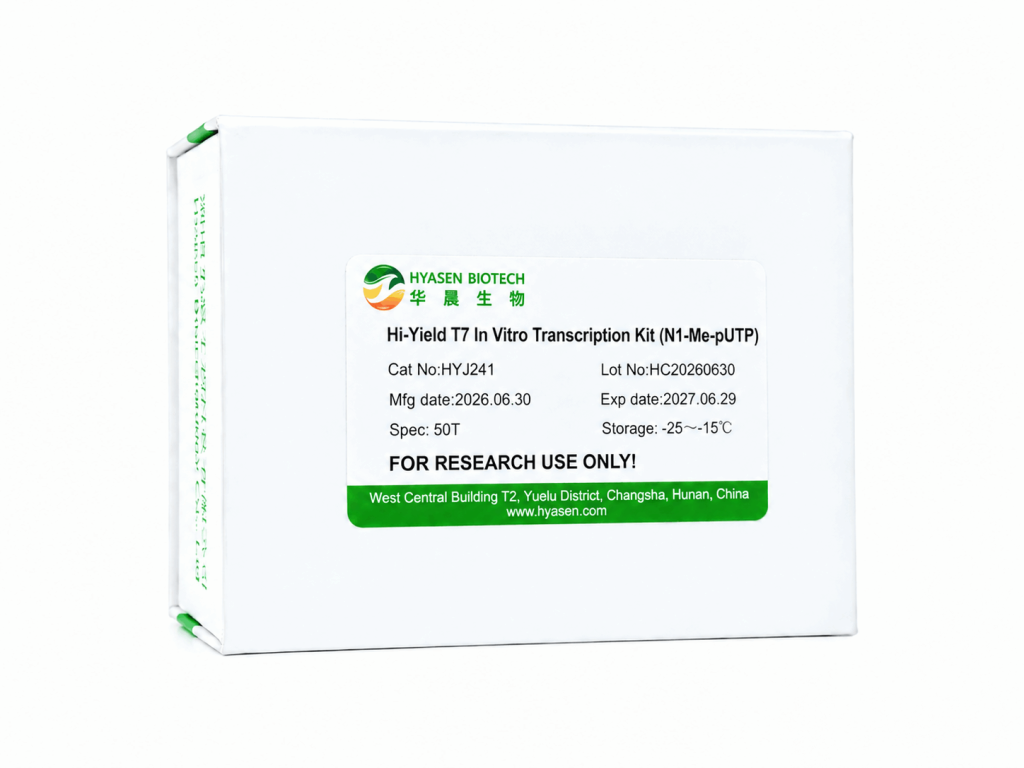
N1-methylpseudouridine (N1-Me-pUTP) is a modified nucleotide used in mRNA synthesis to help reduce unwanted innate immune recognition associated with unmodified RNA. Hyasen Hi-Yield T7 In Vitro Transcription Reagent (N1-Me-pUTP) provides an optimized reaction system for producing RNA from linear DNA templates containing a T7 promoter. The included N1-Me-pUTP can replace UTP during transcription to generate modified RNA. The kit includes T7 enzyme mix, NTPs, N1-Me-pUTP, reaction buffers, DNase I, and RNA purification reagents. It supports high-yield RNA synthesis and downstream mRNA capping and polyadenylation workflows.
Components
| Components | Concentration | 50T |
| ATP | 100 mM | 100 μL |
| CTP | 100 mM | 100 μL |
| GTP | 100 mM | 100 μL |
| UTP | 100 mM | 100 μL |
| N1-Me-pUTP | 100 mM | 100 μL |
| 10 × Hi-Yield IVT Buffer A | / | 100 μL |
| 10 × Hi-Yield IVT Buffer B | / | 100 μL |
| Enzyme Mix | / | 100 μL |
| Control template 1 | 0.5 μg/μL | 10 μL |
| LiCl | 5 M | 1.4 mL |
| DNase I | 5 U/μL | 100 μL |
Product Features
- High RNA Yield: Stated yield of 150–200 μg RNA per 20 μL reaction under suitable conditions.
- N1-Me-pUTP Included: Supports synthesis of N1-methylpseudouridine-modified RNA.
- Optimized IVT System: Supplied with enzyme mix, NTPs, and two reaction buffers.
- Convenient Workflow: Includes DNase I and LiCl for DNA template removal and RNA purification.
FAQ
Q1: Why is N1-Me-pUTP used in mRNA synthesis?
N1-Me-pUTP enables the incorporation of N1-methylpseudouridine into RNA, a modification commonly used to help reduce unwanted innate immune recognition.
Q2: What are the recommended reaction conditions?
The standard protocol recommends incubation at 37°C for 2 hours, using a T7 promoter-containing DNA template and the supplied IVT reagents.
Q3: Does the kit include reagents for capped mRNA synthesis?
The kit supports co-transcriptional capping with compatible cap analogs, which are purchased separately. Post-transcriptional enzymatic capping can also be performed using suitable enzymes.