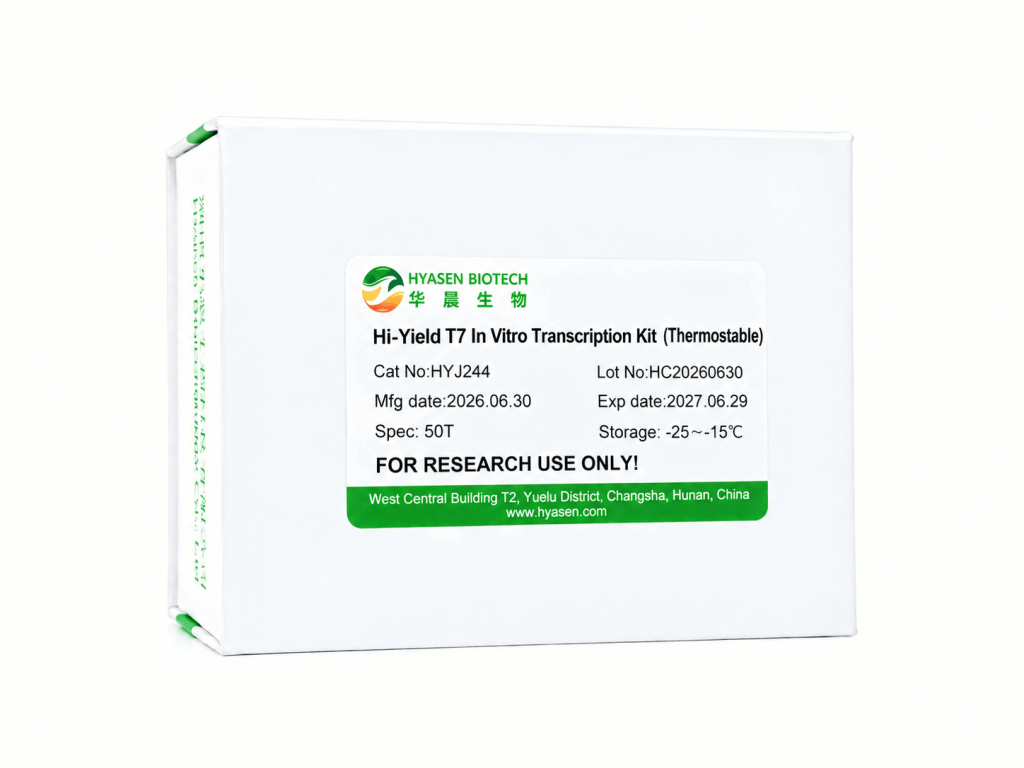
Product Overview
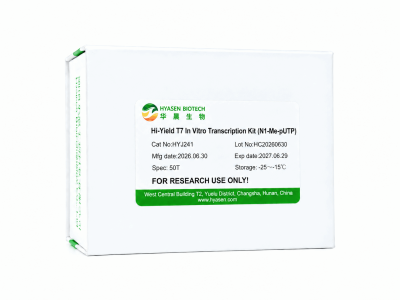
High-temperature in vitro transcription provides an alternative approach to RNA synthesis and can help reduce the formation of double-stranded RNA (dsRNA) byproducts. Hyasen Hi-Yield T7 In Vitro Transcription Reagent (Thermostable) uses a thermostable T7 RNA polymerase system capable of transcription at elevated temperatures up to 50°C. The kit includes N1-Me-pUTP for modified RNA synthesis, along with NTPs, reaction buffer, DNase I, and LiCl. It supports high-yield RNA preparation and downstream mRNA processing applications requiring elevated-temperature transcription conditions.
Components
| Components | Concentration | 50T |
| ATP | 100 mM | 100 μL |
| CTP | 100 mM | 100 μL |
| GTP | 100 mM | 100 μL |
| UTP | 100 mM | 100 μL |
| N1-Me-pUTP | 100 mM | 100 μL |
| 10×Hi-Yield IVT Buffer A | / | 100 μL |
| Enzyme Mix (Thermostable ) | / | 100 μL |
| Control template 1 | 0.5 μg/μL | 10 μL |
| LiCl | 5 M | 1.4 mL |
| DNase I | 5 U/μL | 100 μL |
Product Features
- High-Temperature IVT: Thermostable T7 enzyme mix supports transcription at 50°C.
- Reduced dsRNA Formation: Elevated-temperature transcription can help limit dsRNA byproducts.
- High RNA Yield: Stated yield of 150–200 μg RNA per reaction under suitable conditions.
FAQ
Q1: Why does running the transcription reaction at 50°C help reduce dsRNA byproducts?
dsRNA byproducts primarily form through self-templated, RNA-dependent RNA extension activity of T7 RNA Polymerase during transcription. Elevated reaction temperatures destabilize the secondary structures and mis-primed intermediates that enable this side reaction, thereby suppressing dsRNA formation, while the thermostable polymerase in this kit ensures high transcription efficiency is maintained at 50°C.
Q2: Does this kit include N1-Me-pUTP?
Yes. The kit contains N1-Me-pUTP, which can replace UTP for modified RNA synthesis.
Q3: Can RNA produced with this kit be capped and polyadenylated to generate mRNA for transfection experiments?
Yes. RNA synthesized using this kit can be further processed with the Vaccinia Virus Capping Enzyme and mRNA Cap 2´-O-Methyltransferase to generate a Cap 1 structure, and with Poly(A) Polymerase to add a poly(A) tail — together producing a fully processed mRNA with reduced dsRNA content, suitable for downstream applications such as in vitro translation and transfection.