Product Overview
1× dsDNA HS Assay Kit is a fast, sensitive, and accurate fluorescent assay kit for double-stranded DNA (dsDNA) quantification. It offers high selectivity for dsDNA, with excellent linearity across a quantification range of 0.2–100 ng. The kit features a simple and convenient workflow. Simply mix the working solution with the dsDNA sample and measure fluorescence using a Qubit fluorometer or fluorescence microplate reader. With its ease of use and reliable performance, the kit is ideal for high-throughput DNA quantification in NGS workflows, including input DNA and DNA library quantification.
Components
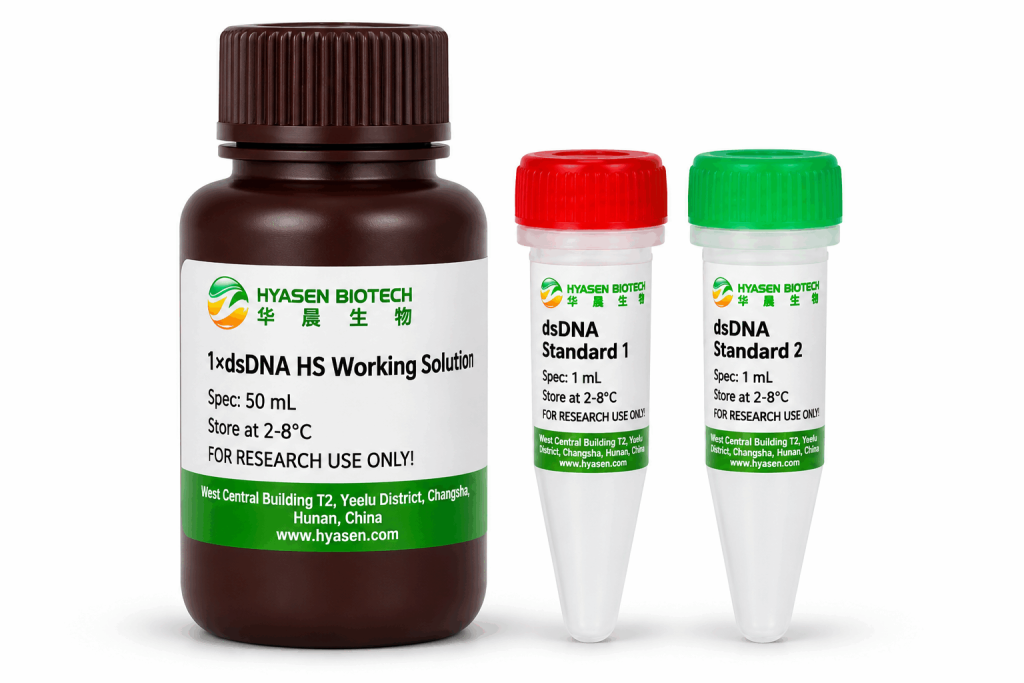
| Components | Concentration | 100 rxn | 500 rxn |
| 1×dsDNA HS Working Solution | 1×concentrate in DMSO | 50 mL | 250 mL |
| dsDNA Standard 1 | 0 ng/μL in TE buffer | 1 mL | 5×1 mL |
| dsDNA Standard 2 | 10 ng/μL in TE buffer | 1 mL | 5×1 mL |
Product Features
- Ready-to-Use 1× Format: Eliminates working-solution dilution before assay setup.
- DNAInput and Library QC: Provides dsDNA concentration measurements for routine sample and library assessment.
- Fluorescence Readout with Standards: Supports measurement using Qubit fluorometers or compatible plate readers.
Storage Conditions
Store at 2-8°C. Shelf life: 1 year.
FAQ
Q1: What is this kit used for?
The kit measures double-stranded DNA concentration using fluorescence. Applications include quantifying input DNA and DNA libraries for next-generation sequencing workflows.
Q2: What is the DNA quantification range?
The assay measures 0.2–100 ng of dsDNA per reaction. Depending on the sample volume, this corresponds to original sample concentrations of 10 pg/µL–100 ng/µL.
Q3: How much sample is required?
Use 1–20 µL of DNA sample and adjust the working solution volume to obtain a final assay volume of 200 µL. Keep the total DNA amount within the assay range.
Q4: How can I improve measurement consistency?
Bring reagents to room temperature, pipette accurately, mix gently, and avoid bubbles. Use suitable assay tubes and label their lids rather than their sidewalls to prevent interference with fluorescence detection.