Product Overview
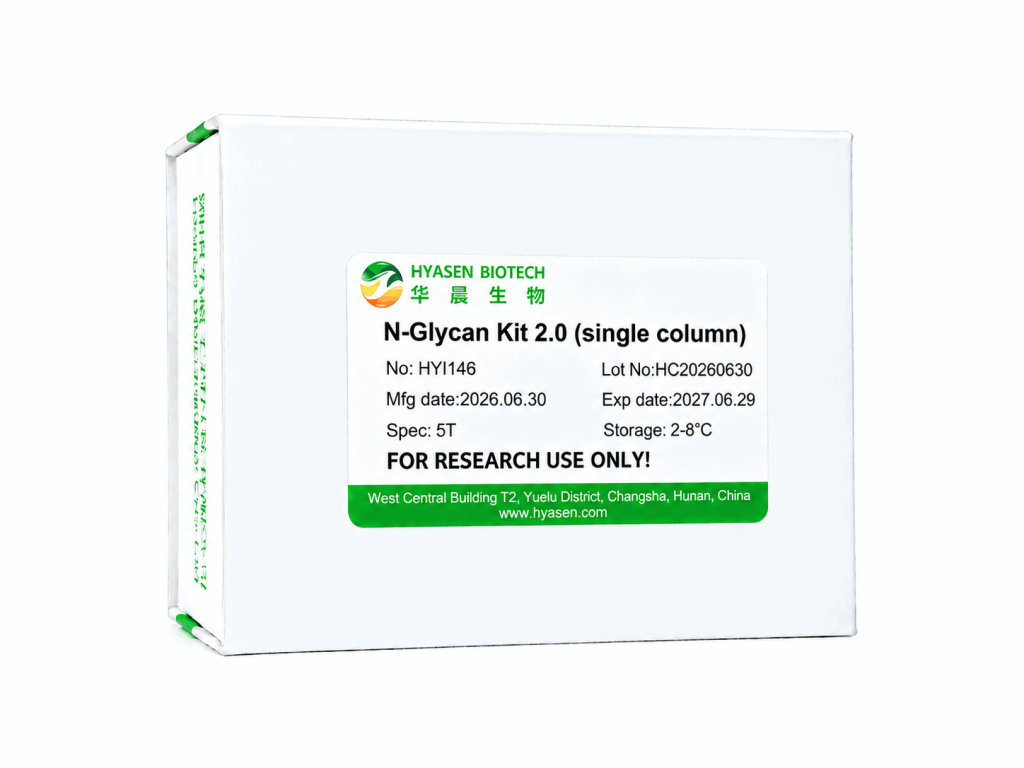
The HYASEN N-Glycan Kit 2.0 (Single Column) is designed for the rapid enzymatic release and labeling of N-linked glycans from glycoprotein samples prior to chromatographic analysis. The workflow combines PNGase F-mediated deglycosylation, rapid labeling of released glycosylamines, and solid-phase extraction (SPE) cleanup to prepare samples for downstream N-glycan profiling. The protocol has been validated using monoclonal antibodies and has also been tested with a wide range of other N-linked glycoproteins. Enzymatic release efficiency should be confirmed for each specific sample type.
Components
| Module | Reagent | 24 T |
| Deglycosylation Module | IgG | 1.2 mg |
| PNGase F | 45 µL | |
| PNGase F buffer | 0.5 mL | |
| Labeling Module | MS reagent powder | 8.2 mg×3 |
| Anhydrous DMF | 1 mL | |
| Clean-up Module | SPE column | 8 pcs/pk×3 |
| Elution Buffer | 5 mL | |
| Sample Diluent | 6 mL | |
| Collection Module | 8-tube Strips (200μL) | 100 pieces |
| 8-cap Strips | 100 pieces | |
| Waste tray | 1 pieces |
Product Features
- Simplified, fast deglycosylation: The supplied PNGase F buffer is used directly, so there is no separate surfactant reagent to prepare. Denaturation (3 min at 90°C) and enzymatic release (5 min at 50°C) are completed within minutes.
- Rapid room-temperature labeling and single-column clean-up: Glycans are labeled in 5 minutes at room temperature, and a single SPE column removes excess reagent and by-products without multiple column exchanges.
- Validated HILIC-FLR(-MS) profiling of IgG glycans: The chromatographic method is provided with the kit and resolves a complete IgG N-glycan profile, including neutral, fucosylated, bisected, and sialylated glycans, with fluorescence quantitation and MS confirmation.
FAQ
Q1: How does the N-Glycan Kit 2.0 differ from the original N-Glycan Kit (single column)?
Both kits follow the same overall workflow: PNGase F release, rapid labeling, SPE clean-up, and HILIC-FLR(-MS) analysis. In the 2.0 kit, the supplied PNGase F buffer is used directly in the deglycosylation step, so there is no separate surfactant reagent to dissolve and prepare before use. The 2.0 kit also comes with guidance for preparing samples that contain interfering buffer components.
Q2: What if my sample is in a buffer that contains citrate, acetate, phosphate, Tris, or SDS?
If the sample contains citrate, acetate, phosphate, Tris, or SDS, or if its pH is lower than 4 or higher than 9, and slight precipitation occurs during use that affects the results, solution replacement is recommended. The kit documentation describes a buffer-exchange procedure using a 10 kD ultrafiltration tube, in which the sample is washed with ultrapure water by centrifugation and then transferred. Protein concentration can be measured afterward and adjusted to a suitable level for N-glycan analysis. Centrifugation times and speeds may need adjusting for your equipment, consumables, and sample.
Q3: What do I need besides the kit, and how long does the workflow take?
You need 0.85% NaCl, LC-MS grade acetonitrile, ultrapure water, formic acid, and 50 mM ammonium formate (pH 4.4), as well as a heating module or metal bath that holds 90°C and 50°C, a vortex mixer, an SPE manifold, and an LC system with a Glycan BEH Amide column and fluorescence detection. The incubation steps (denaturation, enzymatic release, and labeling, including cooling) add up to roughly 20 minutes, followed by SPE clean-up and a 55-minute chromatographic run. The published method parameters were set up on an ACQUITY RDa LC-MS system and can be adjusted for other equipment.