Product Overview
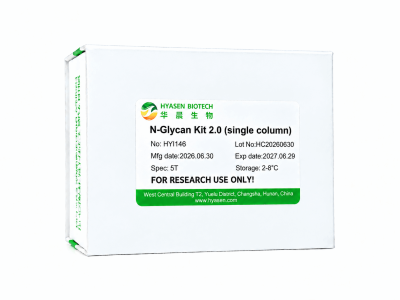
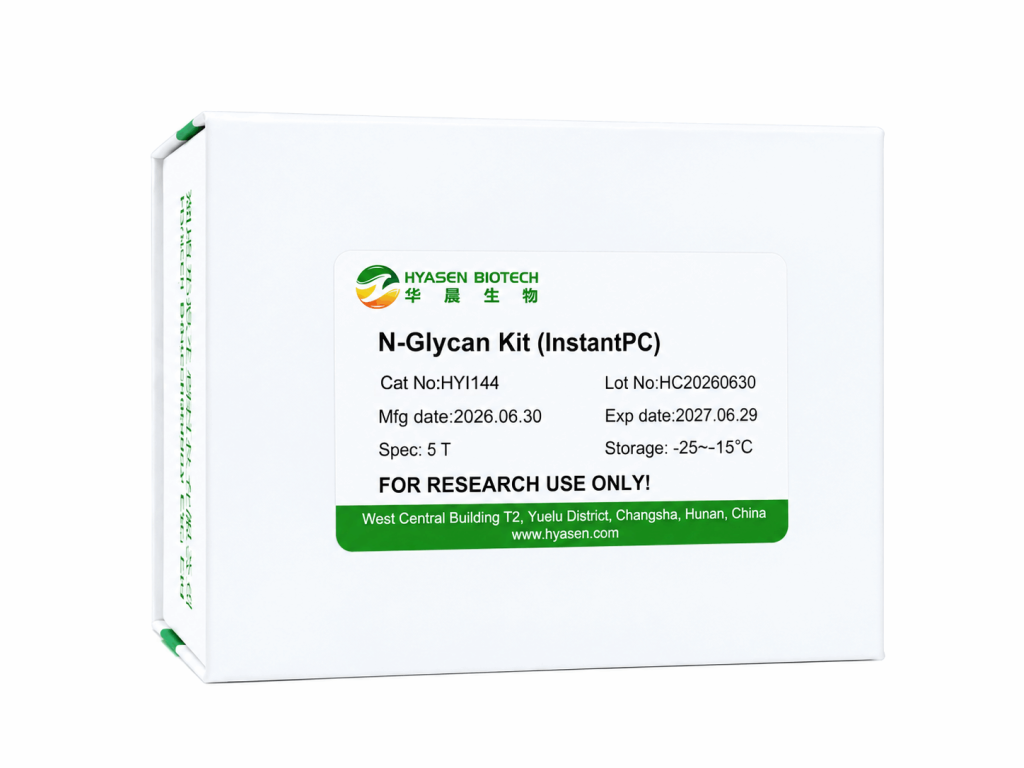
The N-Glycan Kit (InstantPC) provides a complete, streamlined workflow for the fast enzymatic release and rapid labeling of N-glycans, validated using monoclonal antibodies and tested for compatibility with a wide range of other N-linked glycoproteins. The kit is organized into four functional modules — deglycosylation, labeling, clean-up, and sample collection — supporting the full workflow from intact glycoprotein to analysis-ready labeled glycans. In the deglycosylation step, the IgG (or other glycoprotein) sample is denatured (90°C, 3 minutes) and treated with PNGase F (50°C, 5 minutes) to enzymatically release N-glycans — a rapid protocol requiring only minutes of enzymatic incubation rather than the multi-hour digestion times common to conventional glycan release methods. Released glycans are then rapidly labeled using InstantPC (HIP) labeling reagent at room temperature (5 minutes) — a high-sensitivity fluorescent and MS-active label, dissolved in anhydrous DMF, offering rapid room-temperature labeling kinetics compared to labels that require elevated-temperature reaction conditions. The clean-up module uses a 96-well extraction plate format, processed via a vacuum or positive-pressure manifold, to purify labeled glycans through an activation–equilibration–load–wash–elute sequence, supporting efficient parallel processing across multiple samples.
Components
| Module | Reagent | 24 T | 96 T |
| Deglycosylation Module | IgG | 1.2 mg | 5 mg |
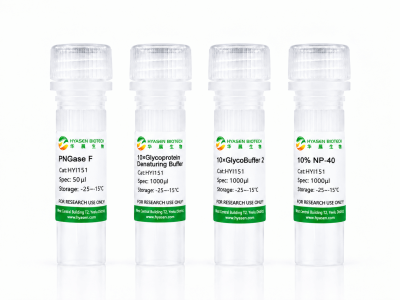
| PNGase F | 45 µL | 150 µL | |
| PNGase F buffer | 0.5mL | 1 mL | |
| Surfactant (SF) | 1.2mg*6 | 3.6 mg*8 | |
| Labeling Module | HIP powder | 8.2 mg*3 | 24.6 mg*4 |
| Anhydrous DMF | 1 mL | 1 mL | |
| Clean-up Module | Elution Plate (96 well) | 1 piece | 1 piece |
| Elution Buffer | 5 mL* 1 | 5 mL*4 | |
| Sample Diluent | 5 mL* 1 | 5 mL*4 | |
| Sample Collection Module | 8-tube Strips (200μL) | 100 pieces | 100 pieces |
| 8-cap Strips | 100 pieces | 100 pieces | |
| Collection plate (96 well) | 1 pieces | 1 pieces | |
| Waste tray | 1 pieces | 1 pieces |
Product Features
- Rapid room-temperature InstantPC labeling: InstantPC (HIP) labeling proceeds at room temperature in just 5 minutes, offering fast reaction kinetics without the need for elevated-temperature incubation steps required by some other glycan labeling chemistries.
- High-throughput 96-well plate clean-up: The clean-up module uses a 96-well extraction plate processed via vacuum or positive-pressure manifold, enabling parallel purification of multiple samples in a single run for efficient higher-throughput glycan sample preparation.
- HILIC-FLR-MS compatible with validated resolution: The workflow is compatible with HILIC-FLR(-MS) analysis using a Glycan BEH Amide column and a validated gradient method tuned to InstantPC’s fluorescence properties (Ex285/Em345 nm), demonstrated to resolve a comprehensive IgG N-glycan profile with strong peak intensity and resolution.
FAQ
Q1: What is InstantPC labeling, and how does it compare to other glycan labeling chemistries?
InstantPC (also known as HIP labeling reagent) is a fast-reacting fluorescent and MS-compatible glycan label that reacts with released glycosylamines at room temperature within minutes, in contrast to some labeling chemistries that require heating steps (e.g., 65°C) to achieve efficient labeling. This room-temperature reactivity can simplify workflow logistics and reduce total processing time.
Q2: What equipment is needed to process the 96-well plate clean-up step in this kit?
The clean-up step requires a vacuum or positive-pressure manifold compatible with 96-well plates to drive sample and buffer flow through the extraction plate wells during activation, equilibration, sample loading, washing, and elution steps, enabling parallel processing of multiple samples.
Q3: What analytical instrumentation is required to analyze samples processed with this kit?
Labeled, purified glycans are designed for analysis via HILIC-FLR (fluorescence detection) or HILIC-FLR-MS, using a Glycan BEH Amide column (e.g., 130 Å, 1.7 μm, 2.1 × 150 mm) with the validated gradient method and fluorescence settings (Ex285/Em345 nm) provided in the manual. The published method parameters are based on an ACQUITY RDa LC-MS system; users working with other UPLC/HPLC or MS platforms can adjust parameters accordingly.