Product Overview
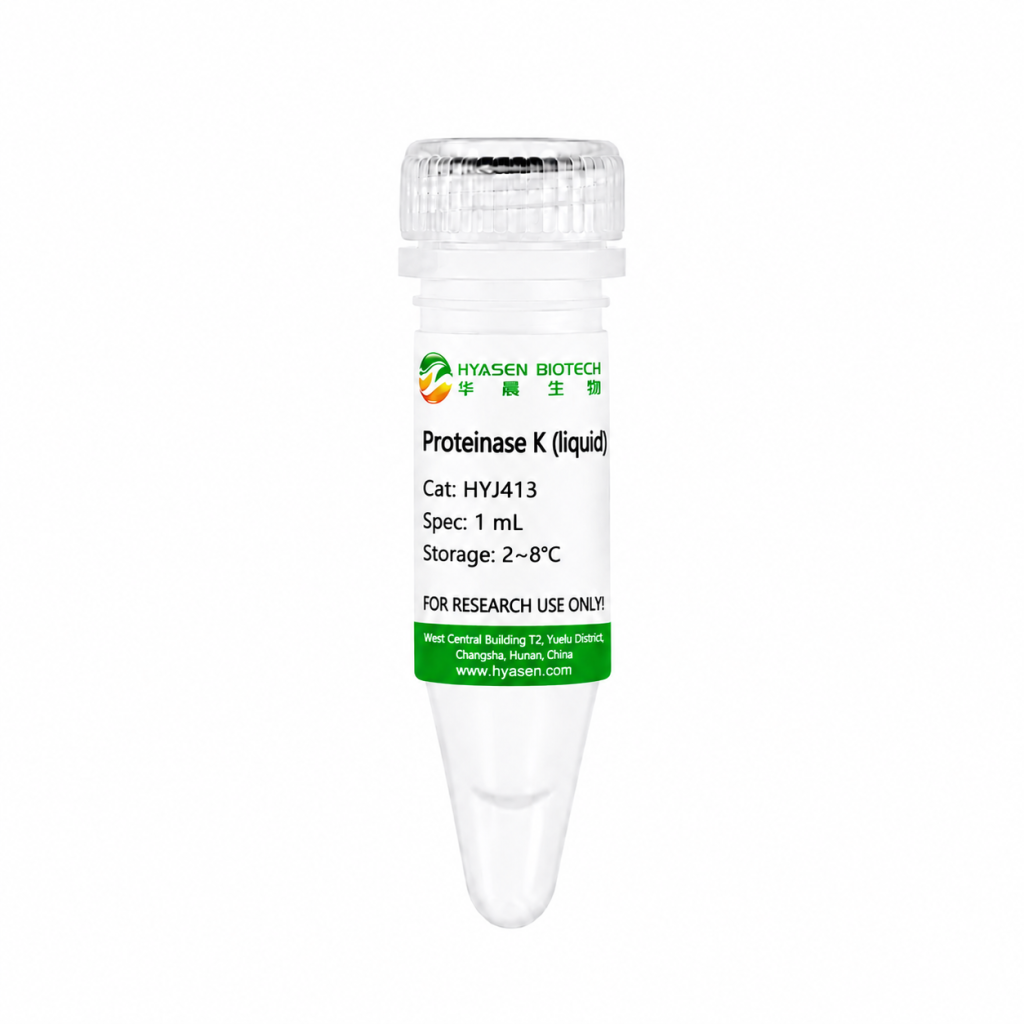
Proteinase K (liquid) is a highly active serine protease characterized by broad substrate specificity, efficiently cleaving ester and peptide bonds located adjacent to the C-termini of hydrophobic, sulfur-containing, and aromatic amino acid residues. This broad cleavage preference enables Proteinase K to rapidly and effectively degrade a wide range of proteins into short peptides, making it a widely used reagent for eliminating protein contaminants during nucleic acid extraction, cell lysis, and sample preparation workflows. Structurally, Proteinase K possesses the classical catalytic triad (Asp39-His69-Ser224) characteristic of serine proteases, which drives its catalytic mechanism. In addition, two Ca²⁺ binding sites surrounding the active center contribute to enhanced structural stability, allowing the enzyme to retain high activity across a wider range of temperature, pH, and denaturant conditions than many other proteases — including in the presence of SDS and other detergents commonly used in lysis buffers.
Components
| Components | Size-1 | Size-2 |
| Proteinase K(liquid) | 1 mL | 10 mL |
Product Features
- Broad substrate specificity for efficient protein digestion: Proteinase K cleaves peptide bonds adjacent to hydrophobic, sulfur-containing, and aromatic amino acids, enabling rapid and near-complete degradation of a wide range of protein substrates into short peptides.
- Enhanced stability via dual Ca²⁺ binding sites: Two calcium-binding sites flanking the active center stabilize the enzyme’s structure, allowing it to maintain high catalytic activity across a broader range of reaction conditions, including in the presence of denaturing agents such as SDS.
- Effective performance in the presence of detergents and denaturants: Unlike many proteases that lose activity under denaturing conditions, Proteinase K remains active in commonly used lysis buffers containing SDS or urea, making it well suited for protein removal during nucleic acid purification protocols.
FAQ
Q1: Why is Proteinase K commonly used in nucleic acid extraction protocols?
Proteinase K efficiently degrades proteins — including nucleases, histones, and other DNA/RNA-binding proteins — that would otherwise interfere with nucleic acid purity or protect nucleic acids from complete lysis. Its ability to remain active in the presence of SDS and other denaturants makes it particularly effective when used alongside standard lysis buffers in DNA and RNA extraction workflows.
Q2: What role do the calcium-binding sites play, and does the reaction require added Ca²⁺?
The two Ca²⁺ binding sites surrounding the enzyme’s active center contribute to its structural stability and resistance to autolysis (self-digestion), supporting sustained activity over longer incubation times. While the enzyme retains substantial activity without added calcium, including Ca²⁺ in the reaction buffer (commonly at low mM concentrations) can further enhance stability and prolong functional activity during extended digestion protocols.
Q3: Under what conditions does Proteinase K work best, and how is it typically inactivated after use?
Proteinase K is commonly used at temperatures between 37–60°C, with activity generally increasing with temperature up to a point before thermal denaturation occurs; optimal conditions should be verified against the current product insert/COA for specific applications. The enzyme can be inactivated by heating (typically 95°C for several minutes) when complete inactivation is required prior to sensitive downstream enzymatic steps, such as certain PCR or restriction digestion protocols.