Product Overview
RNase R (Ribonuclease R) is a 3′→5′ exoribonuclease belonging to the E. coli RNR superfamily, produced under controlled fermentation and purification processes to ensure high purity and consistent enzymatic activity. The enzyme processively cleaves RNA from the 3′ end toward the 5′ end in a stepwise manner, releasing dinucleotide and trinucleotide products as it degrades the RNA strand. A defining characteristic of RNase R is its substrate selectivity: while it efficiently digests nearly all linear RNA molecules, it shows markedly reduced activity on circular RNA, lariat structures, and double-stranded RNA bearing 3′ overhangs shorter than 7 nucleotides. This selective resistance makes RNase R a valuable tool in gene expression and alternative splicing research, where it is commonly used to digest away linear RNA species and thereby enrich circular RNAs (circRNAs) and lariat RNAs from total RNA preparations. This enrichment step is a key part of workflows such as constructing intronic cDNA libraries from total RNA and studying circRNA biology and alternative splicing events.
Components
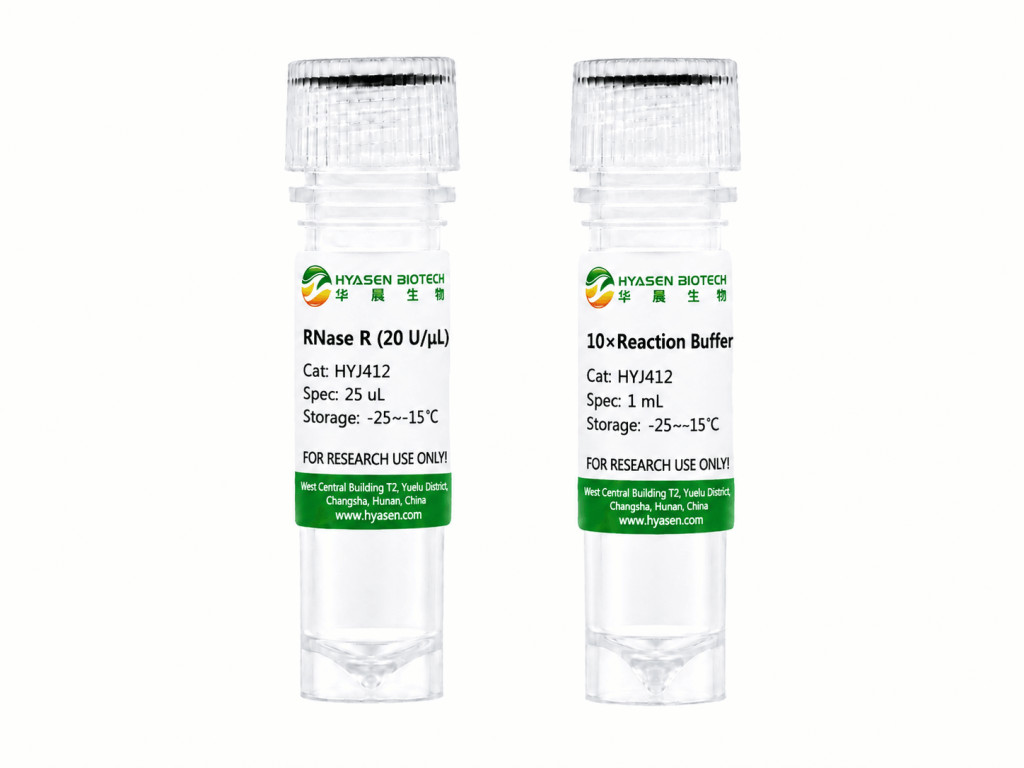
| Components | 0.5 KU | 5 KU |
| RNase R (20 U/μL) | 25 uL | 250 μL |
| 10×Reaction Buffer | 1 mL | 10×1 mL |
Product Features
- Selective degradation of linear RNA: RNase R processively digests linear RNA molecules from the 3′ end while sparing circular RNA, lariat structures, and RNA with short (<7 nt) 3′ overhangs, enabling targeted removal of linear RNA background from complex RNA populations.
- Effective enrichment of circRNA and lariat RNA: By selectively eliminating linear RNA species, RNase R treatment substantially enriches for circRNAs and lariat RNAs within total RNA samples, improving the sensitivity and specificity of downstream detection and sequencing.
- Supports intronic cDNA library construction and splicing studies: The enrichment capability of RNase R makes it a key reagent for constructing intronic cDNA libraries from total RNA and for studying alternative splicing and circRNA-related gene expression mechanisms.
FAQ
Q1: Why does RNase R digest linear RNA but not circular RNA or lariat structures?
RNase R is a 3′→5′ exoribonuclease that requires a free 3′ end to initiate processive degradation. Circular RNA has no free 3′ or 5′ end, and lariat RNA structures contain a branched 2′-5′ phosphodiester linkage that blocks linear 3′→5′ exonucleolytic processing — both features make these RNA species intrinsically resistant to RNase R digestion, which is the basis for their selective enrichment.
Q2: Does RNase R completely spare all circular RNA, or are there exceptions to be aware of?
While RNase R strongly favors linear RNA degradation, digestion efficiency and resistance can vary depending on RNA secondary structure, the presence of short 3′ overhangs (generally resistant below approximately 7 nucleotides), and reaction conditions such as enzyme concentration and incubation time. For applications requiring high circRNA purity, reaction conditions should be optimized and enrichment efficiency verified by appropriate downstream analysis (e.g., qPCR or sequencing).
Q3: What downstream applications commonly use RNase R-treated RNA samples?
RNase R-enriched RNA is commonly used in circRNA sequencing and profiling studies, alternative splicing research, and the construction of intronic cDNA libraries from total RNA. It is also widely applied in exploratory research into circRNA function and biomarker discovery, where accurate enrichment of circular and lariat RNA species from a linear RNA-dominated background is essential.