Product Overview
RNase T1 is a guanosine-specific endoribonuclease originally identified in Aspergillus oryzae. Unlike nonspecific ribonucleases, RNase T1 selectively cleaves single-stranded RNA at guanosine (G) residues, making it a useful tool for studying RNA sequences and structures.
HYP433 RNase T1 from Hyasen catalyzes the hydrolysis of phosphodiester bonds on the 3′ side of guanosine residues. The reaction proceeds through a 2′,3′-cyclic phosphate intermediate and ultimately produces RNA fragments with 3′-phosphate termini. This defined cleavage specificity allows researchers to generate RNA fragments for mapping and analytical studies.
The enzyme does not require divalent metal ions for catalytic activity, providing flexibility in RNA digestion experiments. Its preference for accessible single-stranded regions also makes it useful for investigating RNA secondary structures, where base pairing can influence cleavage patterns.
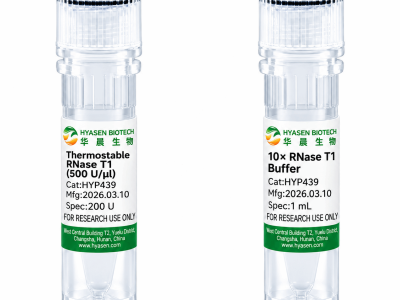
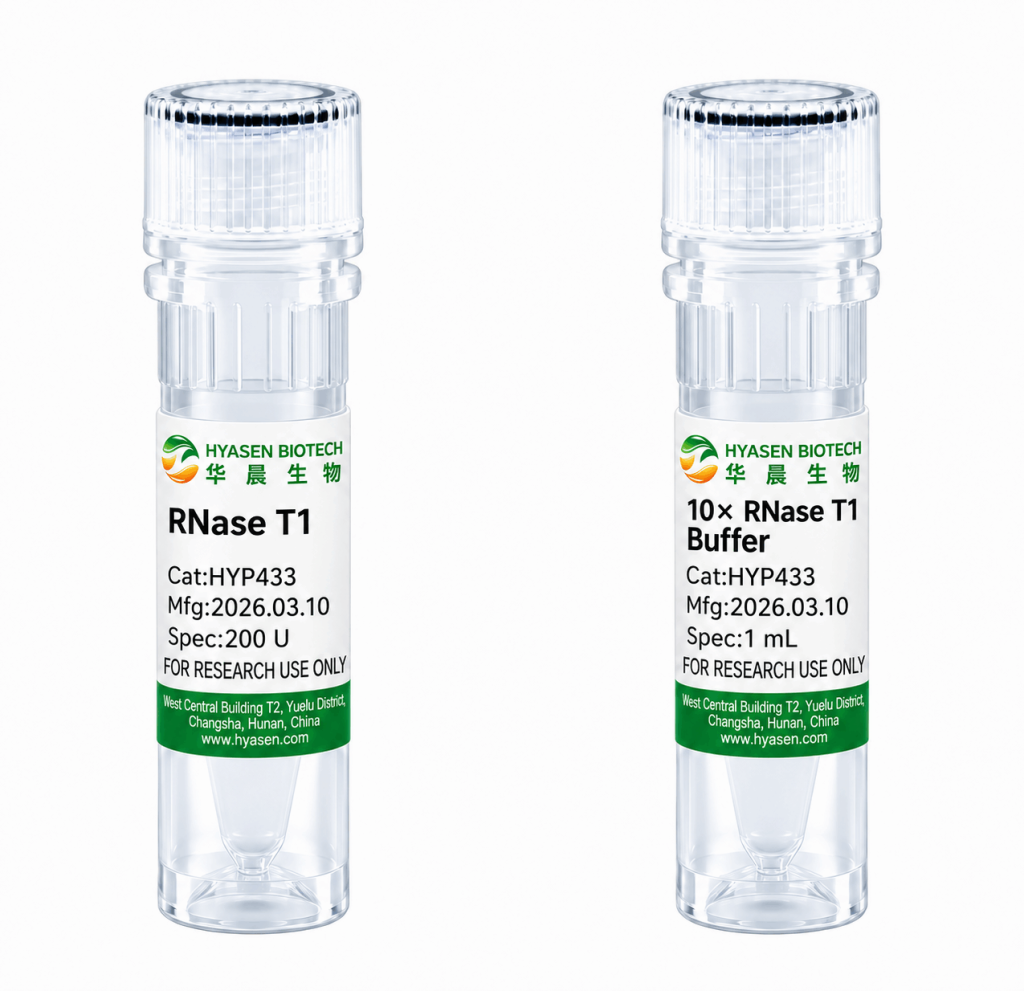
Supplied at 500 U/µL with a 10× RNase T1 Buffer, the enzyme is suitable for RNA mapping, RNA structure probing, and oligonucleotide analysis workflows.
Product Features
- Guanosine-Specific RNA Cleavage: Selectively cleaves single-stranded RNA at the 3′ side of guanosine residues, generating defined RNA fragments with 3′-phosphate ends for sequence-specific analysis.
- Ideal for RNA Mapping and Structure Studies: Enables controlled RNA digestion for RNA mapping, oligonucleotide analysis, and RNA secondary structure studies. Cleavage patterns can provide insights into accessible regions of RNA molecules.
- Metal Ion-Independent Activity: Does not require divalent metal ions such as Mg²⁺ or Mn²⁺ for catalytic activity, offering flexibility in RNA digestion workflows without the need for metal ion supplementation.
FAQ
Q1: Where does RNase T1 cleave RNA, and what products does it generate?
HYP433 RNase T1 specifically cleaves phosphodiester bonds on the 3′ side of guanosine (G) residues in single-stranded RNA. The reaction involves a 2′,3′-cyclic phosphate intermediate and produces RNA fragments with 3′-phosphate and 5′-hydroxyl ends. Cleavage efficiency may vary depending on RNA secondary structure and the accessibility of individual guanosine residues.
Q2: Can RNase T1 be used for RNA mapping and secondary structure analysis?
Yes. HYP433 RNase T1 is commonly used in RNA mapping and structure studies because it preferentially cleaves accessible guanosine residues in single-stranded RNA regions. By analyzing the resulting RNA fragments, researchers can investigate RNA sequence features and gain insights into secondary structure. Reaction conditions should be optimized according to the RNA substrate and analytical method.
Q3: Does RNase T1 require metal ions, and how should it be stored?
No. HYP433 RNase T1 does not require metal ions for catalytic activity. It is supplied at 500 U/µL with a 10× RNase T1 Buffer for reaction setup. The enzyme should be stored at −20°C and has a stated shelf life of 2 years under the recommended storage conditions.