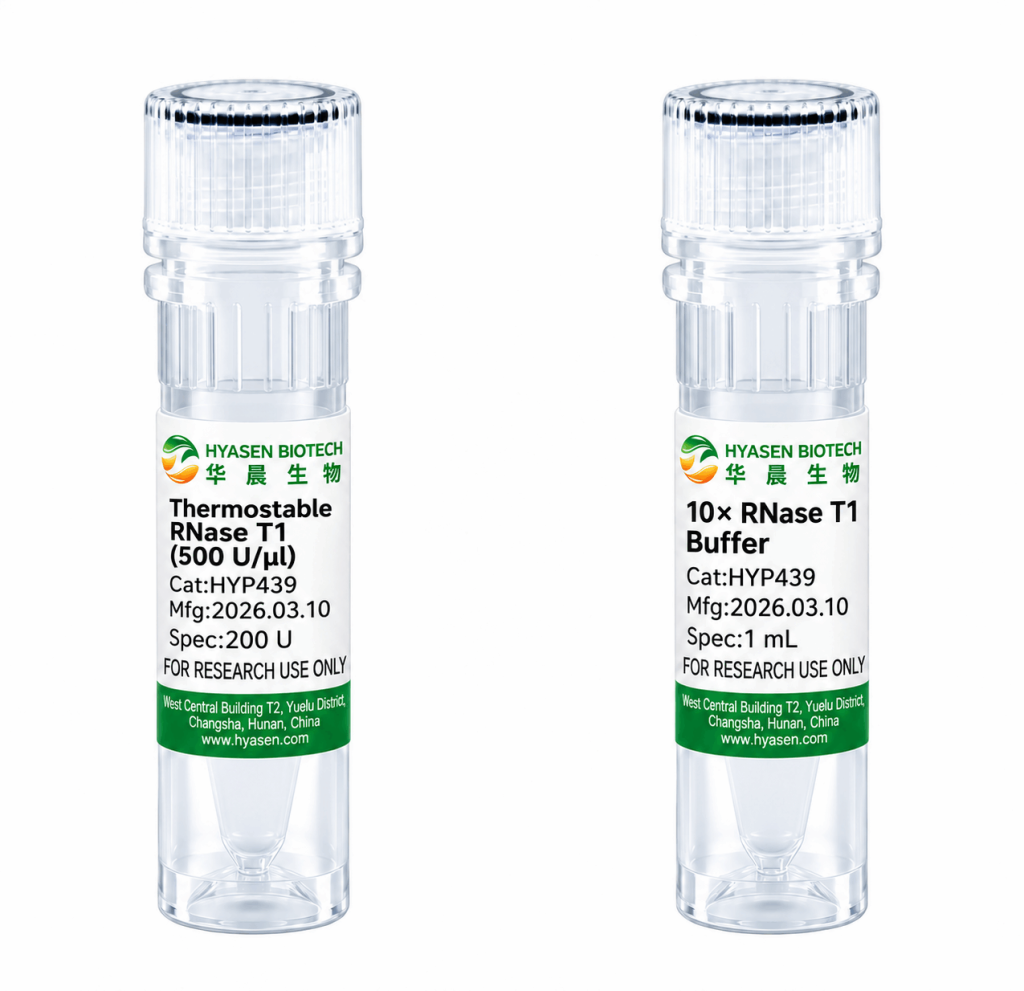
Product Overview
RNA secondary structures can limit the accessibility of cleavage sites, making complete enzymatic digestion difficult. Higher reaction temperatures can help disrupt these structures, but conventional RNases may lose activity under such conditions.
Hyasen Thermostable RNase T1 (HYP439) is an engineered variant of RNase T1 developed through directed evolution to improve thermal stability while maintaining guanosine-specific RNA cleavage activity.
Compared with wild-type RNase T1, the enzyme retains full activity at 50°C under the reported comparison conditions, whereas the wild-type enzyme loses at least 50% of its activity. This improved thermal stability allows digestion at elevated temperatures, where RNA secondary structures may be less stable and previously inaccessible cleavage sites become more exposed.
The enzyme cleaves single-stranded RNA at the 3′ side of guanosine residues, making it useful for RNA digestion, oligonucleotide analysis, and RNA mapping. Its enhanced thermostability is particularly beneficial when working with structured RNA substrates that are difficult to digest under conventional conditions.
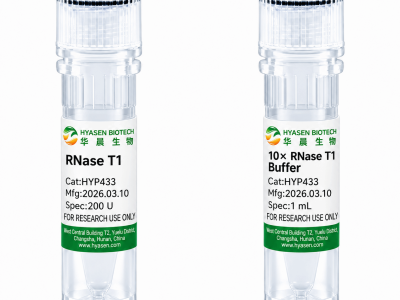
The enzyme is supplied at 500 U/µL with a 10× RNase T1 Buffer and is suitable for research workflows requiring guanosine-specific RNA digestion.
Product Features
- Enhanced Thermal Stability at 50°C: Retains 100% enzymatic activity at 50°C under the reported test conditions, compared with at least a 50% activity loss for wild-type RNase T1 at the same temperature.
- Improved Digestion of Structured RNA: Supports RNA digestion at elevated temperatures, helping reduce secondary structure interference and improve enzyme access to guanosine cleavage sites for more complete digestion.
- Guanosine-Specific RNA Cleavage: Selectively cleaves single-stranded RNA at the 3′ side of guanosine residues, supporting RNA mapping, oligonucleotide analysis, and sequence-specific RNA digestion.
FAQ
Q1: How does Thermostable RNase T1 differ from conventional RNase T1?
HYP439 Thermostable RNase T1 is an engineered variant with improved thermal stability. Under the reported comparison conditions, it retains 100% activity at 50°C, while wild-type RNase T1 loses at least 50% of its activity. Both enzymes recognize guanosine residues in RNA, but the thermostable variant is better suited for digestion at elevated temperatures.
Q2: Why is Thermostable RNase T1 useful for digesting structured RNA?
RNA secondary structures can prevent RNase T1 from reaching certain guanosine cleavage sites. Higher temperatures can help disrupt these structures and expose additional sites for digestion. HYP439 Thermostable RNase T1 remains active at 50°C, making it useful for processing structured RNA that may be difficult to digest at lower temperatures. Digestion efficiency depends on the RNA sequence, structure, and reaction conditions.
Q3: What applications are suitable for Thermostable RNase T1, and how should it be stored?
HYP439 Thermostable RNase T1 is suitable for guanosine-specific RNA digestion, RNA mapping, oligonucleotide analysis, and studies involving structured RNA. The enzyme is supplied at 500 U/µL with a 10× RNase T1 Buffer. Store at −20°C for up to 2 years under the recommended storage conditions.