Product Overview
RNase H is an endoribonuclease that selectively cleaves RNA within RNA–DNA hybrids. Unlike conventional RNases that degrade single-stranded RNA, RNase H acts on RNA paired with a complementary DNA strand, making it useful for applications that require selective RNA removal.
Hyasen HYP421 RNase H catalyzes the hydrolysis of phosphodiester bonds in the RNA strand of RNA–DNA hybrids without directly degrading the DNA strand. This substrate specificity allows researchers to remove RNA templates from RNA–DNA hybrid intermediates while retaining the DNA for subsequent processing.
The enzyme has an optimal pH of approximately 8.0 and requires divalent metal ions, such as Mg²⁺ or Mn²⁺, for catalytic activity. It can be used in cDNA synthesis workflows, RNA–DNA hybrid processing, and studies involving RNA–DNA interactions.
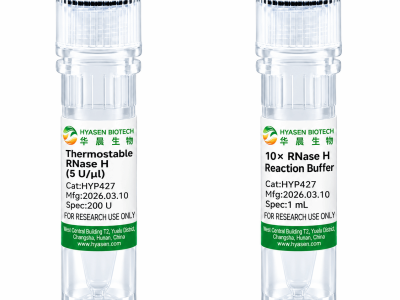
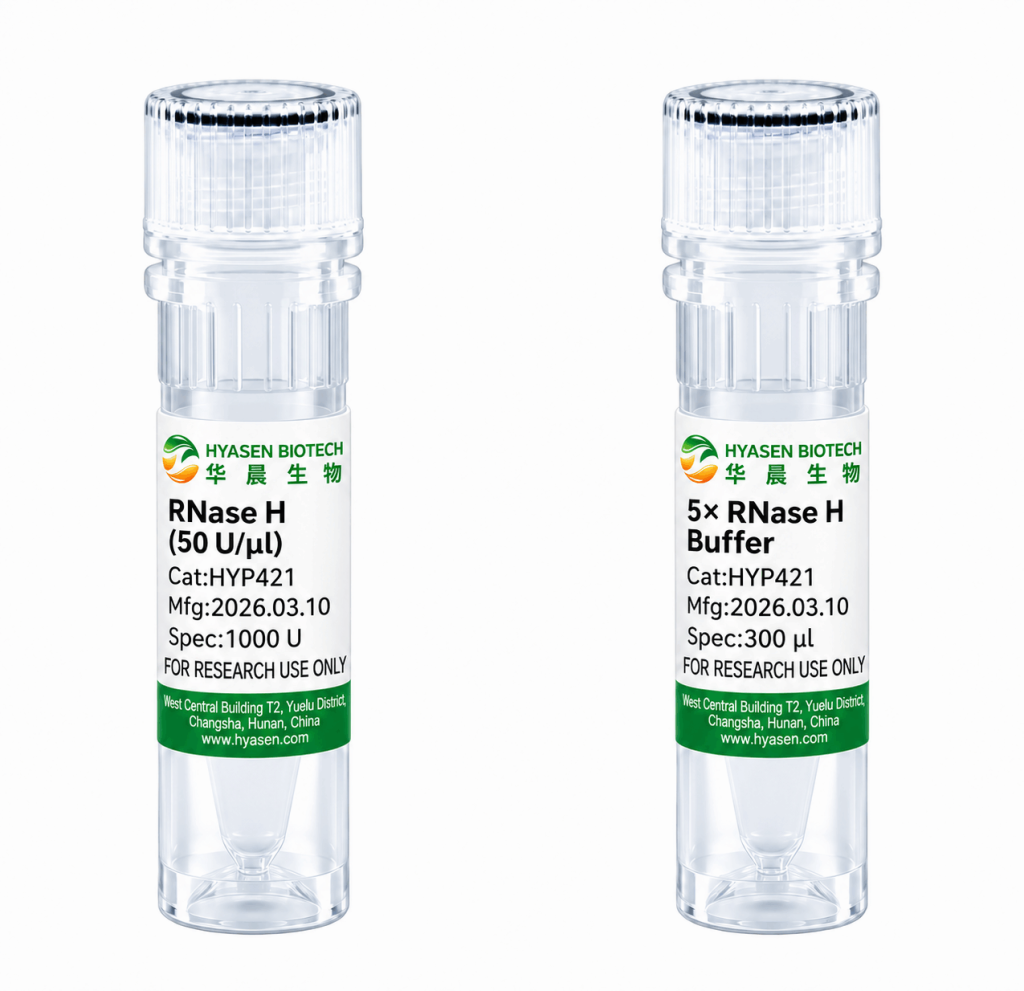
Supplied at 50 U/µL with a 5× RNase H Buffer, the enzyme offers a convenient option for laboratory workflows requiring controlled RNA digestion. It should be stored at −20°C and has a stated shelf life of 2 years under the recommended storage conditions.
Product Features
- Specific RNA Digestion in RNA–DNA Hybrids: Selectively cleaves the RNA strand of RNA–DNA hybrids without directly degrading the complementary DNA strand, allowing targeted RNA removal during nucleic acid processing.
- Suitable for cDNA Synthesis Workflows: Can be used to remove RNA templates from RNA–DNA hybrid intermediates following reverse transcription, supporting downstream cDNA processing and compatible second-strand synthesis methods.
- Divalent Metal Ion-Dependent Activity: Requires Mg²⁺ or Mn²⁺ for catalytic activity and has an optimal pH of approximately 8.0, supporting RNA–DNA hybrid digestion under appropriate reaction conditions.
FAQ
Q1: What is the difference between RNase H and RNase A?
HYP421 RNase H specifically degrades the RNA strand of RNA–DNA hybrids while leaving the complementary DNA strand intact. In contrast, RNase A primarily digests single-stranded RNA and does not require an RNA–DNA hybrid substrate. RNase H is therefore useful when RNA must be selectively removed from an RNA–DNA hybrid.
Q2: Can RNase H be used after reverse transcription?
Yes. HYP421 RNase H can be used after reverse transcription to degrade the RNA template in RNA–DNA hybrids. This step is useful in certain cDNA synthesis and downstream DNA processing workflows. Whether RNase H treatment is necessary depends on the reverse transcription protocol and the intended application.
Q3: What reaction conditions and storage temperature are recommended for RNase H?
HYP421 RNase H has an optimal pH of approximately 8.0 and requires Mg²⁺ or Mn²⁺ ions for activity. The enzyme is supplied at 50 U/µL with a 5× RNase H Buffer. Reaction temperature, incubation time, and enzyme amount should be optimized according to the substrate and experimental protocol. Store the enzyme at −20°C for up to 2 years under the recommended conditions.