Product Overview
Thermostable RNase H is a heat-resistant endoribonuclease that specifically cleaves RNA within RNA–DNA hybrids. Unlike conventional RNase H enzymes, its ability to remain active at elevated temperatures makes it useful for molecular biology workflows that require high-temperature reaction conditions.
Hyasen’s HYP427 Thermostable RNase H selectively hydrolyzes the RNA strand of RNA–DNA hybrids while preserving the complementary DNA strand. The enzyme does not degrade single-stranded or double-stranded RNA or DNA on their own, allowing targeted RNA cleavage without directly affecting other nucleic acid substrates.
With activity retained at temperatures above 65°C, the enzyme supports RNA–DNA hybrid processing under elevated-temperature conditions. It can be used for selective RNA removal, DNA oligonucleotide-directed RNA cleavage, and research workflows involving RNA–DNA hybrid intermediates.
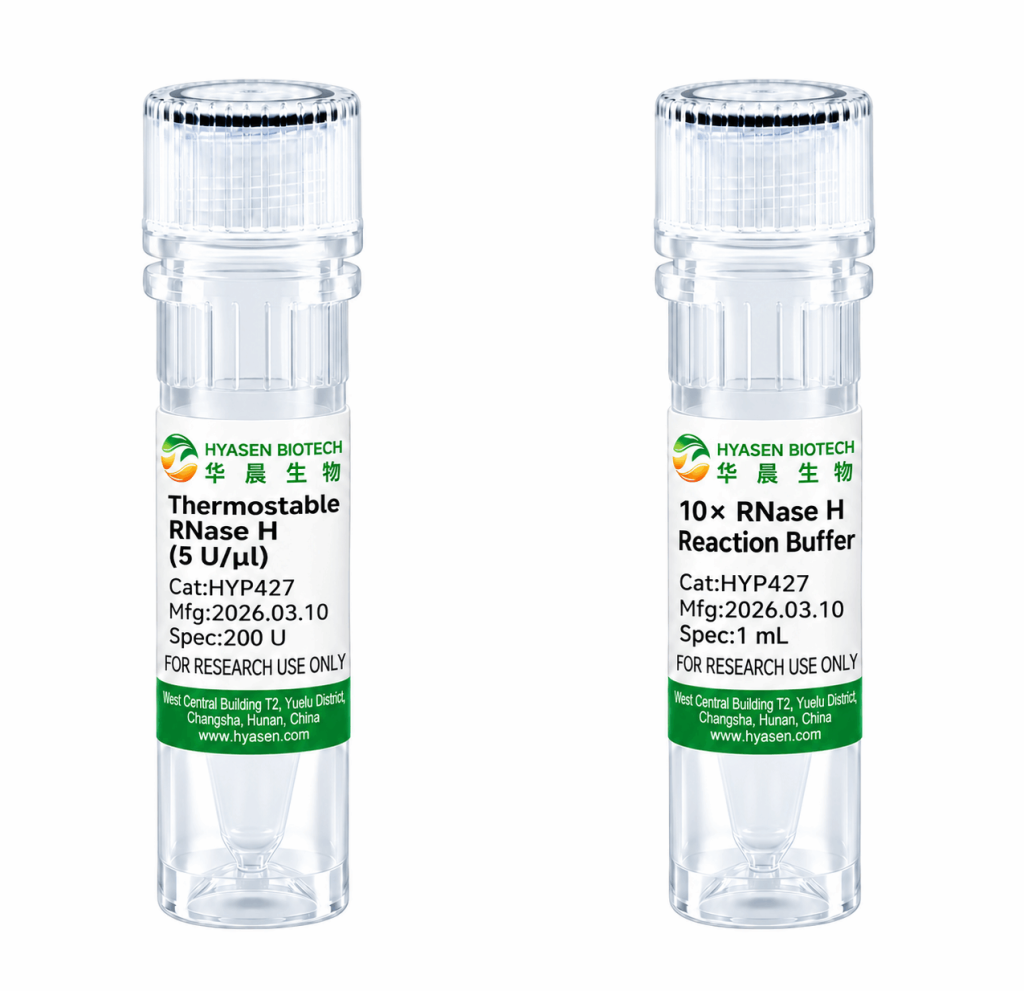
Supplied at 5 U/µL with a 10× RNase H Reaction Buffer, the enzyme provides a convenient option for laboratory applications requiring sequence-directed RNA cleavage at elevated temperatures.
Product Features
- Thermostable Activity Above 65°C: Retains enzymatic activity at temperatures above 65°C, making it suitable for RNA–DNA hybrid processing and molecular biology workflows that require elevated reaction temperatures.
- Highly Specific RNA–DNA Hybrid Cleavage: Selectively degrades the RNA strand of RNA–DNA hybrids while leaving the complementary DNA strand intact, enabling targeted RNA removal without directly digesting DNA.
- No Activity on Single- or Double-Stranded Nucleic Acids: Does not degrade standalone single-stranded or double-stranded RNA or DNA, helping preserve non-target nucleic acids during selective RNA–DNA hybrid digestion.
FAQ
Q1: What is the difference between Thermostable RNase H and conventional RNase H?
HYP427 Thermostable RNase H and conventional RNase H both selectively degrade the RNA strand of RNA–DNA hybrids. The main difference is thermostability. Thermostable RNase H retains activity at temperatures above 65°C, making it suitable for applications requiring elevated reaction temperatures. Conventional RNase H is generally used under lower-temperature reaction conditions.
Q2: Does Thermostable RNase H degrade single-stranded RNA or double-stranded DNA?
No. HYP427 Thermostable RNase H specifically recognizes RNA–DNA hybrids and cleaves the RNA strand within these structures. It does not degrade single-stranded RNA, double-stranded RNA, single-stranded DNA, or double-stranded DNA on their own. This specificity makes it useful for selectively removing RNA hybridized to DNA while preserving other nucleic acid substrates.
Q3: What reaction conditions and storage temperature are recommended for Thermostable RNase H?
HYP427 Thermostable RNase H remains active at temperatures above 65°C and is supplied at 5 U/µL with a 10× RNase H Reaction Buffer. The optimal reaction temperature, enzyme amount, and incubation time should be selected according to the experimental protocol and substrate. Store the enzyme at −20°C for up to 2 years under the recommended storage conditions.