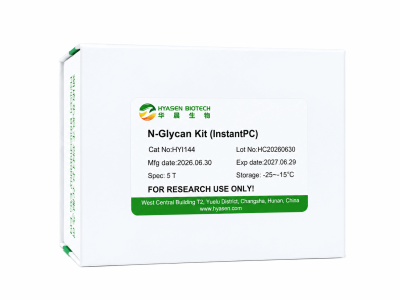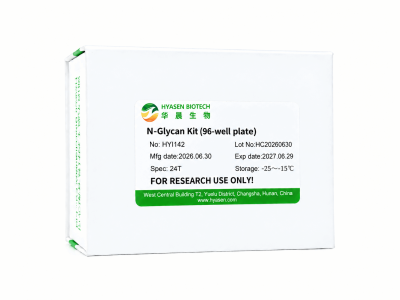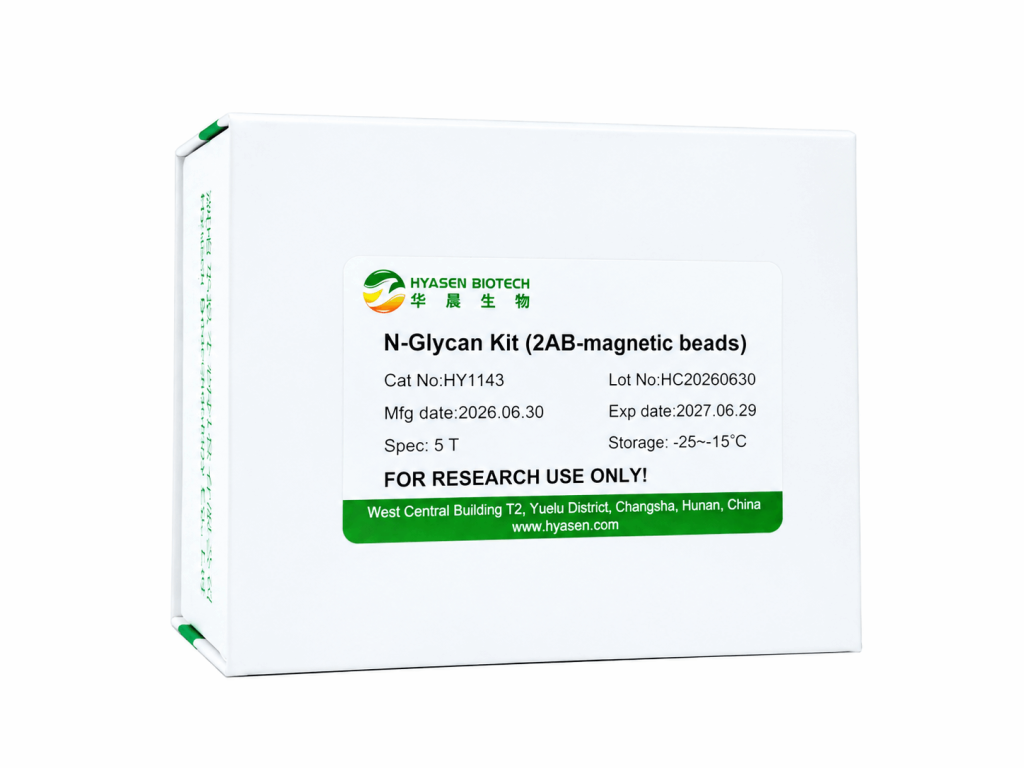
Product Overview
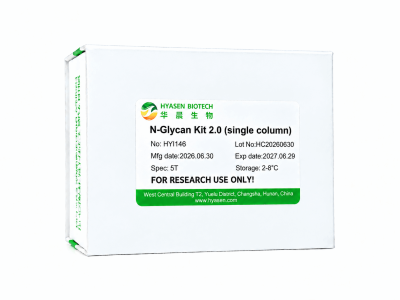
The N-Glycan Kit (2AB-magnetic beads) is designed for N-glycan sample preparation from antibody drugs and other glycoproteins. Its defining feature is the combination of 2-AB (2-aminobenzamide) fluorescent labeling and magnetic bead-based purification. The workflow includes PNGase F-mediated deglycosylation, 2-AB labeling and magnetic bead cleanup. During purification, the magnetic beads are collected using a magnetic stand, allowing the supernatant to be removed without relying on a conventional SPE column or vacuum manifold. The protocol uses a 2-AB labeling solution prepared from 2-AB solution, reductant and formic acid, followed by magnetic bead-based washing and elution. The labeled glycans can then be prepared for downstream UPLC/HILIC-FLR analysis.
Components
| Module | Reagent | 50 T | 100 T | Storage |
| Deglycosylation Module | Co-enzyme | 180µL | 360µL | 2-8℃ |
| PNGase F buffer | 240µL | 480µL | -25~-15℃ | |
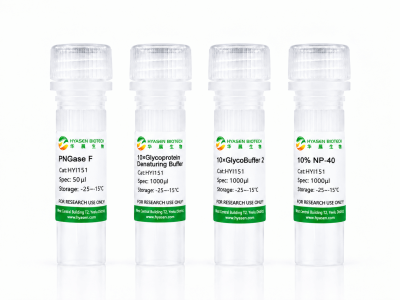
| PNGase F | 120µL | 240µL | -25~-15℃ | |
| Labeling Module | 2-AB solution | 0.5mL | 1mL | -25~-15℃ |
| Reductant | 0.5mL | 1mL | -25~-15℃ | |
| Clean-up Module | Magnetic bead | 12mL | 24mL | 2-8℃ |
| Washings | 48mL | 48mL*2 | 2-8℃ | |
| Elution Buffer | 1.2mL | 2.4mL | 2-8℃ | |
| Sample Diluent | 3.6mL | 7.2mL | 2-8℃ | |
| Filter tube | 50 pieces | 100 pieces | 2-8℃ |
Product Features
- Centrifugation-free magnetic bead workflow: All purification steps — precipitation, washing, and elution — are performed using magnetic bead separation on a magnetic stand rather than centrifugation, simplifying sample handling and reducing hands-on complexity, particularly for laboratories without dedicated centrifuge access for small-volume samples.
- Established 2-AB fluorescent labeling chemistry: The kit uses 2-aminobenzamide (2-AB), a well-characterized and widely adopted fluorescent glycan label, providing compatibility with existing 2-AB glycan libraries and reference standards used across the glycoanalytical community.
- HILIC-FLR compatible with validated resolution: The workflow is compatible with HILIC-FLR analysis using a Glycan BEH Amide column and a validated gradient method tuned to 2-AB’s fluorescence properties (Ex330/Em420 nm), demonstrated to resolve a comprehensive IgG N-glycan profile spanning neutral, fucosylated, and sialylated glycan species.
FAQ
Q1: What advantage does magnetic bead-based purification offer over traditional SPE column or centrifugation-based cleanup?
Magnetic bead-based purification allows all wash, precipitation, and elution steps to be performed using a magnetic stand, eliminating the need for centrifugation equipment and reducing manual handling steps. This can simplify workflow integration, particularly for smaller sample volumes, and reduces the risk of sample loss associated with column-based or centrifugation-dependent methods.
Q2: Why is 2-AB used as the labeling reagent in this kit, and how does it compare to other glycan labels?
2-aminobenzamide (2-AB) is one of the most widely used and well-characterized fluorescent labels in glycan analysis, valued for its efficient labeling of reducing-end glycans and compatibility with established glycan reference libraries and retention time databases developed by the broader glycoanalytical community. This kit’s HILIC-FLR method is specifically tuned to 2-AB’s fluorescence properties (Ex330/Em420 nm) to support accurate detection.
Q3: Is this protocol validated only for IgG samples, or can it be applied to other glycoproteins?
This protocol was validated using monoclonal antibodies (IgG). While the general workflow principles are applicable to other glycoproteins, users are encouraged to optimize reaction conditions — such as sample concentration, PNGase F digestion time, and bead-to-sample ratios — according to their specific glycoprotein and sample matrix to ensure optimal enzymatic release and labeling efficiency.