Product Overview
Residual single-stranded DNA, particularly unused primers left after PCR amplification, can interfere with downstream applications such as DNA sequencing and other molecular analyses. Selectively removing these fragments without damaging double-stranded DNA is an important step in many laboratory workflows.
Hyasen HYP434 Exonuclease I is a recombinant, single-strand-specific exonuclease derived from Escherichia coli. The enzyme progressively digests single-stranded DNA from the 3′ end toward the 5′ end, releasing deoxyribonucleoside 5′-monophosphates.
Exonuclease I shows strong specificity for single-stranded DNA and does not degrade double-stranded DNA or RNA under recommended reaction conditions. This allows researchers to remove unwanted single-stranded DNA while preserving double-stranded DNA products for subsequent analysis.
The enzyme requires an accessible 3′-hydroxyl group to initiate digestion. Single-stranded DNA with a 3′ end blocked by phosphate or acetyl groups is resistant to its exonuclease activity.
HYP434 Exonuclease I is particularly useful for removing residual primers from PCR reactions before downstream processing, including Sanger sequencing and nested PCR workflows. It can also be used to selectively eliminate linear single-stranded DNA from mixtures containing double-stranded DNA.
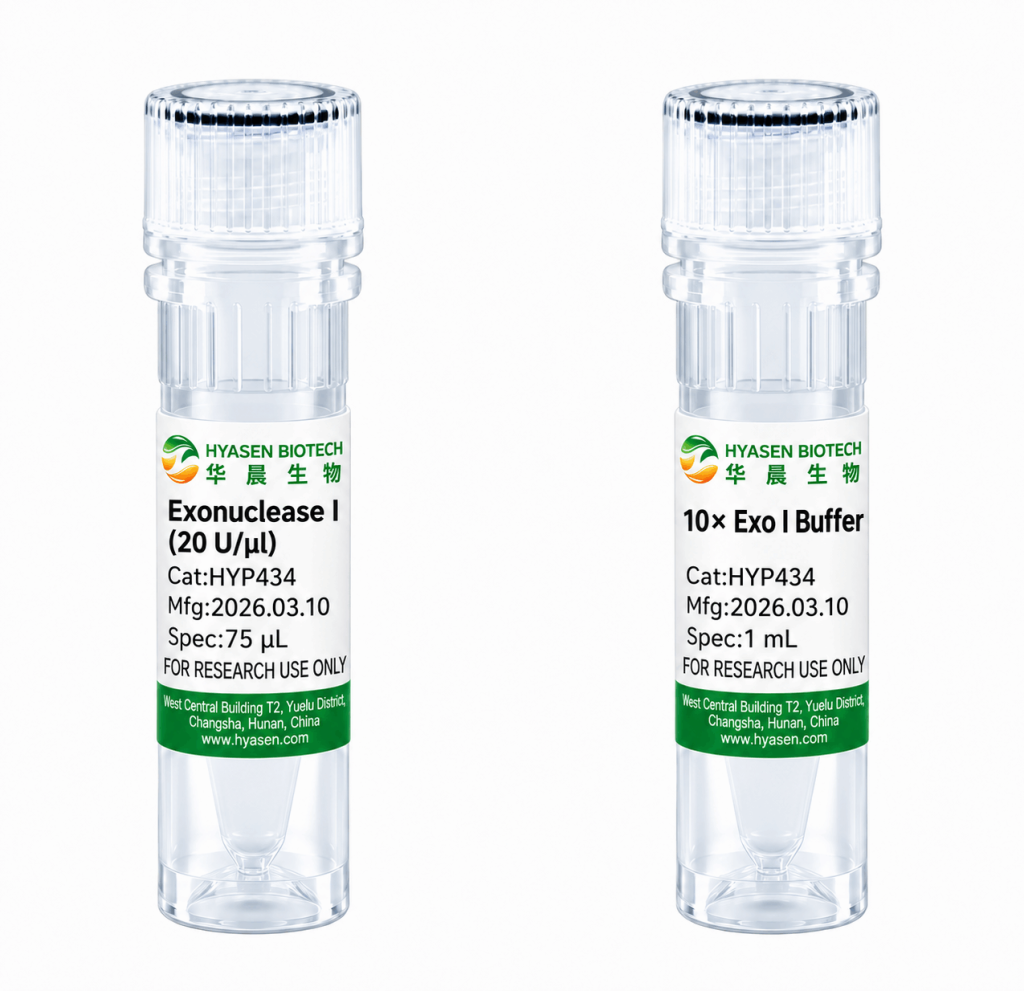
Produced through recombinant expression and purification, the enzyme is supplied at 20 U/µL with a 10× Exo I Buffer for routine molecular biology applications.
Product Features
- Highly Specific 3′ to 5′ ssDNA Digestion: Selectively degrades single-stranded DNA from the 3′ end while leaving double-stranded DNA and RNA intact, allowing targeted removal of unwanted ssDNA.
- Effective Removal of Residual PCR Primers: Digests unused single-stranded primers after PCR amplification, helping prepare double-stranded DNA products for sequencing and other downstream molecular biology applications.
- Selective Activity on Accessible 3′ Ends: Requires an accessible 3′-hydroxyl group for digestion and does not efficiently degrade single-stranded DNA with 3′ ends blocked by phosphate or acetyl groups, providing additional substrate selectivity.
FAQ
Q1: Can Exonuclease I be used to remove leftover primers after PCR?
Yes. HYP434 Exonuclease I selectively digests residual single-stranded primers while leaving double-stranded PCR products intact. This makes it useful for PCR cleanup before Sanger sequencing, nested PCR, and other downstream applications. However, Exonuclease I does not remove unused dNTPs, so an additional cleanup step or phosphatase treatment may be required depending on the application.
Q2: Does Exonuclease I degrade double-stranded DNA or RNA?
No. HYP434 Exonuclease I specifically degrades single-stranded DNA in the 3′ to 5′ direction and does not directly digest double-stranded DNA or RNA under recommended reaction conditions. This selectivity allows unwanted ssDNA to be removed from samples containing double-stranded DNA without degrading the intended DNA product.
Q3: Can Exonuclease I digest DNA with modified 3′ ends, and how should it be stored?
HYP434 Exonuclease I requires an accessible 3′-hydroxyl group to initiate digestion. Single-stranded DNA with 3′ ends blocked by phosphate or acetyl groups is resistant to cleavage. The enzyme is supplied at 20 U/µL with a 10× Exo I Buffer and should be stored at −20°C for up to 2 years under the recommended storage conditions.