Product Overview
Removing unwanted linear or nicked DNA from plasmid preparations can be challenging when the goal is to preserve intact supercoiled DNA. T5 Exonuclease provides a selective enzymatic approach to DNA processing based on differences in DNA structure.
Hyasen T5 Exonuclease (HYP430) is a DNA exonuclease that progressively removes nucleotides in the 5′ to 3′ direction. It acts on linear double-stranded DNA and can initiate digestion at exposed 5′ ends, nicks, or gaps in double-stranded DNA. The enzyme also exhibits activity toward single-stranded DNA, although this activity is influenced by magnesium ion concentration.
A key characteristic of T5 Exonuclease is its ability to digest linear and nicked plasmid DNA while leaving intact supercoiled DNA resistant to degradation. This makes it useful for reducing unwanted DNA species in plasmid preparations and removing incomplete ligation products from DNA mixtures.
T5 Exonuclease also plays an important role in Gibson Assembly. By digesting DNA from the 5′ ends, the enzyme generates complementary 3′ single-stranded overhangs that allow DNA fragments with overlapping sequences to anneal. DNA polymerase and DNA ligase can then complete the assembly process.
The enzyme’s activity on single-stranded DNA is sensitive to Mg²⁺ concentration, with digestion reduced when Mg²⁺ levels fall below 1 mM.
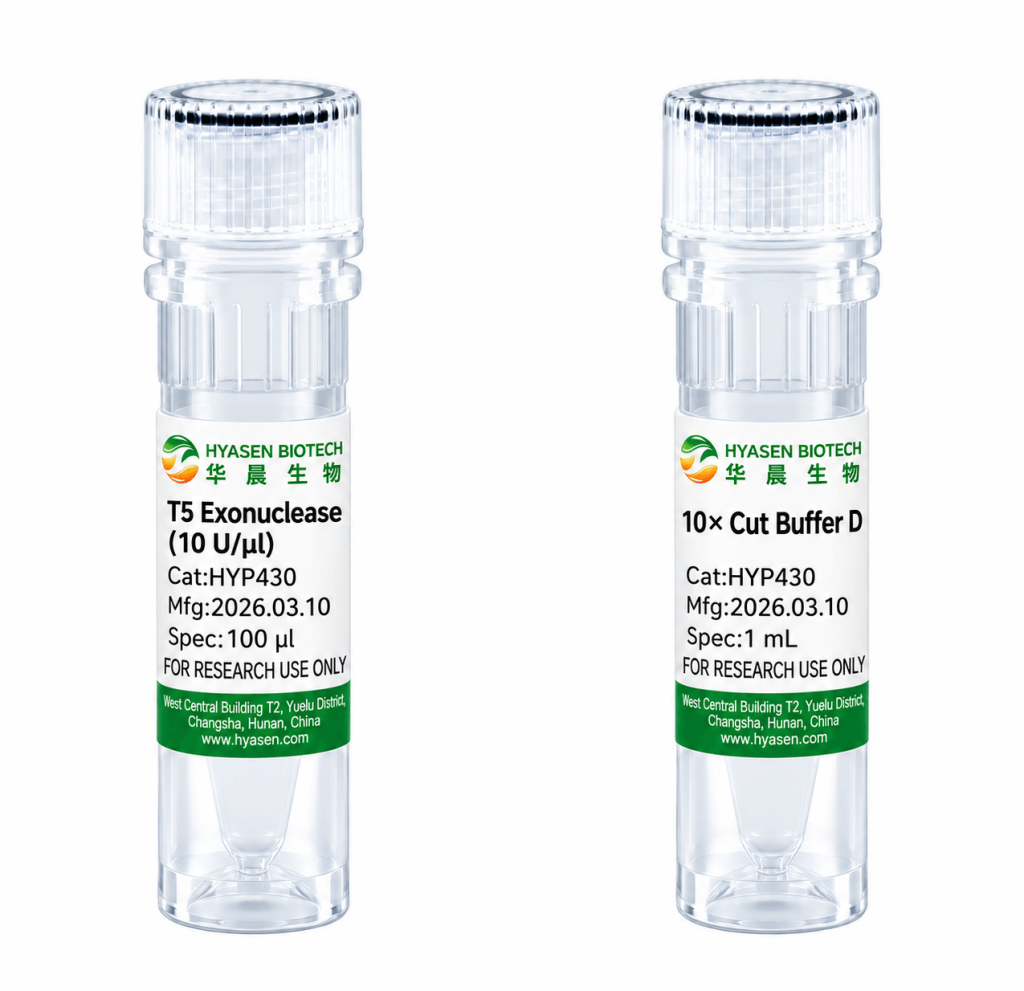
HYP430 T5 Exonuclease is supplied at 10 U/µL with a 10× Cut Buffer D for DNA processing, plasmid preparation, and molecular cloning applications.
Product Features
- Efficient 5′ to 3′ DNA Digestion: Degrades DNA from accessible 5′ ends and can initiate digestion at nicks or gaps in double-stranded DNA, supporting controlled DNA processing and removal of unwanted DNA fragments.
- Selective Removal of Linear and Nicked DNA: Digests linear and nicked plasmid DNA while leaving intact supercoiled DNA resistant to degradation, helping reduce unwanted DNA species in plasmid preparations and ligation mixtures.
- Suitable for Gibson Assembly and Seamless Cloning: Generates 3′ single-stranded overhangs through 5′-end digestion, allowing complementary DNA fragments to anneal during Gibson Assembly and other compatible seamless DNA assembly workflows.
FAQ
Q1: Can T5 Exonuclease remove linear and nicked plasmid DNA without degrading supercoiled DNA?
Yes. HYP430 T5 Exonuclease can digest linear DNA and nicked circular DNA while leaving intact supercoiled double-stranded DNA resistant to digestion. This makes it useful for reducing linearized plasmids, nicked plasmids, and incomplete ligation products in DNA preparations. Digestion efficiency depends on DNA structure and reaction conditions.
Q2: How is T5 Exonuclease used in Gibson Assembly?
HYP430 T5 Exonuclease can be used to generate complementary 3′ single-stranded overhangs by digesting the 5′ ends of double-stranded DNA fragments. These exposed regions allow DNA fragments with matching overlaps to anneal. In a Gibson Assembly reaction, DNA polymerase fills remaining gaps, and DNA ligase seals the nicks to complete the assembled DNA molecule. T5 Exonuclease is one component of this process and does not complete DNA assembly on its own.
Q3: What is the difference between Exonuclease III and Exonuclease I?
Yes. HYP430 T5 Exonuclease exhibits activity toward single-stranded DNA in addition to its activity on double-stranded DNA. However, its single-stranded DNA digestion activity is reduced when Mg²⁺ concentrations fall below 1 mM. Reaction conditions should be selected according to the DNA substrate and the intended application. The enzyme should be stored at −20°C and has a stated shelf life of 2 years.