Product Overview
Exonuclease III (Exo III) is a DNA-processing enzyme that removes nucleotides from double-stranded DNA in the 3′ to 5′ direction. Its activity depends on DNA end structure, making it particularly useful for controlled DNA digestion and molecular cloning applications.
Hyasen Exonuclease III (HYP420) progressively removes nucleotides from 3′-hydroxyl ends of double-stranded DNA, releasing deoxyribonucleoside 5′-monophosphates. The enzyme preferentially acts on blunt-ended DNA and DNA with 5′ overhangs. It can also initiate digestion at nicks in double-stranded DNA, generating single-stranded gaps.
Unlike enzymes that readily digest single-stranded DNA, Exonuclease III primarily targets double-stranded substrates. DNA with 3′ overhangs of four or more nucleotides is generally resistant to digestion, allowing researchers to control which DNA ends are processed.
This end-structure preference is especially useful for generating unidirectional deletions. By designing a linear DNA fragment with one Exonuclease III-sensitive end and one resistant 3′ overhang, digestion can be directed from a selected end. The enzyme can also be used to prepare single-stranded DNA regions for sequencing, mutagenesis, and other DNA manipulation workflows.
In addition to its 3′ to 5′ exonuclease activity, Exonuclease III exhibits RNase H, 3′-phosphatase, and apurinic/apyrimidinic (AP) endonuclease activities.
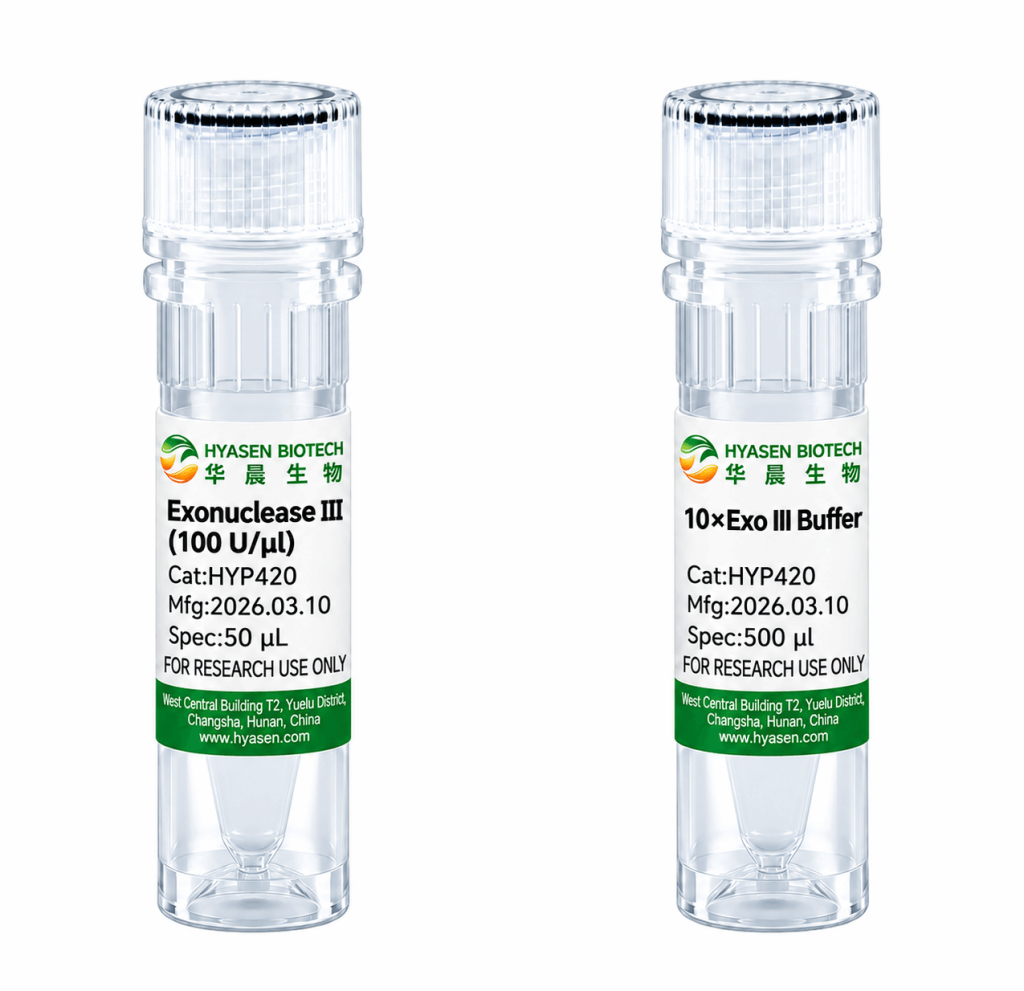
HYP420 Exonuclease III is supplied at 100 U/µL with a 10× Exo III Buffer for molecular biology research.
Product Features
- Specific 3′ to 5′ Digestion of Double-Stranded DNA: Progressively removes nucleotides from blunt ends, 5′ overhangs, and nicked double-stranded DNA while showing little activity on single-stranded DNA.
- Selective Digestion Based on DNA End Structure: Preferentially digests blunt or recessed 3′ ends, while DNA with 3′ overhangs of four or more nucleotides is generally resistant. This selectivity allows greater control over DNA end processing.
- Ideal for Unidirectional DNA Deletion and ssDNA Preparation: Supports controlled DNA deletion, generation of single-stranded DNA regions, site-directed mutagenesis, and other molecular cloning workflows requiring selective DNA digestion.
FAQ
Q1: What types of DNA ends can Exonuclease III digest?
HYP420 Exonuclease III preferentially digests double-stranded DNA with blunt ends or 5′ overhangs, removing nucleotides in the 3′ to 5′ direction. It can also initiate digestion at nicks in double-stranded DNA. In contrast, 3′ overhangs of four or more nucleotides are generally resistant to its exonuclease activity. Digestion efficiency may vary depending on DNA sequence, end structure, and reaction conditions.
Q2: How can Exonuclease III be used to generate unidirectional DNA deletions?
HYP420 Exonuclease III can be used to create directional deletions by preparing a linear DNA fragment with different end structures. One end is designed to be sensitive to Exonuclease III, such as a blunt end or 5′ overhang, while the opposite end contains a resistant 3′ overhang. The enzyme preferentially digests DNA from the susceptible end, allowing controlled deletion of one DNA strand. Digestion conditions and incubation time should be optimized to achieve the desired deletion length.
Q3: What is the difference between Exonuclease III and Exonuclease I?
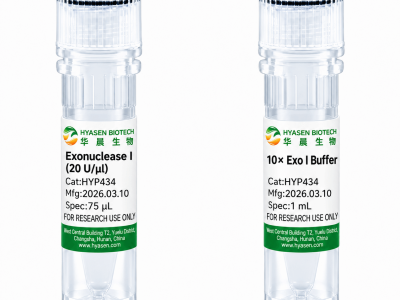
HYP420 Exonuclease III primarily digests double-stranded DNA from accessible 3′ ends, including blunt ends, 5′ overhangs, and nicks. In contrast, Exonuclease I selectively degrades single-stranded DNA in the 3′ to 5′ direction. Exonuclease III is commonly used for controlled DNA deletions and generating single-stranded DNA regions, while Exonuclease I is typically used to remove residual single-stranded DNA, such as unused PCR primers.