Lyophilized reagent stability describes how long a freeze-dried reagent maintains defined performance under specified storage and handling conditions. Evaluating a shelf-life claim means checking its temperature range, supporting data, and, where relevant, transport and post-reconstitution stability.
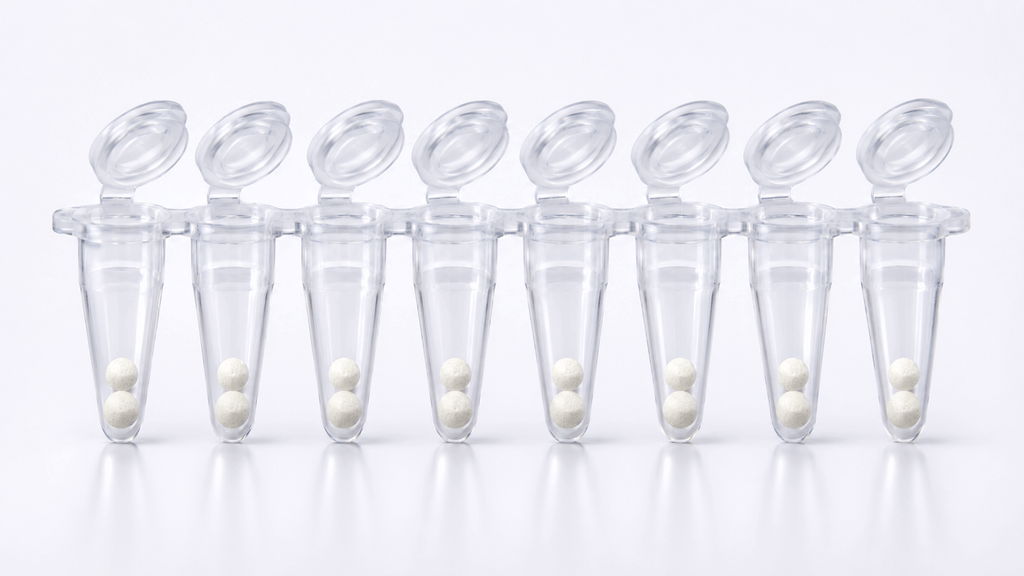
Freeze-drying can reduce molecular mobility and slow certain degradation pathways, but it does not eliminate instability. Residual moisture, the excipient matrix, glass-transition behavior, container-closure protection, and reconstitution conditions can all affect performance. These variables deserve particular attention when qualifying a reagent for a molecular diagnostic workflow or comparing potential suppliers.
This guide covers how to read that claim, what real-time and accelerated data can support, and what to ask before committing to a supplier. For background on dried formats, see why lyophilized reagents matter in molecular diagnostics.
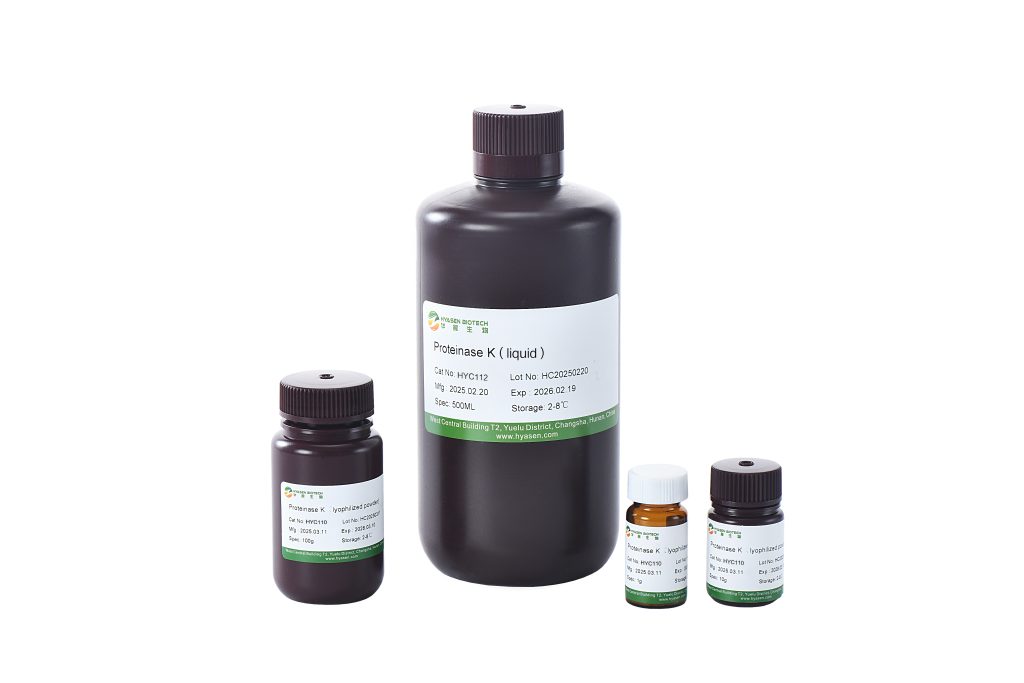
For laboratories and diagnostic reagent manufacturers seeking a reliable freeze-dried enzyme, Hyasen’s Proteinase K (Lyophilized Powder, HYC110) offers high proteolytic activity (≥30 U/mg) and long-term storage stability. Designed for DNA/RNA extraction and molecular diagnostic applications, it is available in multiple packaging sizes with bulk supply and OEM/ODM options. Explore the product specifications to see how it fits your reagent development and manufacturing needs.
Key takeaways
- Read shelf life together with labeled storage conditions and the stability-indicating tests used to justify the claim; request transport and in-use evidence when those conditions affect your workflow.
- Real-time stability data under labeled storage conditions is central to confirming a claim. Accelerated studies can support development and risk assessment, but extrapolation must be justified and subsequently confirmed.
- Temperature class is part of the claim, not a detail. In the Hyasen catalogue, lyophilized LAMP master mixes are specified at 2–8 °C for 12 months, lyophilized Proteinase K powders at ≤8 °C for 36 months, and lyophilized DNase I at −25 to −15 °C for 24 months.
- A useful supplier review checks acceptance criteria, batch coverage, study timepoints, assay performance and relevant distribution conditions—not just an expiry date.
Why Stability Behaves Differently in a Lyophilized Reagent
Freeze-drying removes much of the formulation water and may immobilize components in an amorphous glassy matrix. In susceptible formulations, absorbed water plasticizes that matrix, lowers its glass transition temperature, and increases molecular mobility. Physical changes such as shrinkage or collapse may occur during storage, but their relationship to enzymatic or assay performance is formulation-specific [4].
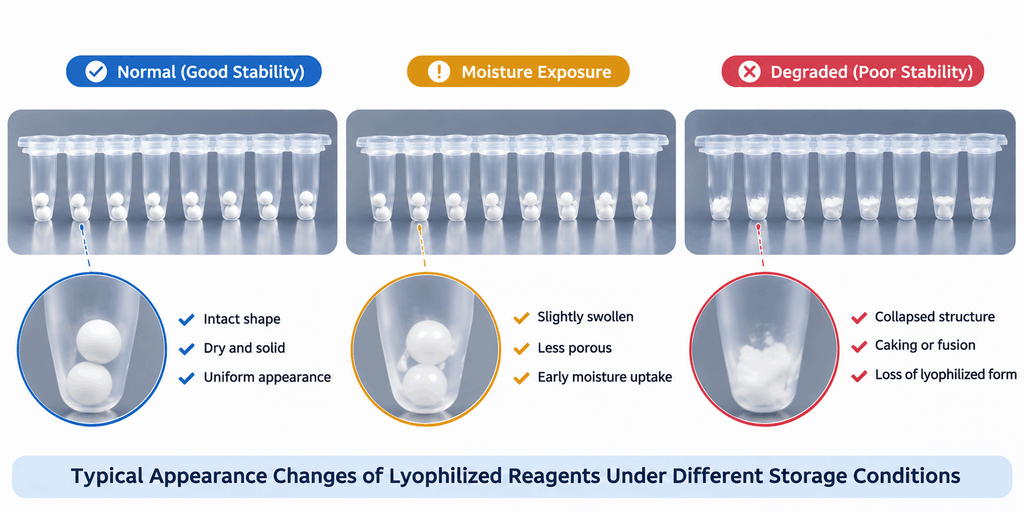
Two distinct categories of change should be monitored; they can occur independently or together:
- Performance drift. Activity falls, a standard curve shifts, or a Ct value creeps upward across a shelf-life study. This is what functional assays detect.
- Physical degradation. Shrinkage, collapse, caking, or incomplete and slow reconstitution. This is what inspection and reconstitution time detect.
Appearance and functional activity measure different attributes. Published protein-formulation research has shown that cake collapse does not always predict residual moisture or immediate protein instability [5]. A visually intact cake therefore cannot establish biochemical stability by itself, while visible collapse should trigger investigation against the product-specific acceptance criteria.
Lyoprotectants, bulking agents, the drying cycle, moisture control and packaging can all influence freeze-dried reagent shelf life. The final storage condition and expiry period still need to be supported by data for the finished formulation and container.
What a Complete Lyophilized Reagent Stability Claim Must Include
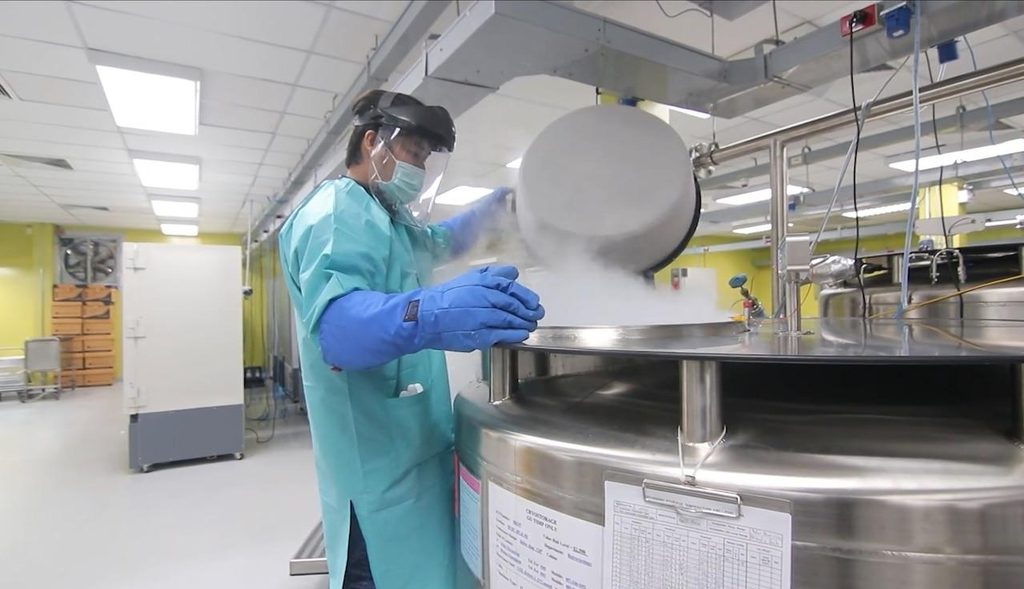
For supplier qualification, review the five evidence areas below. The required level of detail depends on intended use, packaging and whether the reagent is used immediately after opening or held after reconstitution.
| Element | What the claim should state | Common gap | What the gap costs you |
| Unopened shelf life and storage class | A duration tied to a defined temperature range, for example 2–8 °C for 12 months | “12 months” with no temperature attached | You cannot plan inventory, qualify a cold chain, or even test the claim — the number is unfalsifiable |
| Transport tolerance | Excursion limits: how long and how many times the product may leave its storage range, and the basis for that limit | No transport data, or only “ships on dry ice” | An unassessed excursion can put product performance or release decisions at risk |
| In-use expiry after reconstitution | Time and temperature after reconstitution, with the study basis | No in-use claim at all | Hold times after reconstitution may need separate qualification |
| Residual moisture and physical acceptance | Relevant moisture and physical acceptance criteria, where justified, with validated or suitable test methods (e.g., Karl Fischer) | “Appearance: white cake” as the only physical attribute | Potentially important physical changes may go undetected |
| Type of data behind the number | Real-time, accelerated, or both; number of batches; study duration and timepoints | No indication of data type | The strength of the supporting evidence cannot be assessed |
Real-Time vs Accelerated Data: What Each Can and Cannot Support
Real-time data is collected under the proposed labeled storage conditions using predefined stability-indicating measurements and acceptance criteria. For applicable IVD studies, CLSI EP25 (2nd edition) describes a regression-based approach that includes measurements at and beyond the claimed shelf-life endpoint [1]. When reviewing a 24-month claim, ask which batches, timepoints, container configurations and functional assays support it.
Accelerated data is generated under selected stress conditions to investigate degradation behavior and potentially support a justified projection. ICH Q1A(R2) describes 40 °C/75% RH for six months for the general pharmaceutical case and 25 °C/60% RH for refrigerated drug products [2]. These are drug-product study conditions, not universal requirements for freeze-dried IVD reagents. For an IVD assay, select and justify conditions using product-specific evidence and relevant guidance such as CLSI EP25. Three limitations matter:
- Stress can alter degradation pathways. A high-temperature failure may not reflect the dominant mechanism at labeled storage conditions, while an apparently stable accelerated sample does not rule out longer-term change [3].
- Not every response follows a simple kinetic model. Nonlinear trends or a change in mechanism can invalidate a straightforward extrapolation.
- An extrapolation needs evidence. The model, formulation, package integrity and stability-indicating endpoint should all support the proposed inference.
For IVD reagents, CLSI EP25 is the more directly relevant framework: it addresses shelf life, in-use stability, transport simulation, and accelerated testing, and its second edition is recognized by the FDA as a consensus standard [1]. ICH Q1A(R2) offers a useful comparison for study design and physical-attribute assessment, but it is written for pharmaceutical drug substances and products [2]. The applicable regulatory requirements depend on the reagent’s intended use and market.
What a Complete Claim Looks Like in Practice
The following examples reproduce storage conditions and shelf lives reported in the draft as drawn from Hyasen product manuals. These are product-specific labels, not evidence of an industry-wide storage class.
| Product | Format | Storage condition | Shelf life |
| LAMP Colorimetric Master Mix, lyophilized beads (HYB312) | Lyophilized beads | 2–8 °C | 12 months |
| RT-LAMP Colorimetric Master Mix, lyophilized beads (HYB412) | Lyophilized beads | 2–8 °C | 12 months |
| Recombinant DNase I (RNase-free), lyophilized powder (HYC127) | Lyophilized powder | ≤8 °C | 24 months |
| Proteinase K, lyophilized powder (HYC110) | Lyophilized powder | ≤8 °C | 36 months |
| Proteinase K for NGS, lyophilized powder (HYC113) | Lyophilized powder | ≤8 °C | 36 months |
Two observations follow.
First, lyophilized does not automatically mean room-temperature stable. The examples span three temperature classes: refrigerated LAMP master mixes (2–8 °C), refrigerated Proteinase K powders (≤8 °C), and frozen DNase I powder (−25 to −15 °C). Storage requirements need to be checked for each specific formulation and package rather than inferred from the fact that a reagent is freeze-dried.
Second, a change in dosage format may enable a different labeled storage condition. Liquid LAMP-family master mixes are specified at −25 to −15 °C, while certain lyophilized bead formats are specified at 2–8 °C. These are different product specifications, not a controlled demonstration that lyophilization alone caused the difference. For point-of-care developers, compare the finished formulations and associated stability evidence.
The products referenced above are available as Recombinant DNase I (RNase-free), lyophilized powder (HYC127) and Proteinase K for NGS, lyophilized powder (HYC113), with lyophilized LAMP formats such as LAMP Colorimetric Master Mix, lyophilized beads (HYB312). Refer to each product page and manual for current specifications.
How to Evaluate a Lyophilized Reagent Stability Study
Before accepting a shelf-life statement, review what was measured and how success was defined. A technically useful summary should identify the tested formulation and container closure, number of batches, labeled storage conditions, pull points, stability-indicating functional assay, and prespecified acceptance limits. For a lyophilized PCR or LAMP mix, relevant endpoints may include amplification performance on defined positive and negative controls; for an enzyme, retained activity may be more informative.
Look for trends and variability, not only a final pass/fail result. A study can meet a release specification while still showing meaningful drift toward the shelf-life endpoint. Ask how assay variability, lot differences and the claimed period were evaluated. Transport excursions and reconstituted hold times should be assessed separately where the intended workflow exposes the product to those conditions.
Example supplier questions: What was the primary stability-indicating endpoint? Were limits fixed before testing? Do data cover the claimed endpoint? Was the commercial container closure used? Is the after-reconstitution hold time tested at its labeled temperature? These questions help distinguish usable evidence from an unsupported month count.
Red Flags When Reviewing Supplier Stability Data
| Red flag | Why it matters | What to ask |
| Months quoted with no temperature | The number is not a specification; the same product can differ by a full storage class | “At which temperature range, and is that the labeled condition?” |
| Only accelerated data, no real-time study | Accelerated stress can create or mask failure modes; claims are expected to rest on real-time data | “How many real-time timepoints have been completed, and on how many batches?” |
| No in-use or reconstituted stability claim | Reconstitution is where a dried reagent meets water, buffers and room temperature | “What is the in-use expiry after reconstitution, and how was it established?” |
| No batch-to-batch performance data or release criteria | A single successful lot says nothing about consistency across lots | “What are the release criteria, and what is the observed lot-to-lot variation?” |
| No transport validation | Excursions in distribution can consume shelf life before first use | “Do you have a transport simulation report, and what excursion profile was tested?” |
A supplier that can document these points makes technical assessment and change control more practical. Missing information should trigger clarification or additional qualification, not an automatic conclusion about product quality.
Documents to Request Before You Switch Suppliers
- Certificate of analysis (COA) with lot number, relevant test methods, acceptance criteria and results where available.
- Stability study summary describing real-time data, any accelerated studies, batch count, test intervals, packaging and acceptance criteria.
- Transport or temperature-excursion assessment reflecting the intended distribution route and packaging where relevant.
- Change notification and change-control information for formulation, manufacturing process, packaging and site changes that may affect previously qualified performance.
- Moisture and physical-characterization data, where justified by formulation risk, including the measurement method (such as Karl Fischer) and reconstitution acceptance criteria.
Compare the supplier’s evidence with your own stability plan and quality-risk assessment. For IVD projects, documenting the gap between supplied data and the intended use early can reduce repeat testing later. For RUO or bulk materials, adapt the level of requested documentation to the actual application rather than assuming an IVD submission is planned.
For teams building that plan around a dried-format assay, our molecular diagnostics reagent solutions cover lyophilized master mixes, enzymes and OEM/ODM formats, and the companion article on integrated lyophilization development and production describes how formulation, cycle development and stability testing are handled as one workflow.
Conclusion
A lyophilized reagent shelf-life claim is meaningful only in the context of its labeled conditions, stability-indicating methods, acceptance limits and supporting study data. When comparing suppliers, ask whether the evidence covers your intended storage, distribution and after-reconstitution workflow. That approach makes technical qualification more defensible than comparing expiry dates alone.
Evaluating freeze-dried reagents for a molecular diagnostic workflow or sourcing bulk materials? Contact Hyasen to request available product specifications, discuss applicable stability documentation, and explore bulk supply or OEM/ODM options.
Frequently Asked Questions
How long do lyophilized reagents last?
The shelf life of a lyophilized reagent depends on its formulation, packaging and labeled storage conditions. The Hyasen examples in this guide include certain LAMP master mixes reported at 2–8 °C for 12 months, Proteinase K powders reported at ≤8 °C for 36 months, and DNase I powder reported at −25 to −15 °C for 24 months; confirm current values against the product manual.
Does freeze-drying affect reagent activity?
Yes. Freezing, drying, and reconstitution can affect a reagent’s function, so protective excipients, drying conditions, package integrity and residual moisture must be evaluated. A lyophilized formulation may have different labeled storage conditions from a liquid product, but the benefit must be demonstrated for that specific product.
What is the difference between real-time and accelerated stability data?
Real-time studies measure performance under the labeled storage conditions and are central to confirming shelf life. Accelerated studies explore stress responses and may support a justified projection, but they do not automatically establish the labeled expiry. Conditions in ICH Q1A(R2) are pharmaceutical examples, not universal IVD requirements.
How should lyophilized reagents be stored after reconstitution?
Follow the product-specific instructions for diluent, reconstitution volume, mixing, temperature and maximum hold time. If a reconstituted reagent will be stored or reused but the documentation gives no in-use limit, request supporting data or establish a qualified hold time before routine use.
What documents should I request before switching lyophilization suppliers?
Request a COA, a stability summary with study conditions and acceptance criteria, relevant transport or excursion data, change-control information, and moisture or reconstitution data when they are critical quality attributes. Match the request to your intended use and the supplier’s claimed storage conditions.
References
- Clinical and Laboratory Standards Institute. Evaluation of Stability of In Vitro Medical Laboratory Test Reagents. 2nd ed. CLSI EP25; 2023. — IVD shelf-life, in-use and transport-stability study design.
- International Council for Harmonisation. Stability Testing of New Drug Substances and Products. ICH Q1A(R2); 2003. — pharmaceutical stability conditions and study concepts; not an IVD-specific protocol.
- Westgard QC. Stability Testing and CLSI EP25-A (guest essay) — limits of accelerated stability testing, including stress-induced mechanisms that do not occur under normal storage.
- Duralliu A, Matejtschuk P, Williams DR. Humidity induced collapse in freeze dried cakes: a direct visualization study using DVS. European Journal of Pharmaceutics and Biopharmaceutics (2018) — moisture sorption, glass transition and collapse in freeze-dried cakes.
- Systematic investigation of the effect of lyophilizate collapse on pharmaceutically relevant proteins III: collapse during storage at elevated temperatures. European Journal of Pharmaceutics and Biopharmaceutics (2013) — comparable residual moisture in collapsed and non-collapsed cakes.
- United States Pharmacopeia, General Chapter <921> Water Determination — Karl Fischer titration for residual moisture.