RNA sequencing library preparation is the process of converting RNA into a sequencing-compatible DNA library: the RNA is enriched, fragmented, copied into cDNA and ligated to sequencing adapters so that a short-read sequencer can read it. It is the step that decides how much of the transcriptome your sequencing budget actually sees.
RNA-seq library prep matters because ribosomal RNA makes up the large majority of total RNA in a cell — commonly cited at 80–90% [1] — and every protocol choice, from poly(A) selection to adapter ligation, shapes which transcripts survive into the final data. Get the library right and differential expression, novel transcript discovery and biomarker studies all rest on solid ground.
For laboratories and diagnostic reagent manufacturers seeking a reliable stranded RNA-seq workflow, Hyaseq Strand-Specific RNA Library Prep Kit (dUTP) (HYD212) provides a dUTP-based, orientation-preserving library preparation chemistry compatible with Illumina and MGI platforms.

It delivers high strand specificity without actinomycin D, supports total RNA inputs from 10 ng to 4 μg through the poly(A) route (or 100 ng–1 μg with rRNA depletion), and ships in 24 T or 96 T formats for both research and bulk supply. Explore the product specifications to see how it fits your RNA sequencing library preparation and kit manufacturing needs.
Key takeaways
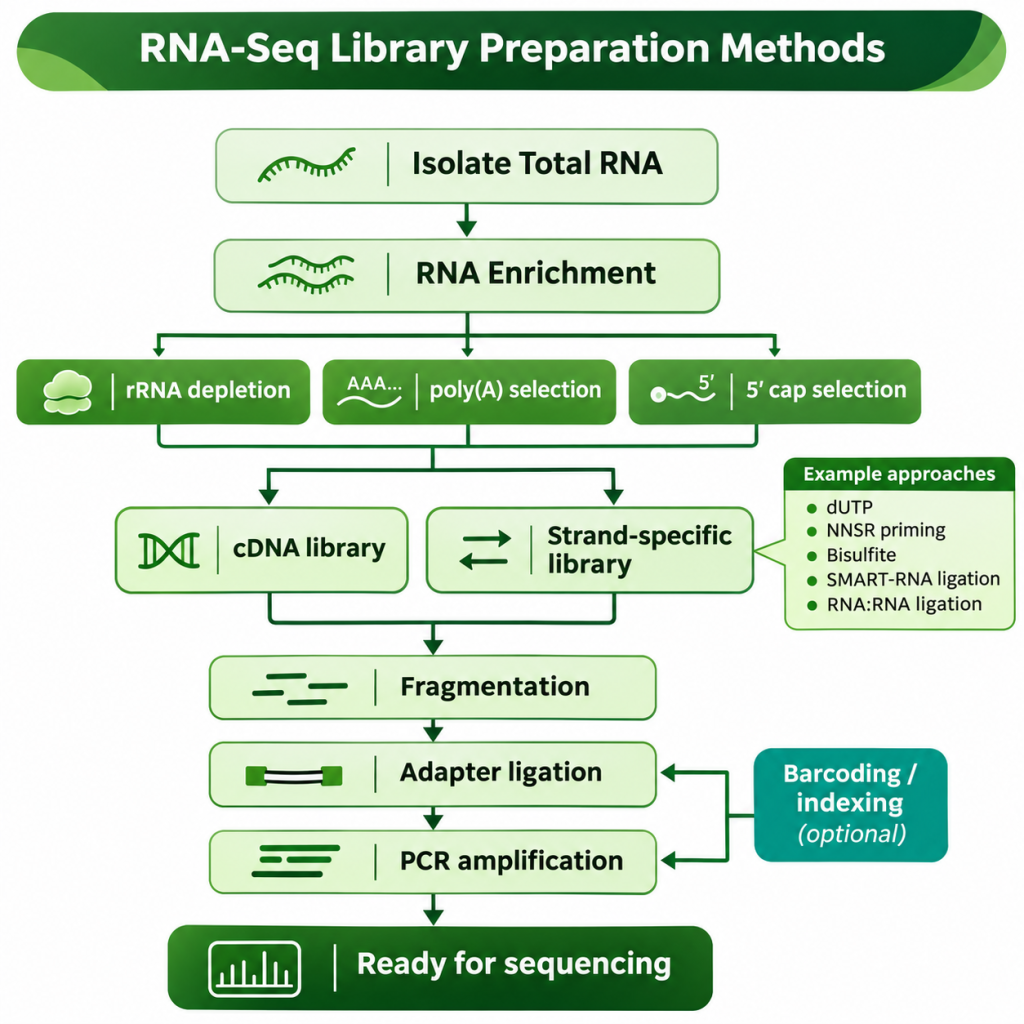
- RNA library prep = RNA enrichment (poly(A) selection or rRNA depletion) → fragmentation → cDNA synthesis → adapter ligation → size selection → PCR.
- Poly(A) selection suits intact eukaryotic RNA and mRNA-focused studies; rRNA depletion suits degraded samples, FFPE material and non-coding RNA discovery.
- Stranded (dUTP) libraries preserve transcript orientation and resolve overlapping genes; unstranded libraries are simpler but lose strand information.
- Adapter dimers, over-amplification and poor input RNA quality are the three most common failure modes — and all three are controllable.
What Is RNA-Seq Library Preparation and Why Does It Matter?
Standard sequencing platforms read DNA, not RNA. RNA sequencing library preparation bridges that gap: it converts an RNA population into a barcoded, size-selected cDNA library whose reads are proportional to the abundance of the original transcripts.
Three reasons this step deserves careful attention:
- It defines what is observable. An mRNA-focused poly(A) library and a total RNA-seq rRNA-depleted library can return materially different views of the same sample. Non-coding RNAs, pre-mRNAs and partially degraded transcripts only survive in the right library type.
- It defines data quality. Fragment size distribution, strand information, PCR duplication levels and coverage uniformity are all locked in during library prep — sequencing depth cannot fully rescue a biased library.
- For kit developers, it is the product. Consistent enrichment, ligation and amplification performance across lots is what diagnostic and service providers are buying when they source library prep reagents in bulk.
How Does RNA-Seq Library Preparation Work?
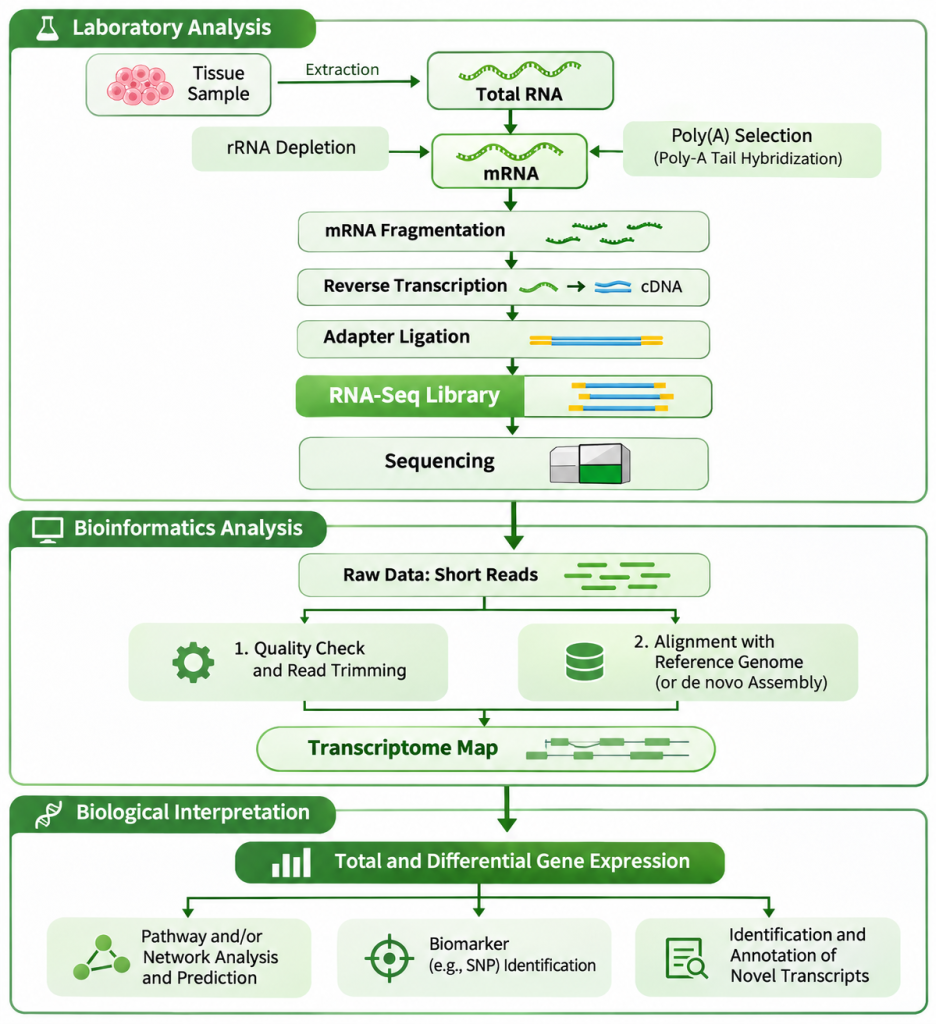
The core logic is conversion and selection. Sequencers read short DNA fragments with known adapter sequences at both ends, so library prep must:
- Select or deplete the RNA species of interest (mRNA enrichment or rRNA removal), since rRNA would otherwise dominate the reads;
- Convert RNA into double-stranded cDNA through reverse transcription;
- Add adapters that provide priming sites for sequencing and sample indexes for multiplexing;
- Amplify the library to a sequenceable quantity while keeping PCR bias low.
Every workflow in commercial use is a variation on this skeleton — the differences lie in how enrichment is done, whether strand information is preserved, and how fragmentation and size selection are implemented.
Step-by-Step RNA-Seq Library Preparation Workflow
The following outline reflects the standard short-read RNA-seq workflow used by mainstream kit families. Exact volumes, times and input ranges depend on the kit; the validated protocol should always take priority.
Step 1: RNA Input and Quality Control
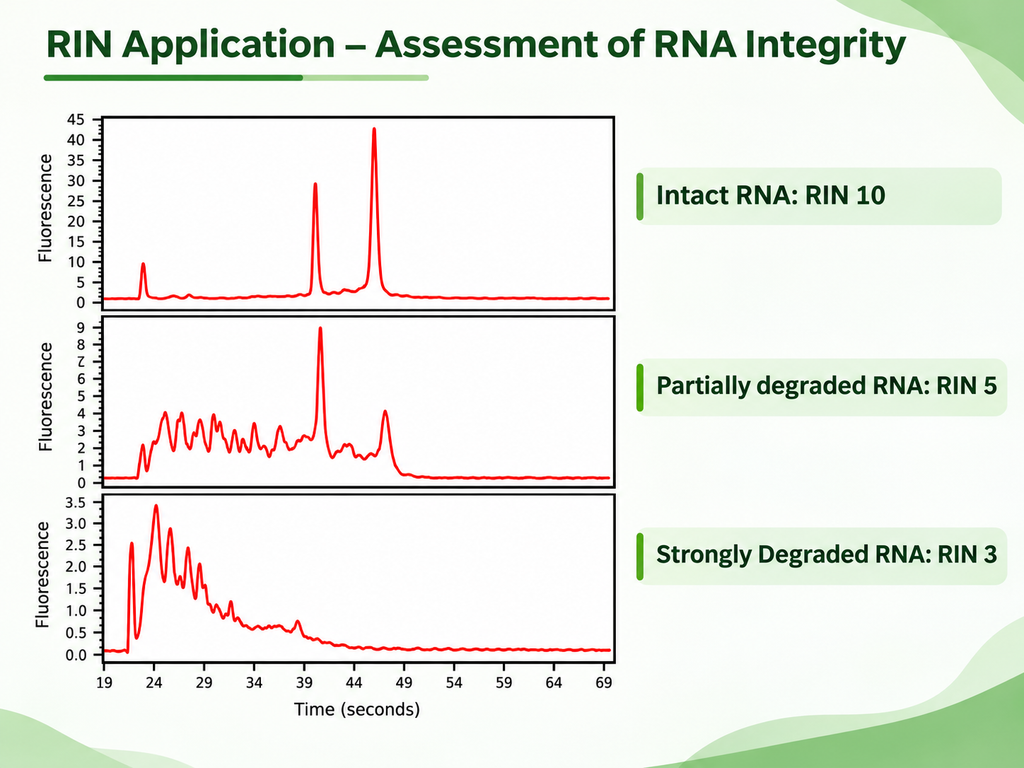
Start with total RNA whose quantity and integrity have been measured. Fluorometric quantification (Qubit-type) is preferred over absorbance for accurate input, and an integrity score such as RIN is the de facto gate: many groups target RIN ≥ 7 for standard mRNA-seq, while RIN < 6 is reported to introduce substantial bias into sequencing results [1]. DNA contamination should be removed before prep — see our RNA purification protocol guide.
Step 2: RNA Enrichment — Poly(A) Selection or rRNA Depletion
Two mainstream routes exist:
- Poly(A) selection: oligo(dT) magnetic beads hybridize to the poly-A tail of mature eukaryotic mRNA, enriching it from total RNA. The Hyaseq mRNA Capture Kit V2 (HYD217) uses oligo(dT)-functionalized magnetic beads to isolate polyadenylated mRNA from 10 ng–4 μg of good-integrity total RNA (RIN ≥ 7.0 recommended).
- rRNA depletion: probes or enzymes remove ribosomal RNA (and, in some kits, ITS/ETS regions) from total RNA, keeping everything else — mRNA, non-coding RNA, partially degraded transcripts. For plant samples, the Hyaseq rRNA Depletion Kit (Plant) (HYD219) reduces cytoplasmic, mitochondrial and chloroplast rRNA from 100 ng–1 μg of plant total RNA, including partially degraded material.
This choice is the single most consequential decision in the workflow; a dedicated comparison follows below.
Step 3: Fragmentation
Enriched RNA is broken into short pieces using divalent-cation heat fragmentation or enzymatic digestion. Fragmentation before reverse transcription gives more uniform transcript coverage; fragmenting after cDNA synthesis can bias reads toward the 3′ end. Small RNA-seq skips this step entirely. Exact insert-size targets are workflow-specific: in the Hyaseq Strand-Specific RNA Library Prep Kit, fragmentation programs are selected to target insert sizes of roughly 200–300 bp, 300–400 bp or 400–500 bp depending on application and RNA quality.
Step 4: First-Strand cDNA Synthesis (Reverse Transcription)
Random primers and reverse transcriptase copy the RNA fragments into first-strand cDNA. Reverse transcriptase choice and conditions affect coverage uniformity, because the enzyme can pause or dissociate at certain sequence motifs.
Step 5: Second-Strand Synthesis
DNA polymerase I and RNase H (or equivalent chemistry) replace the RNA template with second-strand cDNA. This is also where stranded protocols diverge: in the dUTP method, dUTP substitutes for dTTP in the second strand, marking it for selective degradation later [1]. The Hyaseq Strand-Specific RNA Library Prep Kit (dUTP) delivers high strand specificity without actinomycin D, which improves operational safety in production workflows.
Step 6: End Repair, A-Tailing and Adapter Ligation
The double-stranded cDNA is end-repaired, a single A overhang is added, and Y-shaped sequencing adapters — carrying sequencing priming sites and sample indexes — are ligated to both ends. Ligation efficiency varies with fragment ends and sequence context, and it is a common source of library yield loss. Adapter concentration is selected by input amount and adapter platform, so follow the kit’s corresponding instructions rather than generalizing a single value.
Step 7: Size Selection and Cleanup
Bead-based (or gel-based) size selection enriches the target insert range and removes adapter dimers, which otherwise consume sequencing reads. Distinguish insert size from final library size: a 200–300 bp insert yields a larger final library once adapters are added — the exact final size depends on the adapter type and bead workflow, so size-selection ratios should be tuned bead-by-bead and insert-by-insert rather than copied across protocols.
Step 8: Library PCR Amplification and Final QC
A limited number of PCR cycles (often with high-fidelity polymerase) amplifies the library to a sequenceable amount; fewer cycles mean less amplification bias, which is why sufficient RNA input matters. Final QC checks concentration, size distribution and absence of adapter dimers before equimolar pooling. qPCR is preferred for quantifying fully adapter-ligated, sequenceable molecules, since fluorescent dsDNA assays estimate concentration but are not specific for complete library; sizing by capillary electrophoresis confirms the size distribution.
Poly(A) Selection vs rRNA Depletion: Which Should You Use?
Intact eukaryotic RNA and mRNA-centric questions → poly(A) selection; degraded samples, prokaryotes or anything beyond mature mRNA → rRNA depletion [1][2].
| Decision Factor | Poly(A) Selection | rRNA Depletion |
| What you measure | Mature, poly-adenylated mRNA | Total RNA: mRNA + non-coding RNA + pre-mRNA |
| RNA integrity requirement | Needs intact poly-A tails; degraded RNA underperforms | Works with partially degraded RNA, including FFPE |
| Non-coding RNA discovery | Not captured | Captured (lncRNA, circRNA-compatible) |
| Bacterial/prokaryotic samples | Not applicable (most bacterial mRNAs lack poly-A tails) | Standard choice |
| Typical use case | Standard differential expression in intact samples | Total RNA-seq, FFPE, ncRNA, microbiome-adjacent studies |
Stranded vs Unstranded RNA-Seq Libraries
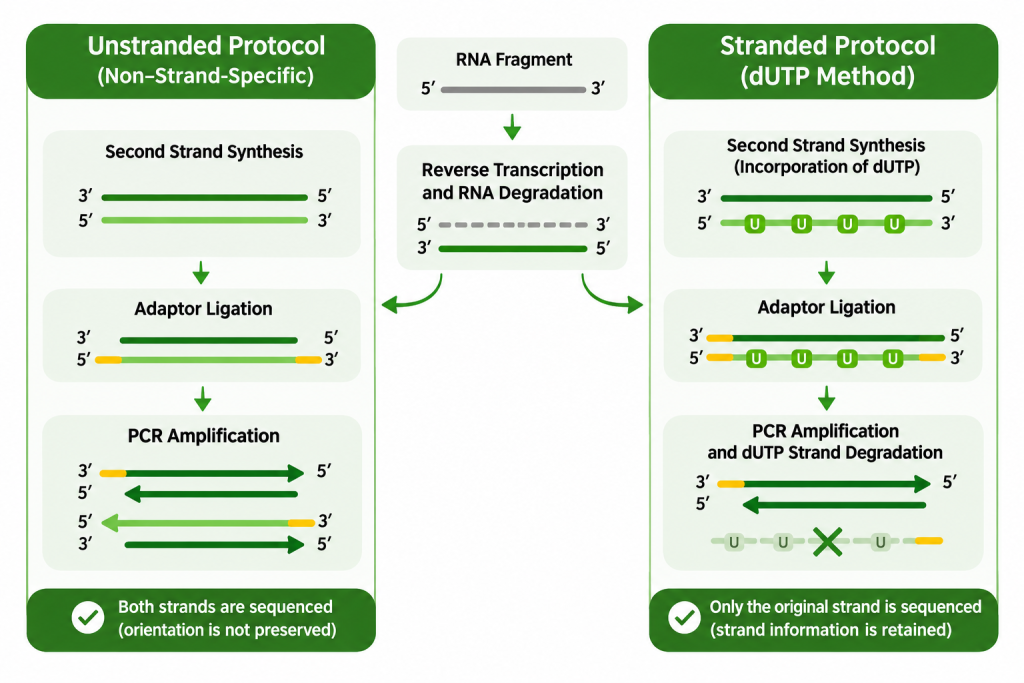
Standard (unstranded) library prep loses the orientation of the original transcript, which complicates quantification of overlapping genes and antisense transcription. Stranded libraries preserve it. The dominant dUTP approach marks the second cDNA strand with dUTP, then degrades that strand with UDG/USER chemistry before PCR, so only strands matching the original RNA orientation are amplified [1].
Stranded RNA-seq is preferred when the study involves overlapping or antisense transcripts, novel isoform discovery or precise quantification of sense/antisense pairs. Unstranded libraries remain acceptable for straightforward gene-level expression work in well-annotated genomes.
Factors That Affect RNA-Seq Library Quality
| Factor | Effect | Practical Implication |
| RNA input amount | Too little input forces more PCR cycles | Match input to the kit’s validated range; avoid stretching a low-input kit beyond spec |
| RNA integrity (RIN) | Degraded RNA biases coverage toward fragment ends | QC before prep; choose rRNA depletion for compromised samples |
| Enrichment method | Defines which RNA species are visible | Choose poly(A) vs rRNA depletion by biology, not habit |
| Fragment size distribution | Affects mapping and insert-size-dependent biases | Calibrate fragmentation time; verify with Bioanalyzer-type QC |
| Adapter ligation efficiency | Low efficiency lowers complexity and yield | Use fresh reagents and correct end-repair/A-tailing chemistry |
| PCR cycle number | Over-amplification inflates duplicates and GC bias | Use the minimum cycles that reach required yield |
| Size selection precision | Adapter dimers and off-size fragments waste reads | Optimize bead ratios; verify size distribution before pooling |
Troubleshooting RNA-Seq Library Prep
| Problem | Possible Cause | What to Try |
| Low library yield | Poor RNA input quality or ligation inefficiency | Re-quantify input fluorometrically; check RIN; verify adapter working concentration |
| Adapter dimers dominate | Bead ratio too low, or too little input RNA | Optimize size-selection bead ratio for your insert and bead workflow; re-check adapter dilution |
| Severe 3′ or 5′ bias | Fragmentation after cDNA synthesis, or degraded RNA | Fragment before RT; switch to rRNA depletion for compromised samples |
| High duplicate rate | Over-amplification or low library complexity | Reduce PCR cycles; increase input; check starting material amount |
| Poor coverage of low-abundance transcripts | rRNA carryover or insufficient depth | Verify depletion efficiency; increase sequencing depth |
| Unexpected species in library (e.g., ITS/ETS reads) | Incomplete rRNA-region depletion in total RNA-seq | Use a depletion kit matched to the organism and its rRNA regions |
| Batch-to-batch variation (kit developers) | Inconsistent enzyme or bead lots | Request lot-specific QC data and functional performance statistics from suppliers |
How to Choose an RNA-Seq Library Prep Kit
When comparing RNA library prep kits — or evaluating raw materials for your own kit — check these points:
- Enrichment chemistry and organism coverage. Does the kit support poly(A) selection, rRNA depletion, or both? Are the depletion probes matched to your sample organism’s rRNA (and ITS/ETS for fungal contamination scenarios)?
- Strandedness option. If overlapping-gene resolution or isoform work is in scope, confirm a dUTP-based stranded chemistry is available in the same product family.
- Input range and low-input performance. The kit’s validated input window should cover your real samples, not just ideal ones.
- Protocol time and automation compatibility. Bead-based workflows that suit magnetic handlers scale better for service providers and diagnostic manufacturers.
- Lot-to-lot consistency data. For bulk or OEM/ODM sourcing, ask for functional QC statistics across lots — yield, size distribution and depletion efficiency — rather than a single certificate.
- Platform compatibility. Confirm adapter/index compatibility with Illumina or MGI workflows and whether library quantitation reagents are available from the same supplier.
- Supply model. Bulk packaging, OEM/ODM customization, documentation and technical support matter when library prep reagents feed a commercial pipeline.
Hyasen RNA-Seq Library Preparation Products
Hyasen Biotech supplies bulk-supply RNA-seq and DNA-seq library preparation reagents and enzymes for sequencing workflows, with OEM/ODM customization supported — see the NGS Library Preparation Solution overview.
The three products below have verified specifications from their user manuals; the remaining items are described without unconfirmed figures until their datasheets are reviewed.
- Hyaseq Strand-Specific RNA Library Prep Kit (dUTP) (HYD212) — a research-use-only, dUTP-based stranded RNA library prep kit compatible with Illumina and MGI when paired with the appropriate adapters. It provides reagents for RNA fragmentation, reverse transcription, strand-specific double-stranded cDNA synthesis, adapter ligation and library amplification; RNA enrichment or depletion reagents are supplied separately. Documented total RNA input is 10 ng–4 μg via the poly(A) route (using HYD217) or 100 ng–1 μg via the human/mouse/rat rRNA-depletion route. Store at −25 to −15 °C, valid for 1 year.
- Hyaseq mRNA Capture Kit V2 (HYD217) — a research-use-only upstream enrichment kit that uses oligo(dT) magnetic beads to isolate polyadenylated mRNA from 10 ng–4 μg of good-integrity total RNA (RIN ≥ 7.0 recommended). It does not itself produce a sequencing-ready library and is used within the HYD212 poly(A) workflow. Store at 2–8 °C, valid for 1 year.
- Hyaseq rRNA Depletion Kit (Plant) (HYD219) — a research-use-only depletion reagent that removes plant cytoplasmic, mitochondrial and chloroplast rRNA from 100 ng–1 μg of plant total RNA, including partially degraded material. It is an upstream depletion reagent, not a stand-alone library prep kit; a validated paired HYD212/HYD219 workflow is not established by the supplied manuals. Store at −25 to −15 °C, valid for 1 year.
Other portfolio options (specifications pending their own datasheets):
- Hyaseq RNA Library Prep Kit (HYD211) — a core RNA-seq library prep kit for standard transcriptome workflows. [TODO: confirm input range and library size spec]
- Hyaseq Dual-mode RNA Library Prep Kit (HYD213) — a dual-mode RNA library prep option. [TODO: confirm the two supported modes]
- Hyaseq rRNA & ITS/ETS Depletion Kit (Human/Mouse/Rat) (HYD218) — ribosomal RNA region depletion for total RNA-seq in human, mouse and rat samples. [TODO: confirm depletion coverage and input range]
Related products in the same family: DNA library prep kits (Hyaseq DNA Library Prep Kit V2 (HYD111), Hyaseq Ultra DNA Library Prep Kit V4 (HYD113)) and the Hyaseq Bacterial 16S (V3-V4) Amplicon Library Prep Kit for Illumina (HYD621).
Please refer to each product page for technical specifications, and contact us about samples, bulk supply and OEM/ODM customization.
Frequently Asked Questions
What is RNA-seq library preparation?
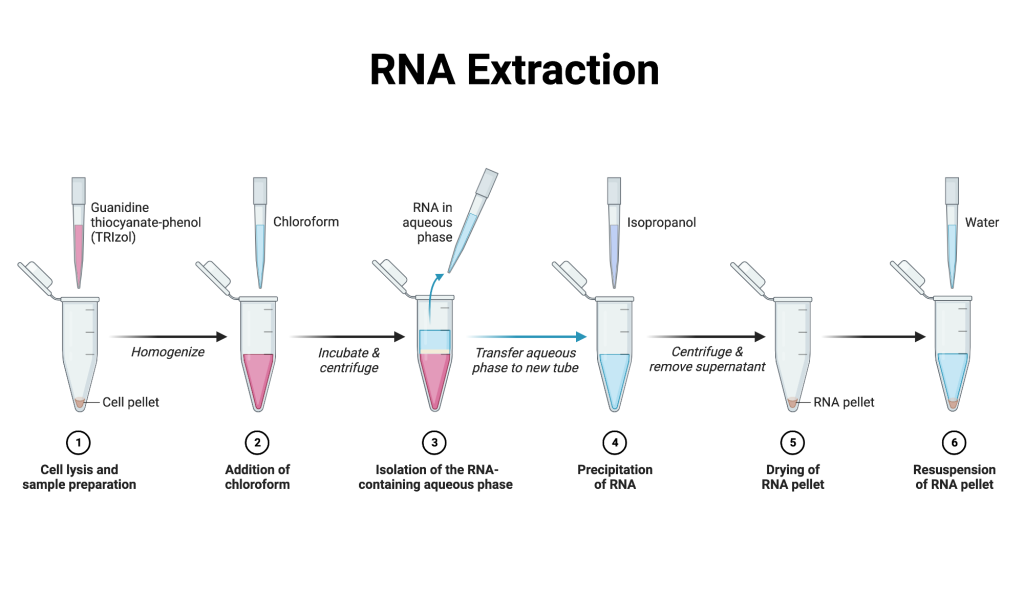
RNA-seq library preparation is the process of converting RNA into a sequencing-ready DNA library: the RNA of interest is enriched or depleted, fragmented, reverse-transcribed into cDNA, ligated with sequencing adapters, size-selected and PCR-amplified.
What are the main steps of RNA-seq library preparation?
The standard workflow is: RNA input QC → poly(A) selection or rRNA depletion → fragmentation → first- and second-strand cDNA synthesis → end repair, A-tailing and adapter ligation → size selection → library PCR amplification → final QC.
What is the difference between poly(A) selection and rRNA depletion?
Poly(A) selection enriches mature mRNA via its poly-A tail and suits intact eukaryotic RNA. rRNA depletion removes ribosomal RNA and keeps everything else, which suits degraded or FFPE samples, prokaryotes and non-coding RNA discovery.
What RIN value do I need for RNA-seq?
RIN runs from 1 to 10, with higher values indicating more intact RNA. Many groups target RIN ≥ 7 for standard mRNA-seq; RIN < 6 is reported to introduce substantial bias, and compromised samples should use rRNA depletion instead of poly(A) selection [1].
Stranded or unstranded RNA-seq library — which do I need?
Choose stranded (typically dUTP-based) libraries when overlapping genes, antisense transcription or isoform-level analysis matter. Unstranded libraries are simpler and remain acceptable for standard gene-level expression studies.
What causes adapter dimers in RNA library prep?
Adapter dimers form when adapter molecules ligate to each other and get amplified — usually from too little input RNA or suboptimal size-selection bead ratios. They appear as a short peak in library QC and waste sequencing reads.
How many PCR cycles should I use for RNA library amplification?
Use the minimum number of cycles that reaches your required library yield, as specified by the kit protocol. Excess cycles inflate duplicate rates and sequence-dependent bias.
Can the same platform serve both RNA-seq and DNA-seq library prep?
Kit families are usually separate because the input chemistry differs, but suppliers with an integrated NGS portfolio provide parallel RNA and DNA library prep kits, shared adapters and compatible QC reagents — worth confirming when sourcing raw materials at scale.
Conclusion
RNA sequencing library preparation is where transcriptome experiments are won or lost. The workflow itself is stable — enrich, fragment, convert, ligate, size-select, amplify — but every decision inside it, from poly(A) versus rRNA depletion to PCR cycle number, shapes what the sequencer can see. Match the enrichment chemistry to your biology, preserve strand information when your analysis needs it, keep amplification minimal, and source reagents whose lot-to-lot consistency is documented rather than assumed.
Looking for RNA-seq library prep kits or bulk raw materials for your own library prep products? Contact Hyasen to discuss samples, technical specifications, bulk supply, OEM/ODM and customized solutions.
References
- Rao et al., “RNA-seq and ChIP-seq as Complementary Approaches for Comprehension of Plant Transcriptional Regulatory Mechanism,” Int. J. Mol. Sci. 2020, 21(1), 167 — RNA-seq wet-lab workflow, RIN thresholds, fragmentation size ranges, poly(A)/rRNA depletion and dUTP stranded method.
- “RNA Sequencing Methods: A Guide to Library Prep, Strandedness, and Sequencing Depth” — poly(A) vs rRNA depletion decision factors for degraded/FFPE samples.